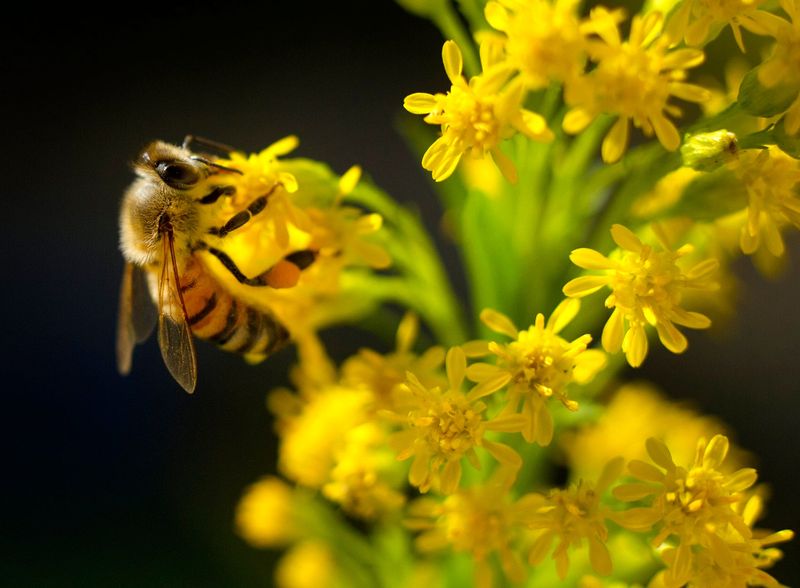
When most people think of bees, they think of honeybees living in hives; but do you recognize native bees?
Most native bees are solitary, living in a hole inside a tree, a hollow plant stem, or underground. Most native bees in New York State are “digger bees”: they are solitary and ground-nesting.

Other native bees in New York are above ground cavity nesters, using things such as twigs, hollow stems, beetle burrows, or sites above ground. These include mason bees, wood carder bees, resin bees, and carpenter bees.
Quick facts. There are more than 400 species of native bees in New York. While honeybees sting as a means of protection, most native bees are not inclined to sting or don’t have enough venom for a painful sting.
Honeybees are social, living in a hive with a queen and others with specific tasks. Most native bees are solitary, building their own nests and living on their own. Native bees provide “buzz pollination” that can’t be done by honeybees. Native bees vibrate their wing muscles so rapidly, they shake the pollen out of the plant.
Buzz pollination is important for vegetable crops as well as fruits such as blueberries.
Be “Bee-Friendly.” Grow flowering plants that bloom at various times. Use native plants; studies have shown that native plants are four times more attractive to native bees than ornamental plants. Bee nesting houses/boxes can provide shelter for certain native bee species such as mason bees.
The Illinois University Extension has a fact sheet on how to make your own mason bee house; visit https://extension.illinois.edu/sites/default/files/bee_house_instructions_final_asw.pdf. You can also build your own solitary bee hotel. Visit the Nebraska State Extension service at https://extensionpubs.unl.edu/publication/g2256/2021/pdf/view/g2256-2021.pdf.
Bees need water. Add a shallow dish filled with pebbles and water; drain and refill the dish every few days to avoid mosquito issues. Delay fall clean-up and leave plants with dry stems which can serve as over-wintering sites for native bees.
Avoid using pesticides to prevent poisoning. Native bees are the unsung pollinator heroes. Providing valuable habitat and learning more will help us protect them.
Join the master gardeners on Tuesday, July 15, 2025, at 6 pm, at the CCE of Oneida County, 121 Second Street, Oriskany, NY, as we host Professor Bryan N. Danforth, Department of Entomology, Cornell University for his talk on native bees entitled “Project GNBee”. This talk will focus on how you can help to preserve our most threatened and valuable pollinators, the ground-nesting, solitary bees. This program is free; however, registration is required by Friday, July 11th by contacting Holly Wise, Resource Educator at (315) 736-3394 ext.125 or e-mail at hlw2@cornell.edu.
Cornell Cooperative Extension Oneida County answers home and garden questions which can be emailed to homeandgarden@cornell.edu or call 315-736-3394, press 1 and ext. 333. Leave your question, name, and phone number. Questions are answered on weekdays, from 8am to 4pm. Also, visit our website at http://cceoneida.com/ or phone 315-736-3394, press 1 and then ext. 100.
This article originally appeared on Observer-Dispatch: The importance of native bees. What to know
Reporting by Rosanne Loparco / Observer-Dispatch
USA TODAY Network via Reuters Connect