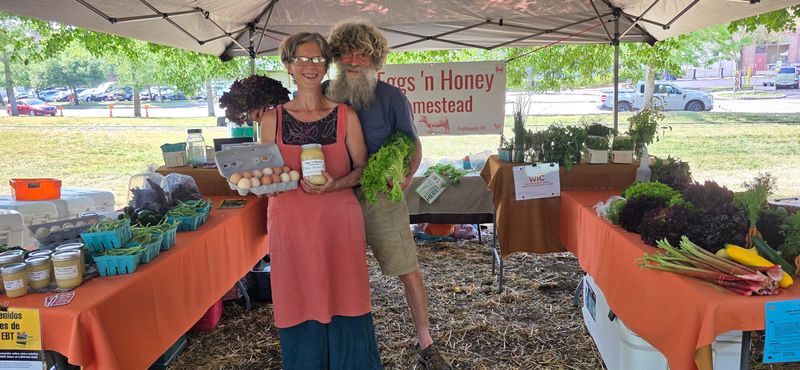
The Corning Farm Market is bustling this summer. With the arrival of July comes the arrival of more wonderful vegetables, produce and products. The entire food basket can be sourced from the market with the exception of salt, pepper and spices. Herbs are coming into season at vendors such as Eggs ’n Honey, located in Prattsburgh, NY, and are really shining right now. This week we will take a closer look at the Eggs ‘n Honey market stand. This stand is a creation of Celeste Arlie and Alfonzo Zappetella.
They, along with their grandchildren Hazel and Zephyrus, began homesteading in 2015 and shifted to full time in 2021 after retiring from their jobs, Celeste with the Veterans Crisis Line and Alfonzo from construction and house building. Celeste says, “Alfonzo always dreamt of having a farm and even to the point as a little boy he could just envision the chickens.” Alfonzo grew up reading novels such as “Farmer Boy” by Laura Ingalls Wilder. He always knew he wanted to have a farm with the ethos expressed in this novel. For Alfonzo his homestead is “kind of like a dream come true.”

Both Celeste and Alfonzo love what they do and absolutely enjoy sharing their bounty and knowledge with everyone who stops by their stand. According to Celeste, “We want to sell our produce. But beyond that, we want people to begin growing their own. Our products cover a pretty big range. We grow many varieties of lettuce, red beets, golden beets, carrots, spring onions right now, and later on we’ll have big candy onions, tomatoes, peppers both hot and sweet, and dahlias. Garlic is a big feature crop for our farm as well as, not surprisingly, eggs and honey.
“We do a lot of different small amounts of produce, herbs such as thyme, rosemary, oregano and chive, nasturtium flowers and stems, black garlic, and meats. We have grass fed lamb, pastured chicken and turkey, and we will have grass fed beef next year. The food we produce and sell to our customers is the quality and freshness we want for our family.”
The quality of their food is a reflection of how they take care of the soil and their animals. Alfonzo and Celeste talk about taking care of the soil with passion. For Celeste, “One of the biggest facets of our farm is feeding the soil. We find it’s vital to feed the soil for nutrient dense foods. We have to give back to the earth because there is so much taken from the soil when we’re producing, whether it’s garlic or carrots or lettuce. We always want to replace what the plants use and hopefully leave it even better than it was.
“When we feed the soil, those nutrient feed worms, bugs, all the microbes, mycelium, contribute to the overall health of the garden. This really boosts the nutrients of the product. Alfonzo is continuously reading and learning, seeking out YouTube information on how we can feed the soil and how we can grow things so it’s more sustainable and in tune with the environment. He was just talking about the writings of Sir Albert Howard with a customer and how composting feeds the soil. Promoting plants native to the region and learning indigenous ways to care for the environment is vital to the homestead and a true passion for me.”
Their sustainability practices go well beyond tending the soil. It also includes their animals.
Chickens are hatched on the farm from hens that are already on the farm. According to Celeste, “Our animals are born on the farm. We strongly believe that an animal hatched on the farm from chickens, whose parent’s health is very robust with good organic pasture and grain, is the best way to raise chicken. We try to keep their life very natural. They are out in the sunshine eating the grass. We provide them protection as well as freedom so they can range and eat insects and organic feed. They just have greater vitality generation after generation. We are really focused on sustainability of our animals.”
Celeste and Alfonzo source produce waste from Joseph’s Wayside in Naples. Alfonzo describes how “Joseph’s Wayside will fill bins for us of all the waste, what they consider waste, such as cantaloupes, peppers, watermelons. We’ve taken videos of the cattle running after watermelon and cantaloupe as they roll down the hill. They also love potatoes and any produce. The chickens, sheep and goats enjoy this produce too. This helps provide a unique flavor to our animals.”
Celeste says, “Speaking of unique flavor, our honey has probably the most unique flavor. We hear that from our customers. They’ll say, ‘I’ve never tasted honey like this before. What did you do? This honey is very unique and delicious.’ We don’t really do anything. I think it’s the flora and fauna of our area with many wildflowers, wild plants, our gardens, and our neighbors’ gardens that really attract a wide variety of pollen. The bees do all the work.”
Celeste describes Alfonzo as the bee keeper but he says, “the bees keep themselves! Don’t do too much to the bees.” Alfonzo’s beekeeping methodology transfers over to the honey harvesting. “I only harvest capped honey [when the bees cover their finished honey with a wax coating] to provide a really good honey and not tamper with the bees and the honey extraction process. I bring the honey into a room that is about 85 to 90 degrees and use centrifugal extraction. Then I strain the honey and let it set just until it crystalizes. After that I remove anything that has risen to the top. The rest of the honey’s got wax, pollen and everything in it that’s good. That’s medicine. I just spoon it out into jars and it’s never reheated. I believe it is the best.”
Stop by the market and see for yourself if this honey is the most unique flavored honey that you have ever tasted. I think so. You will also find eggs, vegetables, herbs, meats and so much more. The Eggs ‘n Honey Farm stand can be found at the Corning Farmers Market, as well as an online farmers market and their own farm store. They also make deliveries to Josephs Wayside Market and have added a local delivery option to the hamlet of Prattsburgh and the village of Naples.
Celeste says, “We love having customers, individuals, families and groups come to our homestead to experience farm life with the animals, learn a skill, like wet felting, or to enjoy the garden and pick their own produce. Sharing and encouraging homesteading on any level is a major focus for us.”
Join Eggs ‘n Honey at the Corning Farm Market in Riverfront Centennial Park every Thursday from 10 a.m. to 2 p.m. until the last Thursday in October or stop by their farm.
Recipe of the week: Beet Pastrami
Celeste: “A very good friend and customer shared this recipe with me last week and I love the versatility of it and you can use it on vegetables, meat and mushrooms.”
Pastrami Rub Recipe for Beets and Everything!
Ingredients
For Beet Pastrami: 4 small to medium sized beetroots, 1 T olive oil
For Pastrami Rub: 2 T whole coriander, 2 T whole peppercorns, 1 tsp. mustard seeds or dry mustard, 2 tsp. onion powder, 2 tsp. garlic powder, 1 T smoked paprika, 2 tsp. kosher salt, 1 T brown sugar
Instructions: Crush coriander, peppercorns and mustard seeds (if using). Don’t use a spice grinder or food processor. Use a mortar and pestle or crush in a baggie and a heavy pan. Then mix it all together well. If your beetroots came with leaves, cut them off close to the beet and save for later use (perfect cooked greens). Gently scrub the beets without peeling the skin, rinse and pat dry. Place them on a lined oven sheet, brush them with ½ tbsp olive oil. Roast at 400ºF for 45-50 minutes or until tender and a knife or skewer easily goes through. They will be about 3/4 done. Let them cool, peel them or keep skins on (dealer’s choice), slice the beets or leave whole, rub with oil and add the seasoning. Finish roasting. When the beets have cooled slightly, rub with olive oil and dip them into the bowl with the pastrami rub, make sure that all sides are covered. Return them to the oven and roast for 17 minutes at 400ºF. Save leftover pastrami rub for later or use immediately on turkey wings and mushrooms.
This recipe makes plenty, and it goes a long way. Try it on meat, mushrooms, and other vegetables.
This article originally appeared on The Leader: Secret to success for Eggs ’n Honey of Prattsburgh lies in the soil
Reporting by Renee Jacobson, Special to The Leader / The Leader
USA TODAY Network via Reuters Connect
By Renee Jacobson, Special to The Leader | USA TODAY Network