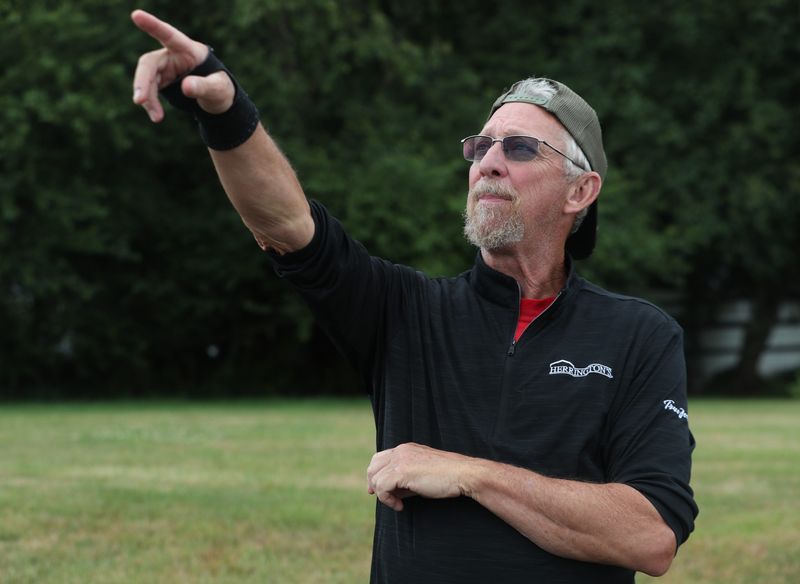
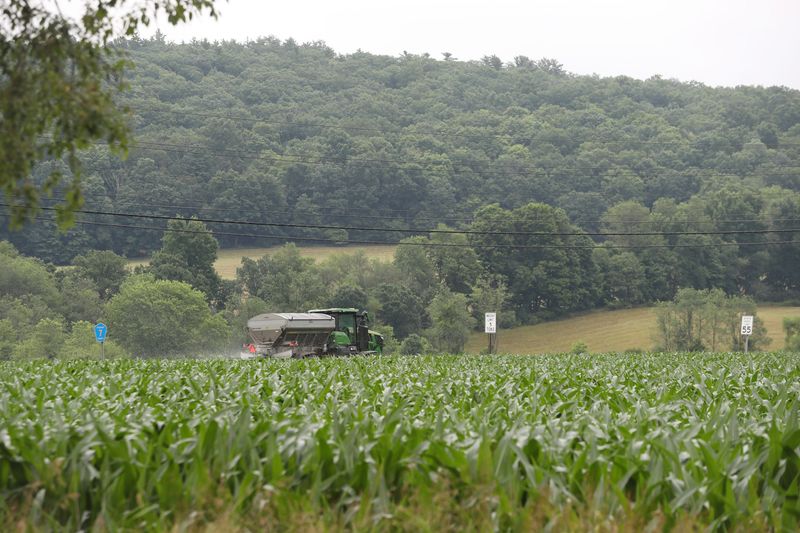
In summer, Bill Leonard looks out his front door onto a lush green hillside bordered by cornfields and hay bales.
Eagles, owls, deer, coyote, even a moose. Leonard’s seen them all during the 32 years he and his wife Patricia have lived in the Cape Cod-style house on Route 7 in Craryville, a Hudson Valley hamlet in the town of Copake. When Leonard’s not out on the lake fishing for bass, the retired truck driver hunts turkey in his backyard.

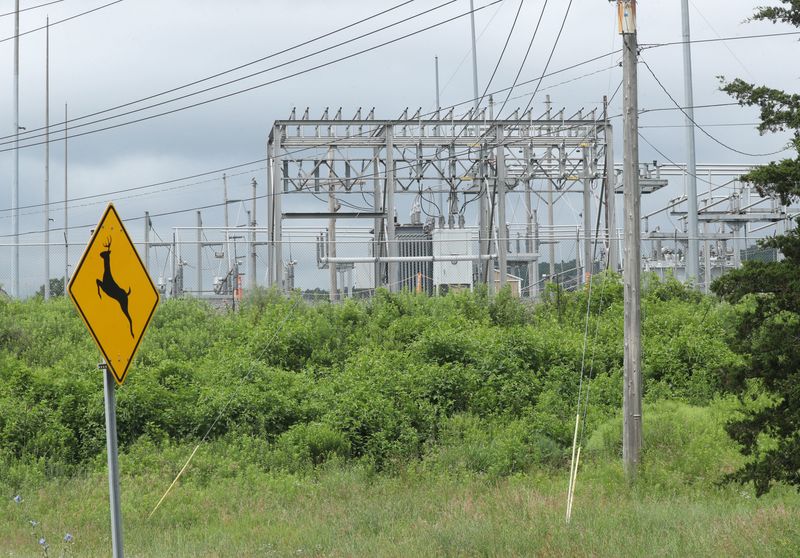
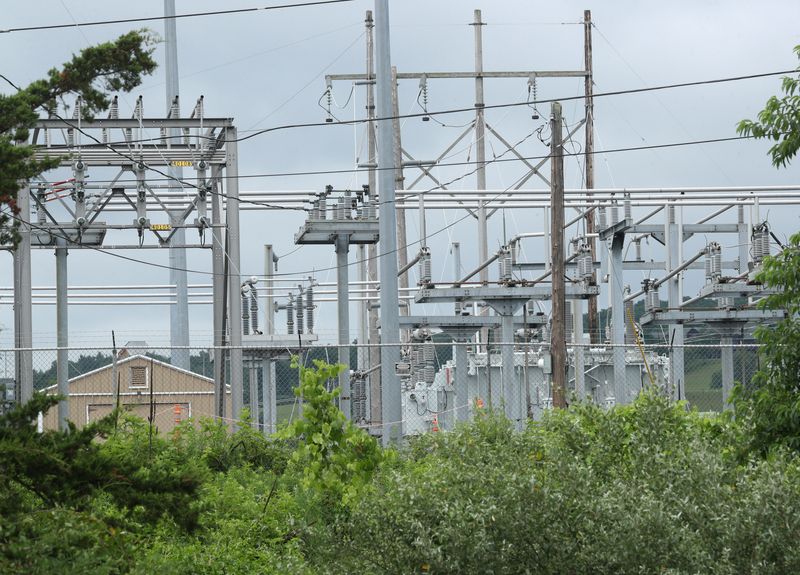
But if developers have their way, Leonard’s view will be marred by acres upon acres of solar panels on privately-owned farmland that will deliver energy to the grid from a New York State Electric and Gas-run substation about a mile west.
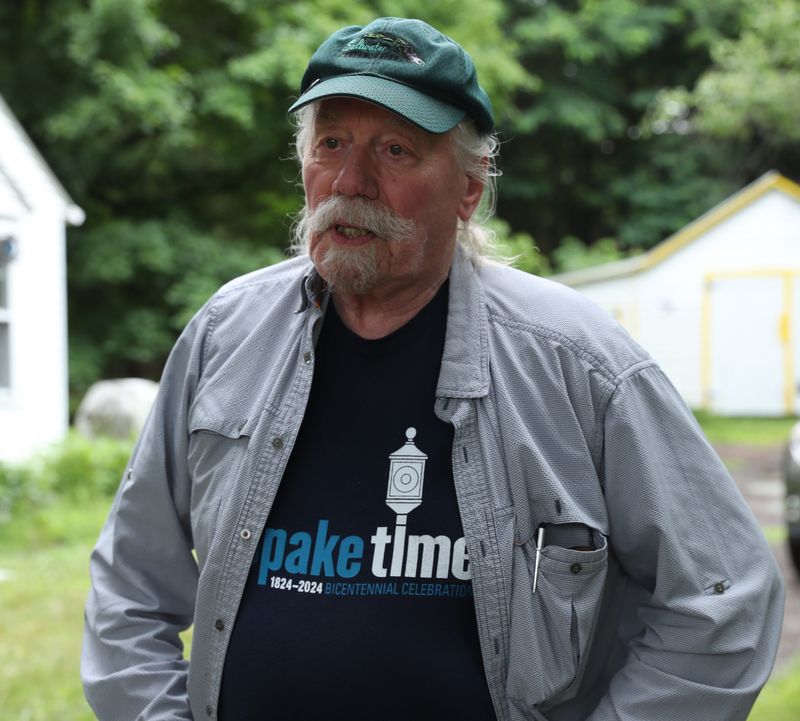
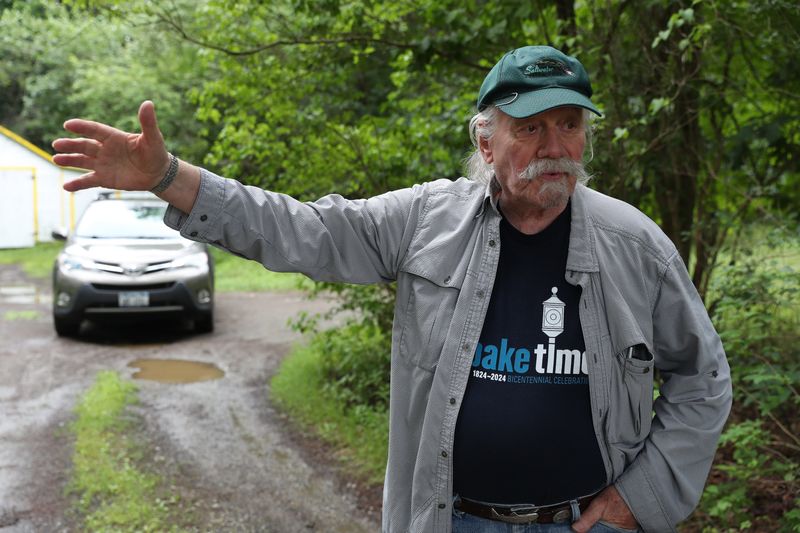
“Even if it was on top of the mountain over there, you’re not going to see it, but right here?,” Leonard said one afternoon in early July, looking out at the hillside from his front lawn.
It’s a question upstate towns — from Yates County on Lake Ontario, to the town of Rush south of Rochester and down to the Southern Tier — have been asking themselves as developers fan out across the region, answering the state’s call to build more solar and wind power.
Why here?
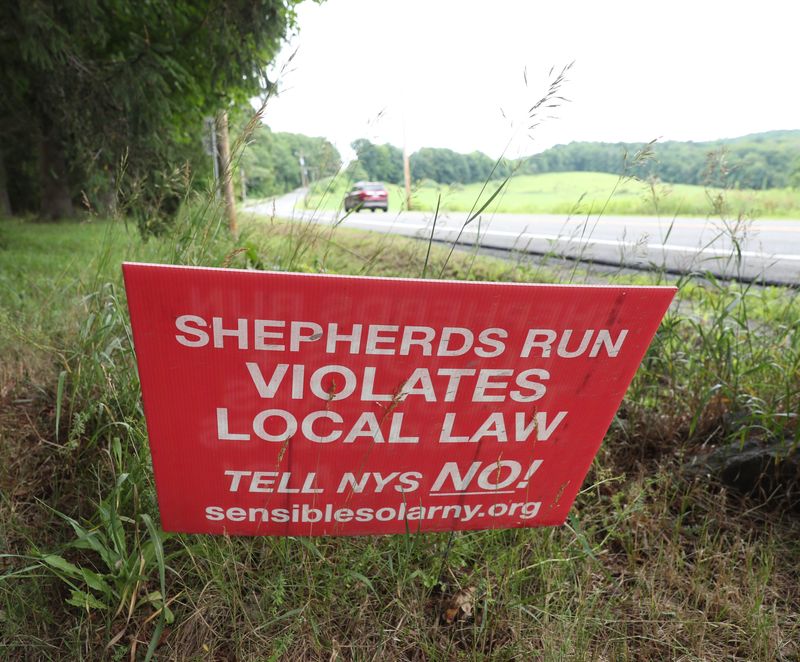
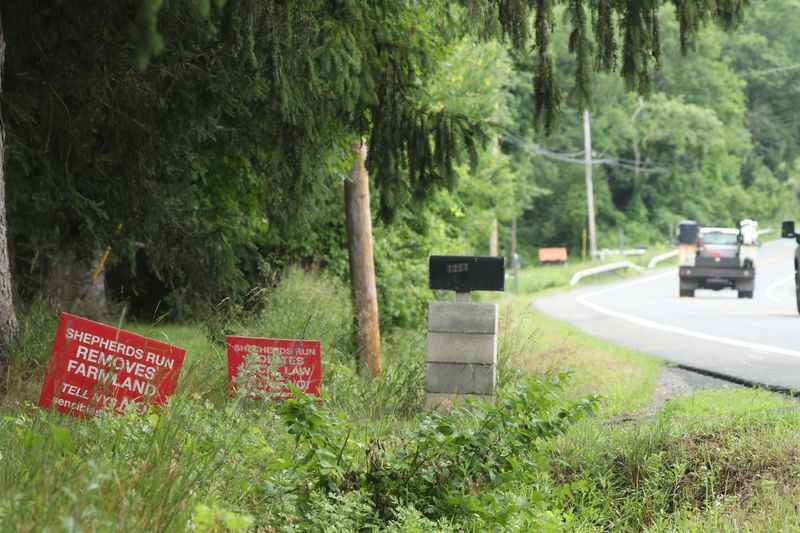
For nearly a decade, Leonard and others in these Hudson Valley towns along the Taconic State Parkway two-and-a-half hours north of New York City have been fighting Hecate Energy’s plan to put solar panels on 173 acres of privately-owned land. The latest version of the Shepherd’s Run project, introduced in 2024, calls for a 42-megawatt solar farm scaled down by some 50 acres from an earlier proposal.
Residents of the towns of Taghkanic, Hillsdale, Copake and Claverack have weighed in at town halls. Lawsuits have been filed. Hundreds of residents have lodged complaints with the state agency that will decide whether Hecate gets a permit in the fall.
They’ve raised dozens of issues. Wetlands would be destroyed, natural landscapes lost, soil eroded. Solar panels could catch fire. An administrative judge’s June decision on the debate runs 225 pages. Supporters highlight the millions of dollars in property taxes that would flow to the town and the financial boost it would provide local farmers.
New York’s broken climate law promises
It was all supposed to go a lot smoother than this.
The state’s Climate Leadership and Community Protection Act of 2019 established a goal of 70% reliance on renewables for the state’s energy needs by 2030. The promise was solar and wind farms upstate would deliver clean energy to the Lower Hudson Valley and New York City in a downstate region that, since the 2021 shutdown of Indian Point nuclear power plant in Westchester County, has had to rely on one of the nation’s oldest generation of fossil fuel plants for nearly all its energy.
So far it’s a promise unfulfilled.
Since 2021, the state has approved 42 large-scale solar and wind projects. Of those, nine are up and running. Among them is Morris Ridge in Livingston County, a 177-megawatt project with 370,000 solar panels on 1,000 acres of private land, enough power for 47,000 households. It opened in 2024.
Eight more have been approved for construction. They include Hecate’s Cider Solar in the towns of Elba and Oakfield in Genesee County, a 500-megawatt solar farm on 2,200 acres. (A single megawatt powers between 850 and 1,000 homes.)
Together, the 17 projects would generate less than 2,500 megawatts of electricity on nearly 85,000 acres, state figures show. That’s a tiny fraction of the energy that will be needed to clean up the downstate region’s fossil-fuel dependent energy mix, which last year got just 4% of its energy from zero carbon emissions. That compares to nearly 90% zero emissions upstate thanks to an abundance of nuclear and hydropower.
The sluggish buildout isn’t all on the state. Developers have been pulling projects from the queue, citing financial challenges posed by the pandemic, inflation and disruption in the global supply chain.
Of over 100 large-scale renewable projects the New York Independent System Operator approved for interconnection since 2019 — a necessary milestone before permits can be approved — just 14 advanced to the construction phase, the nonprofit that oversees the state grid reported this year. Sixty-four of those are solar projects.
Adding to the state’s troubles are transmission constraints that limit the amount of energy that can travel south on high-voltage, overhead cables. In 2024, the state created a department within Office of Renewable Energy Siting (ORES) to speed up transmission approvals that, like the renewable projects, have faced opposition from local towns. Western New York, the Southern Tier and the North Country have “renewable generation pockets” because there’s not enough transmission to move clean energy onto the grid.
All this has state officials reconsidering retirements planned for decades-old fossil fuel plants downstate — many 50 years or older — in favor of upgrades that would reduce the number of pollutants they release into the air.
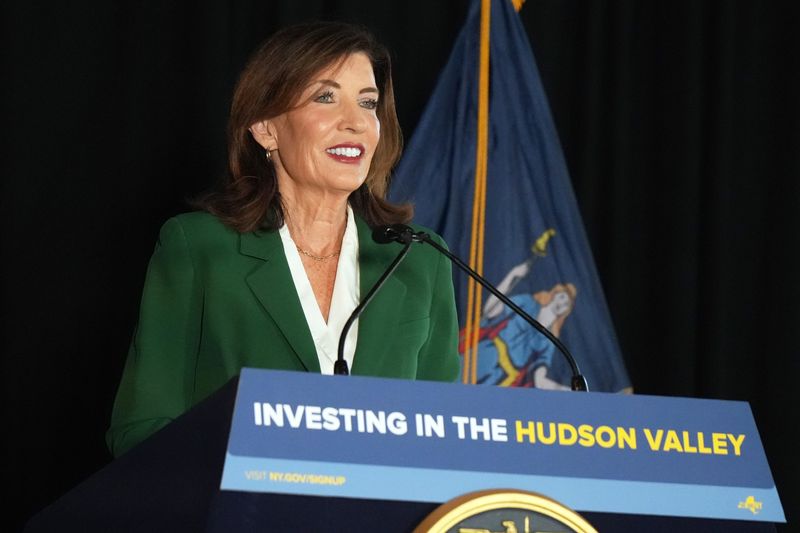
And it has Gov. Kathy Hochul adopting an all-of-the-above energy approach that includes adding not only renewable power to the grid but more nuclear power from upstate plants. The governor has even said she’s open to approving gas pipeline projects if they conform to state permitting regulations.
The Democrat pins much of the blame on Trump administration policies that reduced tax incentives for offshore wind planned for the coast of Long Island that would have helped clean up New York City’s emissions problem.
“And even within our own borders, we have been dealing with NIMBYism, moratoriums and outright bans that have made siting alternative energy facilities such as on-land wind, utility-scale solar and battery storage impossible in too many parts of our state,” Hochul wrote earlier this year, referring to Not-In-My-Backyard critics.
Since then she’s reconsidered the state’s climate goals, pushing out emission limits set by the CLCPA, a move she said would help keep already surging energy bills from rising further.
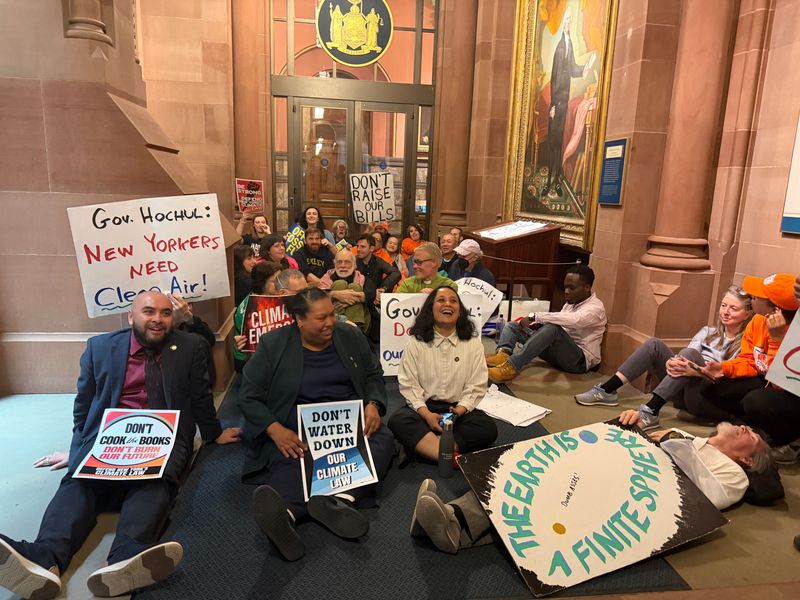
But the pivot upset environmental groups who accuse the governor of betraying her promise to clean up the grid.
“This past year the governor made a political choice to weaken our climate law, which will keep us on fossil fuels longer and stick New Yorkers with the bill if we don’t take proactive action around renewables,” said Liz Moran, the New York Policy Advocate for Earthjustice.
“And ultimately renewables are cheaper,” Moran added. “We are dragging behind states like Texas, which have made big investments in solar and batteries, which we know we need in New York to not only bring down bills but also help us stabilize and make our grid more resilient.”
Blakeman visits Copake
And it’s not just the left that’s unhappy.
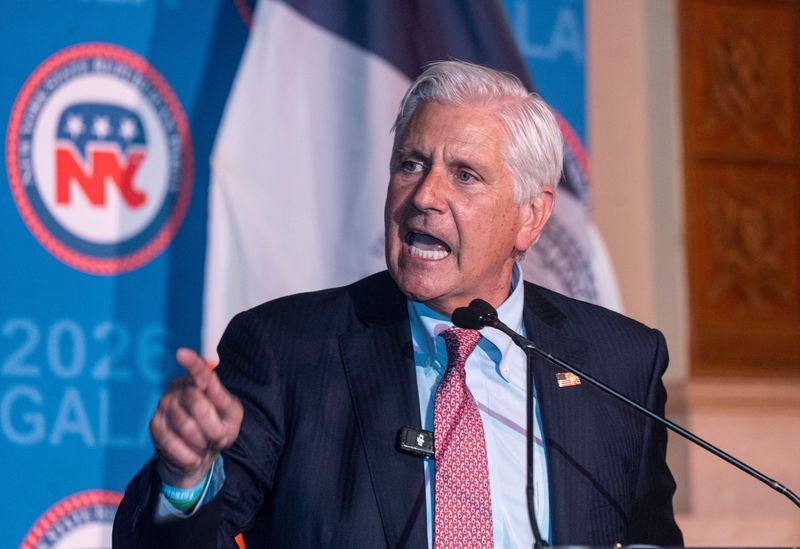
In April, Bruce Blakeman, Hochul’s Republican challenger in this year’s race for governor, held a press conference outside Copake Town Hall, where he aligned himself with Shepherd’s Run opponents, sounding more like a left-leaning environmentalist.
“You know what, they always talk about the environment,” Blakeman said. “Does it make any sense to take thousands and thousands of acres of beautiful farmland and put these ugly solar panels on them?”
The Nassau County executive also blasted Democrats for trying to put wind turbines off the coast of Long Island.
“Does it make any sense to put these 30-story tall windmills in the middle of the ocean where we’re now seeing marine life like whales and dolphin and seals washing up on the shore dead that we’ve never seen before,” Blakeman said. “They’re full of it. Kathy Hochul is full of it. This is a scam.”
In late June, Trump administration Agriculture Secretary Brooke Rollins and Lee Zeldin, the head of the Environmental Protection Agency, chimed in, sending a letter to Hochul demanding answers for why the state was taking prime agricultural land for renewable projects upstate.
“Protecting prime farmland and preventing the United States from becoming a dumping ground for hazardous foreign-made waste are not obstacles to a sound energy future — they are part of it,” they wrote.
Days later, Leonard, the Craryville resident, adopted the attack line in voicing his opposition to Shepherd’s Run. “I don’t really see any positive to tell you the truth, especially if they’re Chinese-made solar panels like they say,” he said.
Hochul defends her record, pointing to the accelerated momentum of approvals after the state created the ORES in 2020 to streamline the permitting process.
The state is on target to meet its 2030 target of 10 gigawatts of distributed solar or so-called behind the meter generation, which includes residential and commercial rooftop installations as well as community solar that gives homeowners credits for investing in solar panels built on farmland nearby.
“We continue to move aggressively toward a clean energy future despite reckless policies out of Washington that seek to kill renewable projects in favor of gas drilling, oil and coal,” said Ken Lovett, Hochul’s senior communications advisor on Energy and Environment.
“The Governor remains committed to moving forward while recognizing that no one solution will solve New York’s energy challenges, which is why she is advancing an all-of-the-above approach that includes more renewables, nuclear, and other forms of energy in order to keep the lights on and costs down for New Yorkers,” Lovett added.
Blakeman’s Copake appearance presented a political dilemma for some members of Sensible Solar for Rural New York, the grassroots group opposed to Shepherd’s Run.
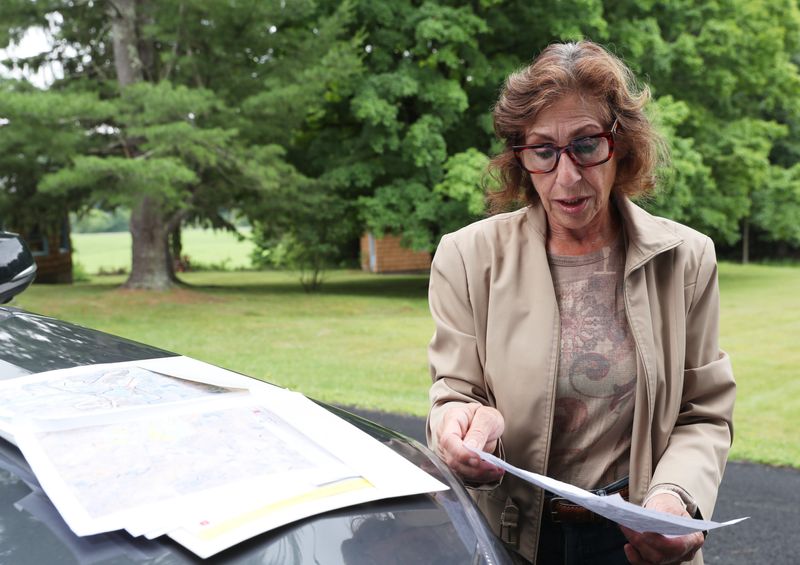
“When he came to Copake there were some people who refused to go to his rally and others who were happy to go to his rally,” said Jean Halloran, one of the group’s leaders.
Some Dems, Republicans unite over opposition to renewable projects
It’s a politically diverse group that includes folks with roots in the Hudson Valley that go back generations, as well as city dwellers up from Brooklyn and Manhattan who ventured north during the pandemic and stuck around.
They count among their ranks Holly Tanner, the Republican clerk of Columbia County which includes Copake, as well as Democrats like state Sen. Michelle Hinchey, Assemblywoman Didi Barrett and Rep. Josh Riley who say the projects will destroy prime farmland.
It’s a one-issue group that resists the urge to dabble in state or national politics. “We don’t endorse political candidates, and we’ll work with any elected official who works with us,” said Halloran.
The movement has forged an alliance between pro-farmer Republicans unenthusiastic about renewable energy and Democrats who might have solar panels on the roofs of their homes but don’t want to see acres of trees chopped down.
Halloran rejects suggestions by Hochul and others that theirs is a NIMBY movement. “That sort of assumes the possibility that anyplace anywhere you can put one of these things you should do it,” said Halloran who lives in Brooklyn part of the year.
“All the things that we believe in like saving wetlands and preserving endangered species should be maintained and not just ignored in order to create solar energy,” she adds.
Barrett, who chairs the energy committee, has accused Hecate of not acting “in good faith” to address the concerns of Copake and nearby towns. In a letter, she said the project would not only remove 40 acres of trees but would destroy valuable farmland and threaten the drinking supply for the city of Hudson, which gets its water from Taghkanic Creek.
“These serious threats to our farmland, natural resources, and surrounding communities have never been addressed by Hecate, the developer,” Barrett wrote in 2023.
At a June hearing, Riley urged Rollins to advocate against the project. Days later, she and Zeldin sent the letter to Hochul.
“It’s such a desecration,” Halloran added. “We can all visualize that valley being covered with glass and steel. We can’t let that happen.”
Farmers are desperate
Tanner, who’s been county clerk for 25 years, grew up in on a dairy farm in nearby Ghent and was the county’s dairy princess in 1986. She still runs a farm of her own with hundreds of acres and understands the pressures on farmers to lease their property to wind and solar developers offering a thousand dollars or more per acre.
“There is a desperation on behalf of some landowners who have very large parcels because the state does not make it easy,” Tanner said. “It’s very expensive between school and property taxes.”
But, she said, that doesn’t mean the state should allow prime farmland to be covered by solar panels
“You know people want to stop at nothing to ensure that what’s happening with climate change is halted but New York isn’t going to solve the problem alone and these ginormous solar farms are anything but green,” Tanner said.
Hecate said it has tried to incorporate as much input from the local community as possible since the project was first announced in 2017. “We can’t do things that would render the project infeasible but we try to do as much as we can,” said Matt Levine, the vice president of development for Chicago-based Hecate.
The project will deliver millions of dollars in property taxes to local towns and villages while allowing the landowners to continue farming the bulk of their 900 acres.
“By giving the owners of this farm fixe revenue that isn’t subjected to the whims of commodity prices in the agricultural sector allows them to hold onto the land for generations and continue farming the balance of the land,” Levine said.
Marguerite Wells, the executive director of the Alliance for Clean Energy New York, which represents renewable developers, said the project has undergone a rigorous review.
She said the letter from Rollins and Zeldin, co-signed by country singer John Rich, the Trump administration’s newly appointed special envoy for the American landowner, was wrong to suggest the state is trying to fast-track the taking of prime agricultural land.
“Projects like that have been in the works for years,” Wells said. “And there’s nothing fast about developing projects in upstate New York. My experience of the state agency regulatory folks is they tend to be extremely protective of the resource they are protecting. You cannot fault them for doing their jobs. They are extremely careful that wetlands are not going to be destroyed on their watch. Rare species are not going to be impacted on their watch.”
NY picks up the pace
Indeed, a 2024 report by state Comptroller Thomas DiNapoli said ORES was moving too slowly to approve large-scale wind and solar projects and threatened to undermine the state’s clean energy goals.
But, state officials say, the agency has since picked up the pace. Of the 54 large-scale solar and wind projects the state has approved, 36 came after ORES was created in 2020, said Jessica Waldorf, the chief of staff and director of policy implementation for the state’s Department of Public Service, which oversees ORES.
ORES recently approved the Alle-Catt Wind Energy project in western New York, one of the largest the state has ever approved, with dozens of wind turbines spread over 1,444 acres in Allegany, Cattaraugus and Wyoming counties. Opponents tried to derail the 340-megawatt project by, among other things, highlighting threats to bald eagle populations.
Lawyers who’ve challenged the state on behalf of towns say ORES has become a rubber stamp for developers. Copake and others sued the state in 2021 claiming the agency was ignoring local zoning laws to approve projects.
“The sluggish build out has nothing to do with the near universal local opposition, which has been utterly ineffective in stopping ORES from approving every project submitted to it at lightning speed and with minimal scrutiny,” said attorney Ben Wisniewski, who represented Copake and other towns.
“The real story here is that even agency capture has its limitations,” Wisniewski added. “The projects have not been built because, despite having everything in their corner, the capacity factor of wind and solar, combined with ever-rising project costs (inflation), means the goals are inherently unattainable.”
Adding to the slow buildout are developers pulling out of projects even after receiving state approval. The pandemic, inflation and supply chain issues were all factors, Wells noted.
“All of a sudden everybody’s equipment costs were up 30% and there was no mechanism within the contract to adjust for that,” Wells said.
Waldorf said the state is doing what it can to work with developers as they navigate financial headwinds. “Ultimately it is really up to the developer whether or not a project is entering construction for whatever reason,” she noted.
She said the criticism leveled by DiNapoli and others has been addressed as the state improves its permitting process. “Whether a process takes five years or one year the goal is to make sure that everybody’s voices are heard,” she noted. “That every issue is raised, discussed, debated, evaluated.”
In the meantime, she said the June completion of the $6 billion Champlain Hudson Power Express, which will deliver some 1,250 megawatts of hydropower along 339 miles of underground and underwater cable from Canada to New York City will help clean downstate’s energy mix.
But, she said, the federal government’s opposition to offshore wind on Long Island will limit the amount of clean energy that can be generated where it’s needed most.
“We hate to see that industry completely disappear,” Waldorf said. “We hope that there’s a silver lining and we can keep some of those projects — I’ll say on deck — for the future in some way, shape or form but if not it means we’re going to have to take a fresh look at our energy strategy, locationally-based resources. Because ultimately even if we build a bunch of renewable energy in upstate New York we’re still going to have to solve locational power constraints in the downstate region.”
Thomas C. Zambito covers energy, transportation and economic growth for the USA TODAY Network’s New York State team. He’s won dozens of state and national writing awards from the Associated Press, Investigative Reporters and Editors, the Deadline Club and others during a decades-long career that’s included stops at the New York Daily News, The Star-Ledger of Newark and The Record of Hackensack. He can be reached at tzambito@lohud.com
This article originally appeared on Rockland/Westchester Journal News: NY led the way on renewable energy. How it lost its path | Exclusive
Reporting by Thomas C. Zambito, New York State Team / Rockland/Westchester Journal News
USA TODAY Network via Reuters Connect
By Thomas C. Zambito, New York State Team | USA TODAY Network