The first time I enrolled in college was in 2004 when a local private college offered classes at Greene Correctional Facility. I was 17 years old and I was only able to to complete two college classes before the college lost funding to run the program. Like many other incarcerated college students in New York, the loss of Pell and TAP grants for people in prison interrupted my educational journey. And unfortunately, it would take more than six credits for me to transform my life.
I entered the system at 15 despite having a good upbringing. In fact, my father was a correctional officer who begged the judge not to send me away when I first got in trouble. As a teen, trying to fit in with the wrong crowd led me down a dark path where I made many mistakes, including being entangled in the juvenile, state and federal prison system.

I’ve spent 20 of my 38 years behind bars, but it wasn’t until I was 35 years old that I had access to a college program again. Thanks to North Country Community College’s presence at FCI Ray Brook, I was able to enroll in their Entrepreneurship Management degree program. North Country, a second-chance Pell program, opened the door once again for incarcerated individuals to earn a college degree, a critical need for those of us who were sent upstate where there were no other educational opportunities.
SUNY OHEP, North Country Community College helped me succeed
Mercifully during my last year of incarceration, I was granted compassionate release to spend my father’s final days with him as he was dying of cancer. At the end, I do truly believe my father and I found peace in our relationship, although I’d be lying if I didn’t say it felt like we were trapped in a lifelong game of Cops and Robbers. We both had to change. I obviously had a lot to learn about fixing my behavior and making better choices, but simultaneously he learned a lot from my journey. My experience of incarceration softened him, opening his eyes to how good people can get caught in a system, and making him take a more progressive stance on crime.
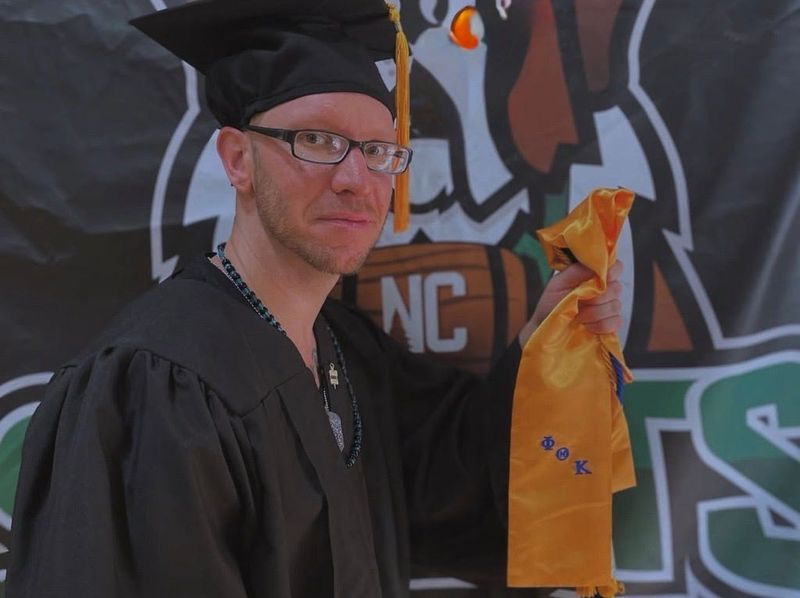
While caring for him, with the help of SUNY’s Office of Higher Education in Prison, or OHEP, I finished my final semester of college online and even got to walk at graduation up at North Country Community College despite having returned to the Hudson Valley. My father was too sick to travel but, on his deathbed, he watched me graduate via Facetime. What made it even more special was that my favorite economics professor from inside the prison was the one to hand me my degree.
My associate’s degree was just the beginning of my educational journey as I then enrolled at SUNY New Paltz to pursue a political science degree. One day, I hope to apply to law school. In addition to being a full-time student, I work full-time as a manager in an auto repair shop. It’s not my first job since my release, but it’s certainly one that allows me to put my associate’s degree to use.
Now, I’m supporting my own son’s journey
Perhaps most importantly, being a free man has enabled me to be a support to my own son, who returned home from a juvenile sentence last summer. On my worst days I fear how much he is like me — a knucklehead kid who made poor choices and got caught in the system. However, my education has allowed me to show him another way. My son will graduate high school this spring and is planning to attend Dutchess Community College this fall.
Education changed my life. It opened doors and changed my entire trajectory. Now it’s also changing my son’s trajectory. In prison, college gave me an opportunity to grow and learn, but it also gave me hope and the understanding that I was part of something much larger. It allowed me to believe in a different kind of future. Since my release, college has allowed me to thrive and positively contribute to my community as a working man, a taxpayer and a father.
It’s critical that more people in prison have access to these kinds of opportunities and that programs have the funding they need going forward. I’ll never know what could’ve happened had my college program not closed in 2004, but I often wonder if it could have saved years of pain and hardship. However, I’m grateful I got the opportunities I did and that my father got to witness my graduation, a milestone neither of us could have foreseen.
College programs in New York prisons change lives, families and communities.
James Sanford is a full-time father and student who is passionate about criminal justice reform and access to education.
This article originally appeared on Rockland/Westchester Journal News: New York prisoners must have access to college. This is why | Opinion
Reporting by James Sanford, Special to the USA TODAY Network / Rockland/Westchester Journal News
USA TODAY Network via Reuters Connect