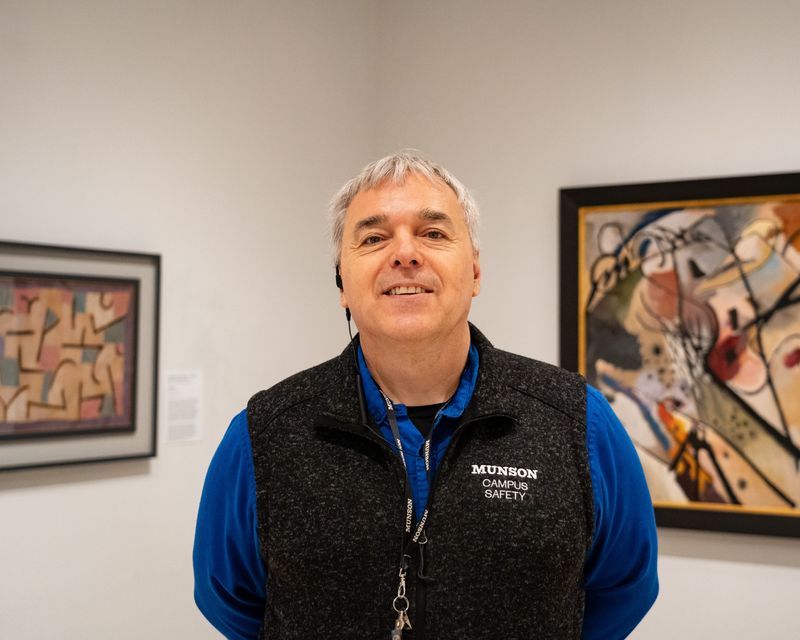
For Rodney Koscielniak, life may sometimes imitate art, but art definitely also imitates life contrary to the famous quotation by Oscar Wilde.
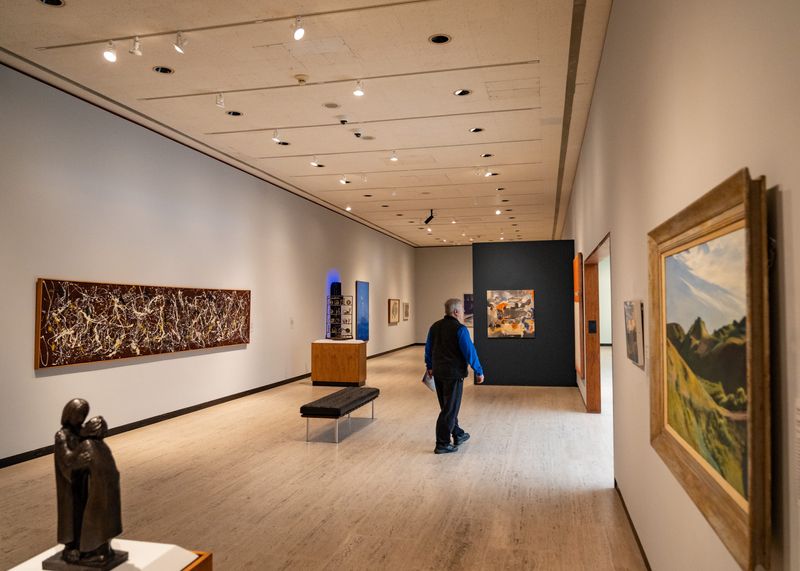
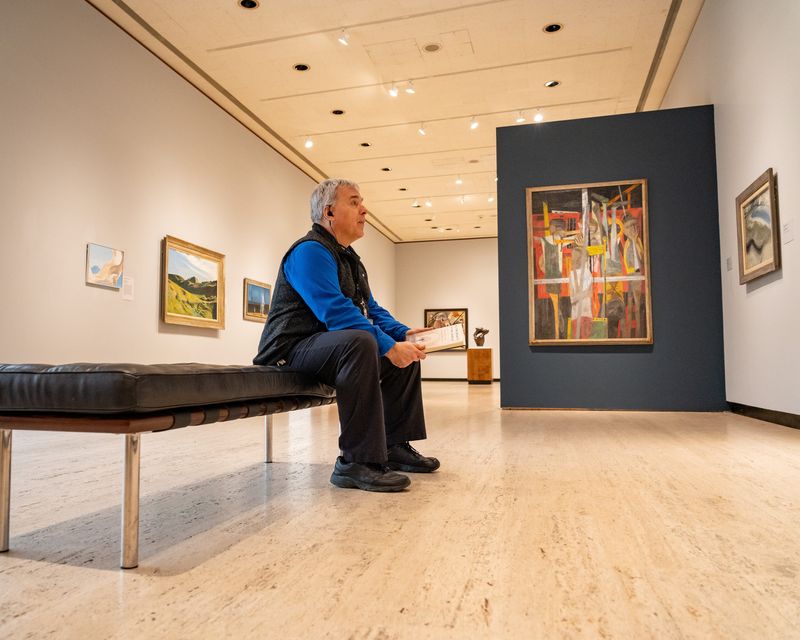
That’s probably not surprising for a man who spends his days not just surrounded by art, but keeping his eye on it as a gallery guard at Munson in Utica.

His favorite art in the museum is Thomas-Cole’s series of four paintings known as the Voyage of Life, which portrays childhood, youth, manhood and old age.
“It makes you think about your own voyage through life,” said Koscielniak, who took his museum job after his retirement as a state worker.
And he’s not the only one who feels the work profoundly.
“I’ve had a woman come in and say every time she sees it, she cries,” he said. “It’s majestic.”
When museum traffic is slow and Koscielniak has time to take his eyes off the paintings, he likes to read — 64 books in his five years on the job, mostly classics like “The Red Badge of Courage,” “I Know Why the Caged Bird Sings” and “Frankenstein.” But he’s also trying to read a book on each president, having read 14 so far.
And sometimes Koscielniak, who has college degrees in sociology, data processing and business administration, reads other genres, including memoirs such as “All the Beauty in the World: The Metropolitan Museum of Art and Me” by Patrick Bringley, a New York Times bestseller.
After finding out his older brother had fatal cancer, Bringley quit his job as events planner at The New Yorker and spent 10 years working as a night guard for the art museum in New York City. He found, Koscielniak explained, solace and comfort, among the beautiful art.
And now Bringley is coming to Munson. He’ll give a talk at 7 p.m. on Tuesday, June 2 in the Museum of Art’s Sinnott Family-Bank of Utica Auditorium, a talk Koscielniak plans to attend.
Sharing art and grief
Bringley’s visit will bring quite an art-meets-life moment to Koscielniak who identified quite a bit with Bringley while reading his book.
Besides their common experiences as museum guards and mutual appreciation for art, Koscielniak felt bound to Bringley by their common grief. Koscielniak’s brother, eight years his elder, died of cancer shortly after he took the job at the museum.
Like Bringley, Koscielniak found solace in art.
“You look at the Voyage of Life and you think, well, we all go through this and time passes,” he said.
There is no way to control life and no way to keep death away, he added.
Koscielniak hopes he’ll find out more about what Bringley has been doing since he left his museum job, including about tours he’s been giving of the Met and other places in New York City, he said.
He also hopes Bringley will autograph his book. And he wants to talk to him about their brothers, to commiserate over their shared grief.
One job, two museums
But Bringley’s book is about a lot more than coping with grief and Koscielniak enjoyed its humor, the great descriptions of art and the diverse cast of characters that make up the museum staff hailing from about 40 countries, he said.
He also noted ways in which his job is similar to the one that Bringley had and ways in which it’s quite different.
Here are some of his observations:
Although 400 or 500 people might show up at a Munson event, most days are quiet.
“Most of the time we’ve only got a couple of people walking around,” Koscielniak said.
Met aspirations
Koscielniak has never actually been to the Met, but he’s hoping to make it someday.
“I’d like to see it all,” he said, although he also acknowledged that the Met is about 25 times Munson’s size.
His first stops will be to see paintings by some of the old European masters. He’d also like to see the painting of George Washington crossing the Delaware River even if some people pooh pooh American art and say American artists aren’t of the same caliber as the great Europeans, he said.
He’ll definitely be hitting the galleries with realism first.
“Slap my hands a bit,” Koscielniak joked, “but I prefer realistic paintings to abstract.”
Since working at Munson, he has made a point of visiting other museums, Koscielniak said. He’s made it to the American Museum of Natural History in New York, the Albany Institute of History and Art, the Fenimore Museum in Cooperstown, the Arkell Museum in Canajoharie and the Everson Museum of Art in Syracuse.
Munson cheerleader
During his time at Munson, Koscielniak hasn’t just guarded its artistic treasures, he’s become their advocate. While talking about his job and the museum, he pointed out several times that admission to the museum is free and that generally, there’s just one summertime exhibit each year for which there’s an admission price.
And Munson’s collection includes great artists, he added, including Alexander Calder, Salvador Dali, Picasso, Piet Mondrian, Wassily Kandinsky and Georgia O’Keeffe, to name a few.
“This is the best thing we’ve got in the city,” he said.
But not enough people realize that. Koscielniak has gotten some of his relatives and friends to visit and they were impressed, he said. But he’d like to get more of them to come.
“Just like the general public, they don’t realize what we have here,” he said.
His niece, a ballerina who danced the part of Clara in the Nutcracker, would have loved a past exhibition of paper dresses, but she never came to see it, he said. (That exhibit was tough, because a lot of people wanted to touch the dresses, which were extremely fragile, he said.)
“This is a real gem to have a museum of this quality in such a small city,” he said.
Munson may be relatively small, but its beauty shines large in Koscielniak’s eyes.
“I feel we have,” he said, “a small segment of all the beauty in the world on a smaller scale.”
He urged the public to check out the annual Community Arts Student Exhibition, which runs from Friday, May 29 through Friday, June 26; the Festival Art Show from July 11 to July 19 this year; this summer’s exhibition “Watercolor Stories: Art of Charles Burchfield” from June 12 to Sept. 13 (Admission costs $8.); and exhibitions each April of work by freshman and sophomore students at Pratt Munson.
Guarded questions
Museum visitors do ask the guards a lot of questions. The most common is the location of the restrooms, Koscielniak said.
But, many people do ask questions about the art, whether general questions or more specific things such as what medium was used, how much it weighs or how the staff manages to move large works, he said.
Koscielniak has learned a lot about the permanent collection over the years simply by hearing the docents give tours so often, especially in Fountain Elms, the mansion that is part of the museum. Koscielniak could almost conduct that tour himself since he knows it backwards and forwards, he said.
But he tries to make sure he’s well informed on all the art, including new pieces and exhibition pieces so that he can answer questions correctly. When new works or an exhibition come in, he reads the placards about a million times and studies up on artists, Koscielniak said.
The guards are always willing to try to answer visitors’ questions, he said.
‘We aren’t art experts,” he cautioned. “If you have any detailed questions, you can ask a curator or a docent.”
Little kids do sometimes ask one question, though, to which Koscielniak can answer “no” without hesitation: Is the Mona Lisa here?
“And sometimes,” he added quietly, “adults ask (too).”
And, of course, movie lovers always wonder whether museum exhibits come to life after dark like in the movie “Night at the Museum.”
“No, unfortunately,” Koscielniak answered.
Apparently life and art don’t always intersect.
Relative artist
Perhaps Koscielniak’s appreciation for art is in his genes. He’s related to a Polish artist for whom art and life converged in the grimmest possible way.
Mieczysław Kościelniak was arrested in 1941 during World War II and sent to the concentration camp at Auschwitz. He was able to get charcoal and paper sneaked in to him because the guards liked him, his relative Koscielniak said.
His charcoal drawings, some of which are in the collection of the Auschwitz-Birkenau Memorial & Museum, showed the outside world the atrocities that took place in the concentration camp, Koscielniak said.
Kościelniak survived the war and died an acclaimed artist in 1993.
Andy Warhol
When first sitting down for an interview, Koscielniak quipped that he thought this would be his 15 minutes of fame, paraphrasing a famous quote by another artist, Andy Warhol.
It’s a quote used frequently by people or to describe people who briefly fall into the media glare.
But, for Koscielniak, Warhol isn’t just a name from art history or pop culture; he’s practically a colleague. Warhol’s painting “Big Electric Chair,” painted in 1967, hangs in the museum.
Maybe life is art. Or is art life?
Tickets for author Patrick Bringley’s talk at Munson cost $18 for members and $22 for the general public. They can be purchased by calling 315-797-0055 or going here.
The talk is brought to Munson by the Mid-York Library System and sponsored by Carol W. Steele and Hospice & Palliative Care of New Hartford.
This article originally appeared on Observer-Dispatch: Meeting art and life: Munson guard feels kinship with museum speaker
Reporting by Amy Neff Roth, Utica Observer Dispatch / Observer-Dispatch
USA TODAY Network via Reuters Connect