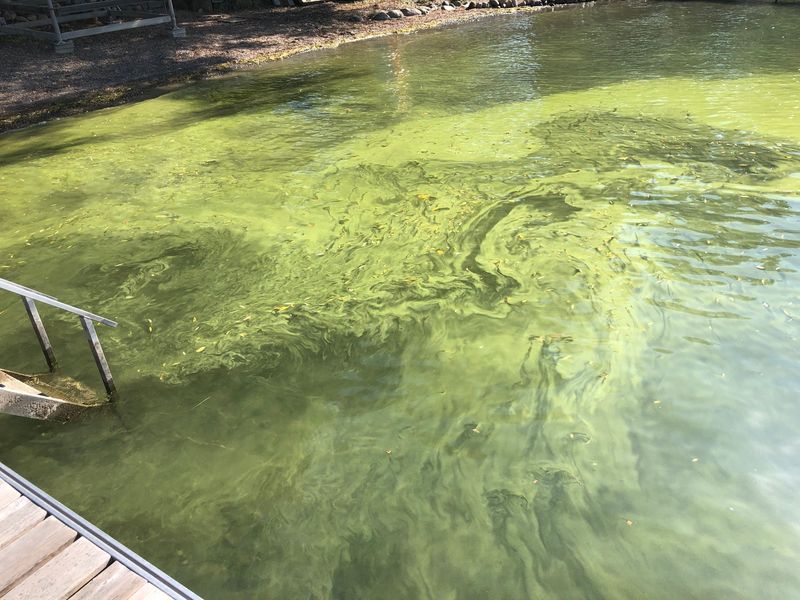
The Livingston County Department of Health has issued a Harmful Algal Bloom (HAB) Advisory for Conesus Lake.

According to the county, small localized HABs have been observed at Vitale Park and points along the shore on the southeast portion of the lake. Conditions are conducive to HABs throughout Conesus Lake, the health department said.
The New York State Department of Environmental Conservation Harmful Algal Bloom System is an online reporting system and interactive map that tracks blooms confirmed by the DEC. As of June 27, the map shows three current HAB bloom reports and one archived bloom report for Conesus Lake.
The extent of all three current HAB bloom reports for Conesus Lake is described by DEC as “Small Localized.”
The health advisory from Livingston County states that the public water supply is safe for drinking, but warns people and animals to avoid suspected areas and stay out of water where the blooms are present.
What is blue-green algae?
Harmful Algal Blooms, also referred to as blue-green algae or cyanobacteria, are considered a group of photosynthetic bacteria that have the potential to produce harmful toxins and irritants.
According to Livingston County, this bacterium can be naturally present in very low concentrations in lakes and streams. However, environmental factors can favor the growth of blue-green algae and, in turn, form into blooms along the surface of a body away where the toxins can become more concentrated, posing a health threat to humans and animals.
Exposure to HABs can cause diarrhea, nausea, vomiting, skin, eye, or throat irritation, allergic reactions, or breathing difficulties, according to the county. These blooms can also have negative impacts on a lake or body of water by discoloring the water and producing foul odors.
How to identify harmful algae blooms
The Livingston County Department of Health stated that HABs can form and disappear quickly, so people need to know how to identify and avoid them.
The HABs are usually blue-green in color, but the cyanobacteria can also produce reddish-purple, green, blue, and brown colors, the county said. These blooms can look like “pea soup”, or puffy clumps that float on the water surface.
According to the county’s health department, HABs can often be confused with filamentous algae, which are not harmful but can also collect on the water’s surface like HABs. Livingston County states that if you see a bloom with a “hair-like or stringy appearance,” it is more likely to be filamentous algae.
Precautions recommended by the Livingston County Department of Health include:
Reporting suspected HABs
To report suspected HABs in Livingston County, contact the Livingston County Department of Health Center for Environmental Health at (585) 243-7280.
You can also report suspected blooms to the NYDEC Harmful Algal Bloom System through their suspicious algal bloom report form. The form can be accessed by visiting https://dec.ny.gov/environmental-protection/water/water-quality/harmful-algal-blooms/notifications.
— Madison Scott is a journalist with the Democrat and Chronicle who covers breaking and trending news for the Finger Lakes Region. She has an interest in how the system helps or doesn’t help families with missing loved ones. She can be reached at MDScott@gannett.com.
This article originally appeared on Rochester Democrat and Chronicle: Is it safe to swim? What the Conesus Lake algae advisory means for summer activities
Reporting by Madison Scott, Rochester Democrat and Chronicle / Rochester Democrat and Chronicle
USA TODAY Network via Reuters Connect