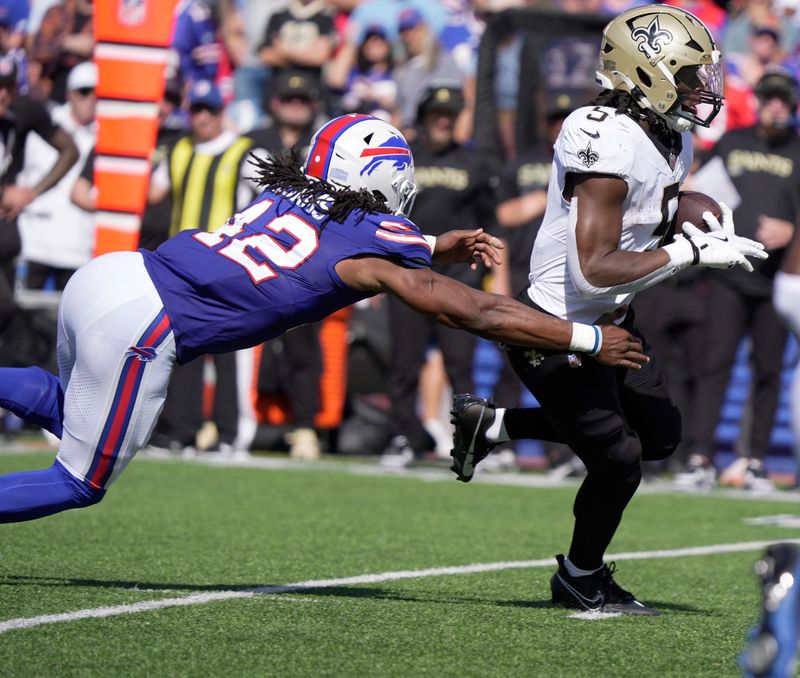
ORCHARD PARK – There is some scuttlebutt emanating from New York that Buffalo Bills president/general manager Brandon Beane had every intention of picking Indiana wide receiver Omar Cooper Jr. at No. 31 in the first round of the NFL Draft.
However, he never got the chance, reportedly, because the Jets got wind of this and made a trade to jump ahead of Buffalo to No. 30 where the 49ers were sitting so they could beat Beane to the punch and get the best receiver on the Hoosiers’ national championship team.

Sorry, but that doesn’t fly for me because if Beane truly wanted to pick Cooper, he could have had him at No. 26 with Buffalo’s original first-round pick, and at No. 28 after he traded down to the Texans’ spot. Why would he risk losing the player with a second trade down to New England at No. 31?
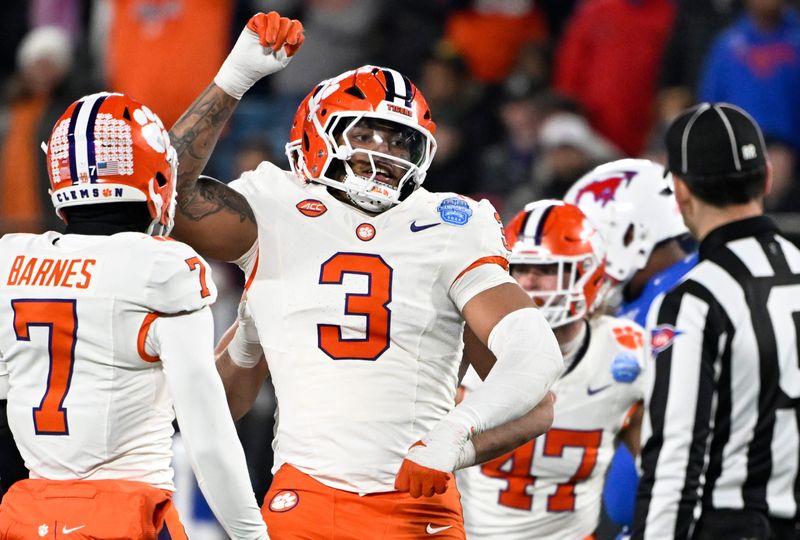
After the Jets got Cooper, Beane quickly made his third trade down, but I don’t think that had anything to do with Beane moving out of the first round and landing at No. 35, the Titans spot near the top of the second round. I think he was targeting Clemson edge rusher TJ Parker all along and he was highly confident he’d still be there, which he was.
“It was one of the strengths of this draft,” Beane said of the edge rusher group. “Some of them are more (designated pass rusher types). I would say TJ is a three-down player. When I went home (Thursday night), I felt confident we were going to add some type of rusher, whether it was a three-down, whether it was a DPR-type, and TJ was the guy we had No. 1 if it fell that way.”
Here’s a look at how the draft impacted the Bills’ depth chart at linebacker:
TJ Parker should be an immediate contributor
Having traded away their original second-round pick to acquire DJ Moore, it never made an ounce of sense to me that Beane would double down and take a receiver in the first round, if you consider Moore, in essence, was their second-round pick.
The Bills needed an infusion of young talent on defense, and whether it was edge rusher, tackle or linebacker, that side of the ball was the priority. Ultimately, six of the first eight players they picked were defenders, checking boxes at edge, off-ball linebacker, corner, safety, and tackle, one season after six of their first seven 2025 picks were on defense.
“Jim Leonhard told us he wasn’t going to take the job for Joe (Brady) if we didn’t promise him more than five draft picks, so he’s still here,” Beane joked. “In all seriousness, we thought we needed – kind of like last year – more youth. We look for some speed, some size, just some versatility. An infusion of some youth on the defensive side of the ball. We felt like there were more opportunities to compete at either starting roles or key backups on the defensive side of the ball, and we also felt like there was enough depth in some of those positions in the draft.”
As the Bills transition to Leonhard’s odd-man front, one of the glaring needs was an edge rusher who is accustomed to playing as a standup outside linebacker. They signed veteran Bradley Chubb because he has spent much of his career in that role, but the rest of the depth chart was lacking.
Michael Hoecht did some of that during his four seasons with the Rams, but he’s coming off a torn Achilles and no one is sure what he’s going to look like when he returns. And Greg Rousseau, the Bills’ best pass rusher, has been solely a 4-3 defensive end.
Parker will jump right into that four-man rotation, and while he had pass rush success at Clemson with 21.5 sacks, he was also a solid run defender which was always so important to Sean McDermott on the edge, and certainly will be with Leonhard.
The Bills clearly have faith in their inside LBs
I’ve made it known on numerous occasions that I thought the best player the Bills could have picked at No. 35 was Jacob Rodriguez, the production machine off-ball linebacker from Texas Tech who ultimately went No. 42 to the rival Dolphins. I have a feeling we’re going to be watching that kid torment Buffalo for the next decade.
But obviously the Bills didn’t value the position in the second round because they passed on five players who went in the second round – Rodriguez, Josiah Trotter (No. 46 to the Bucs), Jake Golday (No. 51 to the Vikings), CJ Allen (No. 53 to the Colts) and Anthony Hill (No. 60 to the Titans).
They finally got around to addressing their major off-ball depth issue behind Terrel Bernard and Dorian Williams by taking Kaleb Elarms-Orr of TCU at No. 126 in the fourth round.
Bernard and Williams should transition nicely into the new defense, but Bernard has battled inconsistency and injury the last two years and nothing can change the fact that he’s still just 6-foot-1 and 224 pounds. And Williams has been a liability in pass coverage throughout his first three seasons, so this was a place the Bills should have looked to improve.
Did they do so with Elarms-Orr? On the surface, he feels like Williams 2.0. They are similar in size as Elarms-Orr is an inch taller at 6-2 and six pounds heavier at 234. Both are excellent athletes who play with speed and menace, they’re effective against the run and as blitzers, but both have shown questionable ball instincts and have notable coverage deficiencies.
“There were guys we valued a little higher in the draft but they just didn’t fall that way,” Beane said of picking Elarms-Orr, which makes me wonder who he was referring to when he had a chance for all those second-round players. The only LBs drafted after Hill at No. 60 and before Elarms-Orr at No. 126 were Michigan’s Jimmy Rolder (No. 118 to the Lions) and Clemson’s Wade Woodaz (No. 123 to the Texans).
“We brought him in for a 30 visit,” Beane continued on Elarms-Orr. “We really liked who he was. We think he’s an arrow-up player. He’ll get stronger here. Yeah, at the end of the day, don’t just chase the card, which is the measurables. Make sure you’re still getting a good football player. We like what he’ll bring, and we think he’ll be a good fourth-down player, too, for (special teams coordinator) Jeff Rodgers.”
How many LBs will the Bills keep?
Rousseau, Chubb, Hoecht, and Parker are locks on the outside, and Williams, Bernard and Elarms-Orr are locks on the inside. I can’t imagine they’d keep more than two others, and at this point the leaders in the clubhouse would be Javon Solomon outside and Joe Andreessen inside, mainly because they are both core special teamers.
However, Shaq Thompson remains available in free agency, and it feels like he would be a legit target for Beane because he’d be an easy fit as an inside LB in a 3-4 and a nice mentor for Elarms-Orr. No one should be surprised if Thompson is back in Buffalo at some point during OTAs because Elarms-Orr as a rookie and Andreessen as a limited player do not present great backup options.
Hoecht’s questionable early-season availability might create that roster spot for Thompson, and when he returns, then there would be a decision to make – keep 10 linebackers, or move on from someone. I actually think they’d stick with 10 based on special teams needs.
Sal Maiorana has covered the Buffalo Bills for more than four decades including 37 years as the full-time beat writer/columnist for the D&C. He has written numerous books about the history of the team, and he is also co-host of the BLEAV in Bills podcast/YouTube show. He can be reached at maiorana@gannett.com, and you can follow him on X @salmaiorana and on Bluesky @salmaiorana.bsky.social.
This article originally appeared on Rochester Democrat and Chronicle: How the NFL draft reshaped the Bills’ linebacker depth chart
Reporting by Sal Maiorana, Rochester Democrat and Chronicle / Rochester Democrat and Chronicle
USA TODAY Network via Reuters Connect