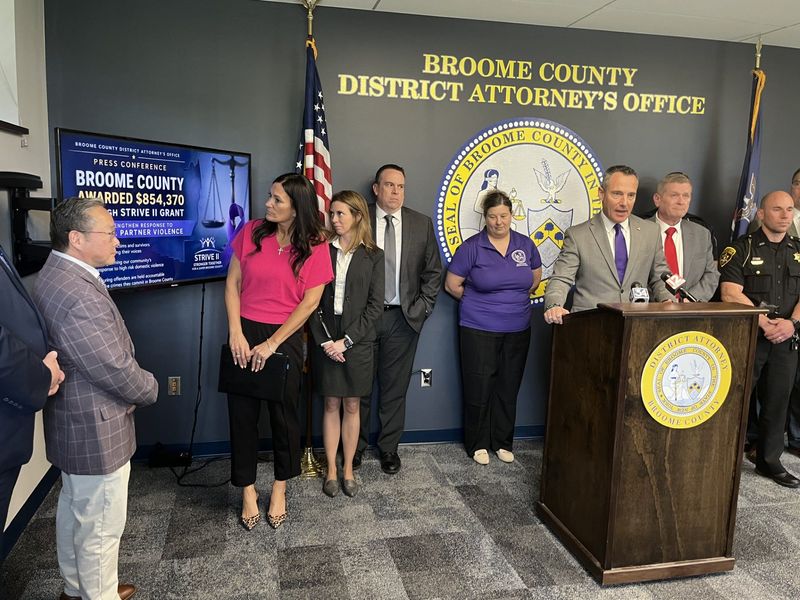
Broome County has received a $854,370 grant to combat intimate partner violence.
The grant is the second of its kind, received through the State Targeted Reductions in Intimate Partner Violence initiative, or STRIVE, and has been termed “STRIVE II” for 2026.

At a press conference on April 23, Broome County District Attorney Paul Battisti said STRIVE II will help aid investigations, prosecution, advocacy, rehabilitation and offender accountability in 2026 for cases involving domestic violence. The $854,370 is an increase from the grant in 2025, which totaled about $740,000.
The funding, which was received April 1, has been allocated among agencies across the county, with $178,000 going to the Binghamton Police Department, $206,000 to the DA’s office, $34,000 to Broome County Probation, $30,000 Broome County Sheriff’s Office, $343,000 to the Broome County Crime Victims Assistance Center, $23,000 to the Endicott Police Department, $25,000 to the Johnson City Police Department and $11,000 to the Vestal Police Department.
The money is being used for various purposes, one of which is the training of all law enforcement officers in the county on the STRIVE initiative, according to Battisti. Every member of law enforcement in Broome County including patrolmen, deputies and members of the New York State Police has been trained by certified trainers in lethality assessment, a tool launched to help identify domestic violence survivors at higher risk of domestic homicide and connect them with support services.
“This initiative prioritizes engagement with survivors, and our goal is not only to respond to violence, but to prevent it and empower those who are affected so they can find safety and stability,” Battisti said.
Allocation of funding
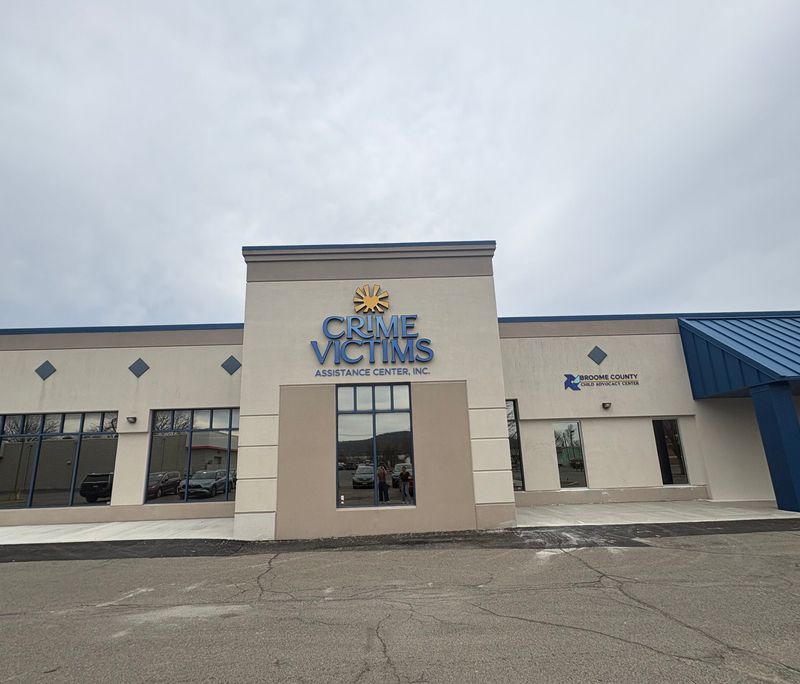
The Crime Victims Assistance Center recently moved to a new facility at 71 Robinson St. to provide crime victims with services including counseling, legal advocacy and crisis support. With the STRIVE II grant funding, CVAC will be able to increase its programming and support members of its staff, according to CVAC Executive Director Christine Battisti.
At the press conference, Christine Battisti said the money will be used to continue supporting additional staff hired by CVAC including a long-term therapist and Director of Intimate Partner Violence Programs at the Broome County District Attorney’s Office Kristin Beylo, who was first hired using funds from STRIVE in 2025. It will also be used to support the on-call, after-hours operation run by CVAC for the lethality assessment program.
Christine Battisti said CVAC has hired a full-time STRIVE intervention education coordinator who will be going out into the community to train other agencies on the lethality assessment program. The center will now be able to offer three offender accountability courses by next month.
“It shows the community that we will hold offenders accountable, but it’s also a strong message to victims – that they’re believed, that they’re supported and that there’s consequences for these behaviors,” she said.
As for law enforcement, Johnson City Police Chief Brent Dodge said the grant money allows for more “intense follow-up” on domestic violence investigations and creates a better link between police and advocates to help victims recover and give their testimony.
STRIVE funding has allowed the Johnson City Police Department to create a new “soft interview room,” designed to support victims and witnesses with a “safe, calm and welcoming environment for sensitive interviews,” according to a JCPD Facebook post.
The room, which was unveiled on Jan. 15, has helped police secure “better depositions and stronger cases,” according to Dodge.
Broome County Director of Probation Kurt Zumbach said the use of the lethality assessment program has helped probation officers identify “high-risk domestic violence offenders” and create “conditions of probation needed to ensure compliance.”
CVAC’s offender intervention groups have allowed people convicted of domestic violence crimes that are on probation to “get treatment for their actions,” Zumbach said.
“This treatment hopefully can create change in the offenders’ thinking process and create lasting effects for the community,” he said.
Funding for the probation department will go toward placing electronic monitoring on all STRIVE offenders to ensure orders of protection are enforced. This, along with “strict supervision” including home and office contacts, will help “enforce the rules of the program.”
Beylo, whose position was created through STRIVE funding in 2025, said she helped conduct a survey of about 400 survivors and victims of intimate partner violence in the beginning of 2026 who provided their opinion on possible uses for the grant money.
This initiative has created “multiple pathways” for victims of domestic violence and this input, according to Beylo, has been “the cornerstone and the foundation” of the program in 2026.
“We promised last year that we would listen to victims and that we would do our work based on how victims and survivors wanted it to be in Broome County, and I’m really proud to say that we kept that promise,” she said.
This article originally appeared on Binghamton Press & Sun-Bulletin: How Broome County is using $850K to hold domestic violence offenders accountable
Reporting by Jillian McCarthy, Binghamton Press & Sun Bulletin / Binghamton Press & Sun-Bulletin
USA TODAY Network via Reuters Connect