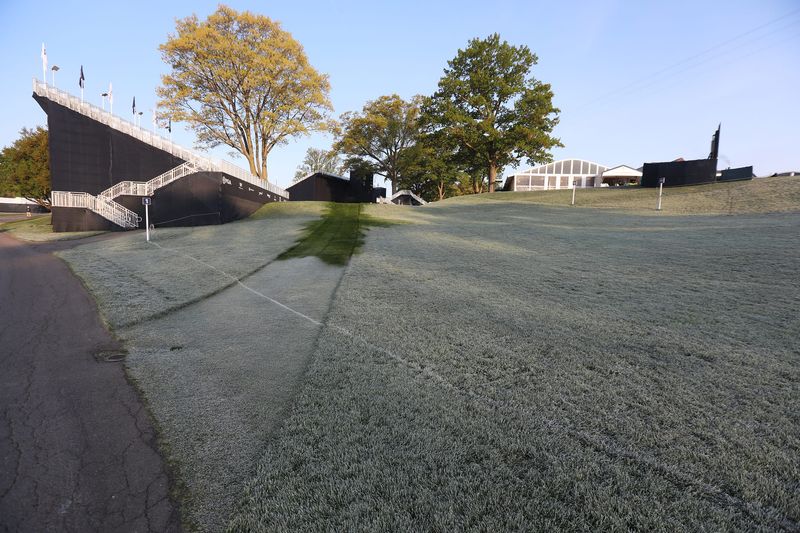
Freezing overnight temperatures have arrived, blanketing yards in a hoary frost.
The only place those chilled tendrils of ice crystals may not form in nature? Underneath a tree.

How frost forms
Frost is the formation of thin ice crystals on the ground and over surfaces, according to the National Weather Service. It’s tied closely to radiational cooling, which is the cooling of the earth’s surface at night. As a result, it frequently occurs when thermometer level temperatures — typically three to four feet off the ground — are in the mid-30s, not even below freezing.
This typically occurs when cold air sinks to ground level on clear, calm nights.
Frost can be formed by either deposition or freezing. Depositional frost, which arranges itself in branching patterns, occurs when the dewpoint is freezing. Frozen frost, or frozen dew, occurs when dew forms at above freezing temperatures, but dropping temperatures overnight cause those dew droplets to freeze.
Why doesn’t frost form under trees?
The evening of Oct. 26 was clear, leaving frost to form under a blanket of stars. Those clear skies are an important ingredient in the formation of frost. As mentioned above, frost is formed by radiational cooling. The greatest amount of heat is lost under clear skies because there’s nothing to stop that transfer of heat from the ground to the frigid expanse of space above.
The same applies to areas under trees; its canopy is warmer than the night sky and less heat is lost from the ground below. This prevents the formation of frost in the area below.
Cloudy skies that prevent escaping radiation are why a snowy night often feels warmer than the clear night that may follow.
Wind also plays a role, as it reduces the formation of frost because it displaces the cold air formed when a surface loses heat.
— Steve Howe reports on weather, climate and the Great Lakes for the Democrat and Chronicle. An RIT graduate, he has covered myriad topics over the years, including public safety, local government, national politics and economic development in New York and Utah.
This article originally appeared on Rochester Democrat and Chronicle: Frost is here in New York. Why it surprisingly doesn’t appear under trees
Reporting by Steve Howe, Rochester Democrat and Chronicle / Rochester Democrat and Chronicle
USA TODAY Network via Reuters Connect