When Will King was hired as director of the Finger Lakes Wine Museum five years ago, he took on the daunting and dusty task of conducting a complete inventory of its collection.
The first museum in the country devoted to wine was founded in 1967 by Greyton and Walter Taylor on the grounds of Bully Hill Vineyards. A 501(c)(3) nonprofit organization, it displays winemaking equipment from the early days of the Finger Lakes wine industry; local memorabilia; artwork by Walter Taylor, founder of Bully Hill; and more.

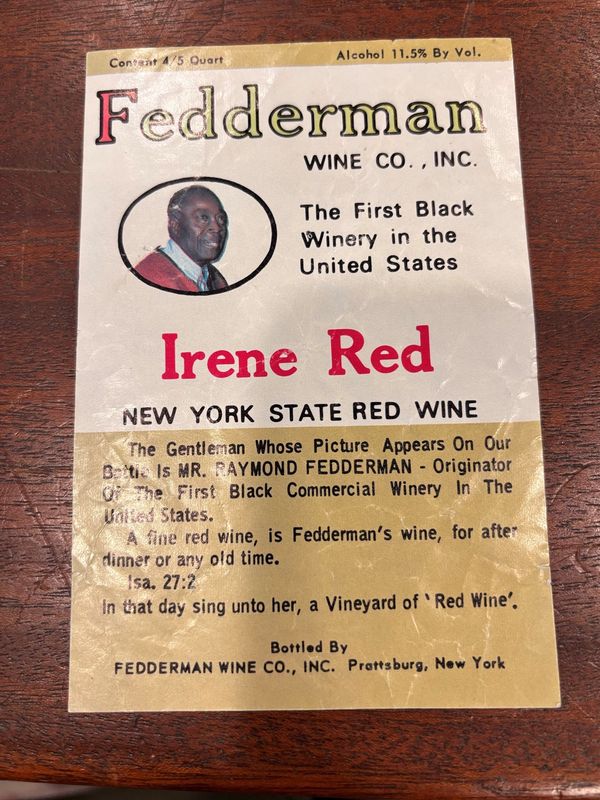
But the museum has much more that’s not on display, including hundreds of bottles of wine. While taking inventory of the bottles, King discovered an interesting half-case. The label was from Fedderman Wine Co. and claimed to be the first Black winery in the United States.
“I was completely unaware of the Fedderman story,” King said, and he started asking around for information. He found that Raymond “Ray” Fedderman was remembered fondly, especially for Irene’s, the restaurant he and his wife owned in Prattsburgh.
Online research revealed that Fedderman was not the first Black-owned winery in the country. Likely unbeknownst to Fedderman, John June Lewis, Sr., established Woburn Winery in Clarksville, Virginia, in 1940, while Fedderman Wine Co. was launched in 1973.
But Raymond Fedderman was likely the second Black winery owner in the United States, and the first in New York. King assumed that Fedderman gave a case of wine to Walter Taylor, who was his friend. Half of the bottles may have been consumed, and the rest eventually found their way into the museum’s collection.
King was convinced that the bottles were historically important, but they were blemished and dirty. “I didn’t feel comfortable putting them on display,” he said. That began a yearslong process of finding a way to preserve the bottles and display them appropriately.
“He’s kind of been forgotten,” said Greg Taylor, vice president and winemaker for Bully Hill. “He was a pioneer.”
The story of Ray Fedderman
According to King’s research and newspaper stories of the time, Fedderman arrived in the Finger Lakes from Virginia in the 1940s to pick potatoes during a harvest at “The Muck,” a large expanse of dark, fertile soil in Potter, Yates County. There, he was asked to bring men up from Virginia to work the farm and to also serve as foreman. He relocated to Prattsburgh in 1952. At that time he managed 200 acres of the farm and ultimately acquired 40 acres of his own. He would eventually open a grocery store, laundromat, janitorial service, car wash and the restaurant.
Fedderman joined the Rotary Club, where he met Walter Taylor and his father, Greyton Taylor. Fedderman and Walter Taylor became friends and discussed the idea of making a wine that would appeal to Black consumers. Fedderman observed the wine operations at Bully Hill Vineyards and also took advice from Richard Vine of the Great Western Winery.
Walter Taylor advocated for Fedderman’s license with governmental agencies and offered to store wine at Bully Hill. Fedderman secured a $350,000 Small Business Association loan through Central Trust Bank in Rochester. He bought vineyards and built a bottling facility near Prattsburgh.
In 1973, Fedderman produced two wines: Irene Red, named after Irene Fedderman, and Rosalind White, named after the wife of plant manager Charles Young, who was also Black. The wines were picked up by distributors in Syracuse; Buffalo; Alexandria, Virginia; and Baltimore, Maryland, but they didn’t sell by the “leaps and bounds as hoped,” according to a Connie Winkler story in the Elmira Star-Gazette.
“We’re so new we’re not even born yet,” was how Young described the situation. “We’re going through the labor pains of the birth of a business. The only thing that’s unique is that it’s a Black winery.” Young had taken a year’s leave of absence from his job at a senior technician at Corning Glass Works to help launch the winery; he returned to Corning but vowed to remain on in an advisory role.
The winery, which sat on 14 acres, had 6 employees. Fedderman had also purchased 20 more acres of land. A new fruit wine, made with watermelons and peaches, was offered to stores for sampling.
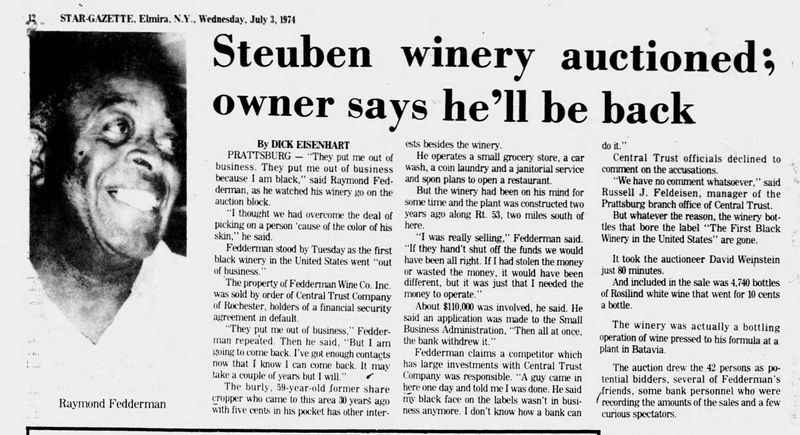
But 1973 would be Fedderman Wine Co.’s only vintage. At some point, the funds promised by the Small Business Association didn’t materialize and the winery was in foreclosure. The operation was sold piece by piece on June 2, 1974, in an auction that took 80 minutes. Among the people in attendance were 42 potential bidders, a few curious spectators and Fedderman himself.
“They put me out of business,” he told Dick Eisenhart, a reporter from the Star-Gazette at the auction. “They put me out of business because I am Black. I thought we had overcome the deal of picking on a person ’cause of the color of his skin.”
“I was really selling,” he said. “If they hadn’t shut off the funds we would have been all right. If I had stolen the money or wasted the money, it would have been different, but it was just that I needed the money to operate.”
In 1976, newspapers reported a curious post scriptum to the story: J. Harold McConnell, 47, of Prattsburgh was indicted by a federal grand jury, accused of making a false notation in the bank records of Central Trust Co.’s Prattsburgh branch while he was a bank manager there. He quit the bank in December 1972. He was accused of indicating that Raymond Fetterman owed the bank $2,850, but Fedderman never owed the bank that amount, according to the indictment. But there was no further coverage of the outcome of the case.
Fedderman vowed to reopen the winery, but that didn’t happen. He died in 1984 at the age of 68.
50 years later, what might have been
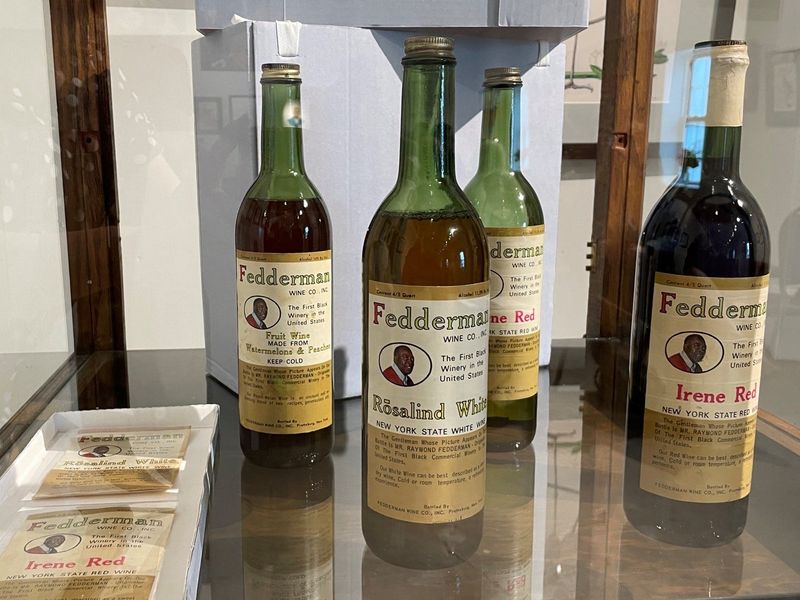
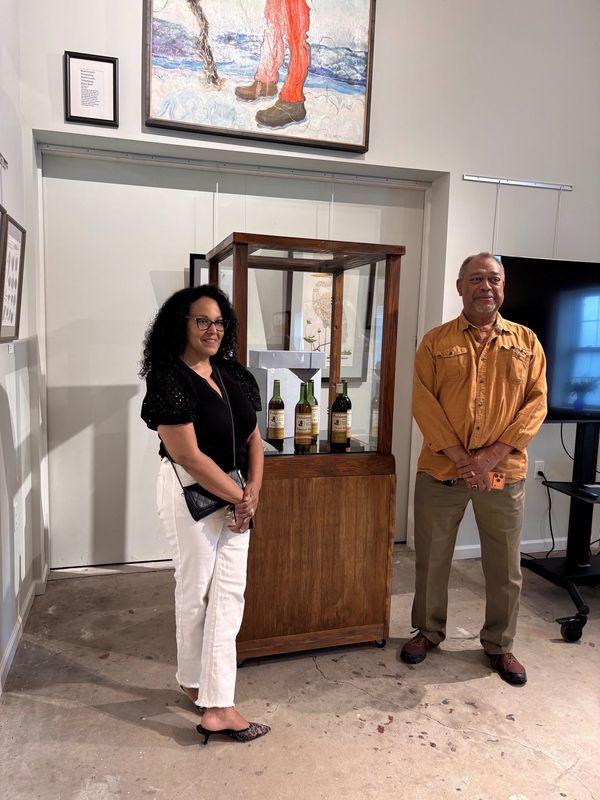
Five Fedderman Wine Co. bottles and two labels were unveiled at the Finger Lakes Wine Museum on June 19, 2026, which coincided with the Juneteenth holiday. Three of the bottles will be kept on permanent display at the museum and the others will be stored as backup.
Priscilla Brendler, executive director of the Greater Hudson Heritage Network, described the convoluted process that was used to get funding to restore the bottles through the Save America’s Treasures grant program. King shared what he knew of Fedderman’s story. Conservator Kate Wight Tyler described the delicate processes she used to clean the bottles and restore the capsule on one of the bottles.
After the presentation, some audience members pointed out that Fedderman’s timing was unfortunate. In 1976, just two years after the foreclosure, Gov. Hugh Carey signed the Farm Winery Act, which allowed New York wineries to sell their own wines and drastically lowered licensing fees.
The legislation spurred a burgeoning wine industry. In 1976, just 19 wineries existed in New York. Today there are hundreds; the New York Wine & Grape Foundation counted 513 licensed wineries in 2024.
Had Fedderman launched his winery just a few years later, the outcome may have been different. But some 50 years after the Farm Winery Act, Black-owned wineries in New York State are still few and far between. New York’s most noted Black-owned winery is Gotham Winery, headquartered in Manhattan. Owned by Kwaw Amos, who is also an investment banker, the winery has a production facility in Branchport, near Keuka Lake, and sources its grapes from New York, California and other states.
It’s been widely estimated that less than one percent of U.S. wineries is Black owned, while Black people represent more than 10 percent of American wine consumers. A 2020 study of black wine entrepreneurs by Dr. Monique Bell of the Craig School of Business at California State University, Fresno, found that 43% of the survey participants, which represented wineries and other wine businesses, said that financial capital was the primary roadblock to their businesses.
If you go: The Finger Lakes Wine Museum is at Bully Hill Vineyards, 8843 Greyton H. Taylor Memorial Dr. in Hammondsport. It is open seasonally; its summer hours are 10 a.m. to 5 p.m. Monday through Saturday and 10 a.m. to 4 p.m. Sunday. Parking and admission are free. 315-403-3628, bullyhillvineyards.com.
Food and drink reporter Tracy Schuhmacher has a Level 3 wine certification with merit from the Wine and Spirits Education Trust and enjoys visiting the Finger Lakes as much as she can. Send Finger Lakes wine story tips to Tracys@Gannett.com.
This article originally appeared on Rochester Democrat and Chronicle: Dusty discovery sheds light on NY’s first Black winery owner
Reporting by Tracy Schuhmacher, Rochester Democrat and Chronicle / Rochester Democrat and Chronicle
USA TODAY Network via Reuters Connect
By Tracy Schuhmacher, Rochester Democrat and Chronicle | USA TODAY Network