In an advertisement for Gorman’s Minstrels on Aug. 3, 1891, in the Star-Gazette, one of the performances listed was “Reception of the Colored 400.” What did that mean?
I had to look up what the “Colored 400” was because I had never heard of it. Wikipedia explains it as “the Gilded age ushered in the new Black elite, also known as the ‘colored aristocracy,’ the ‘black 400, ‘upper tens,’ as noted by Willard B. Gatewood in his book Aristocrats of Color: The Black Elite, 1880-1920.” Elmira had one, too. Some of the names of local elite were H.H. Brooks, Miss Flora Belle Smith, James Reid, William Condol, Henry Washington, Noal Simons, and Mr. and Mrs. George Hill. I found other “Colored 400” groups in Waverly, Corning, Niagara Falls, Palmyra, and Hornell. All meant to dress up and have fun.

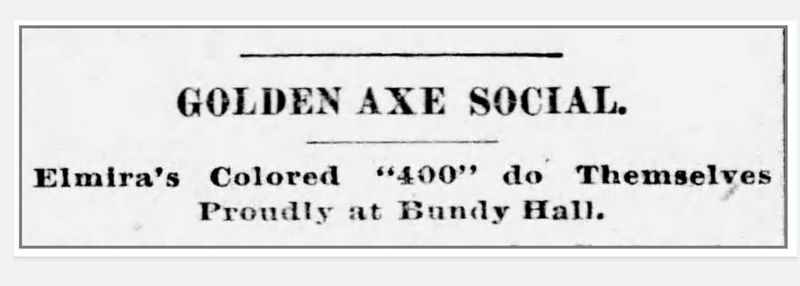
The first mention of a 400 club in Elmira was on March 23, 1893 in the Star-Gazette. The 400 held their first annual ball at Bundy Hall for the Golden Axe Social Club, a society of “young colored people of Elmira.” According to the newspaper the next morning, “The event was a great success, and everyone in attendance had a most enjoyable evening. Seventy-four couples participated in the dancing, and, in terms of style, elegance, and deportment, the reception surpassed many similar events. The ladies were attired in attractive costumes and décolleté. They nearly all wore bunches of roses, or else carried a little bouquet in one hand. The gentlemen were all in full dress. Squire Pine’s orchestra furnished the music. There were many spectators in the gallery, including some of the city’s best-known citizens. The dancing continued until a late hour this morning. Supper was served at midnight at the Davidson House.”
One of the pleasures of these events was a “cakewalk.” It had its roots in the hard days on the old plantations 40 years earlier when enslaved Africans performed dances on plantations mocking the mannerisms of their enslavers. The later Northern adaptation of the cakewalk bears no resemblance to its origins in the antebellum South. Again, I had to find out what a cake walk was. According to Wikipedia, the cakewalk was a dance developed from the “prize walks” (dance contests with a cake awarded as the prize) held in the mid-19th century, generally at get-togethers of enslaved people on plantations before and after emancipation in the Southern United States.
The cakewalks of the 1880s-1900s were an opportunity to win prizes, good prizes, and cash prizes. Black folks came from all around and showed their best clothing and best dance moves. Couples personalized their movements with twists, shuffles, and high kicks. Mark Twain described the cakewalk as, “A competition in elegant deportment.” To me it is reminiscent of the Soul Train line where one had the spotlight for a brief time.
White folks came to eat, sit, and watch the wonderful dancing. Their purchased tickets, along with entrance fees of the contestants, provided the prizes.
Our first local cakewalk sponsored by the 400 was held at Bundy Hall on Nov. 23, 1899. The Star-Gazette mentioned many local cakewalks. On Dec. 29, 1899, it reported that a series of Cakewalks and fancy colored balls were to be held “during the next seven or eight weeks to determine who is the champion cake walker of western NY.” A $100 prize wager was offered – about $4,000 today. “Every available foot of space in the hall and gallery was crowded with spectators.” Gorgeous costumes and fancy steps, gyrations, and sweeping bows were received with enthusiasm as couples tried to outdo each other. The winners of this event were Mr. and Mrs. Hill of Horseheads.
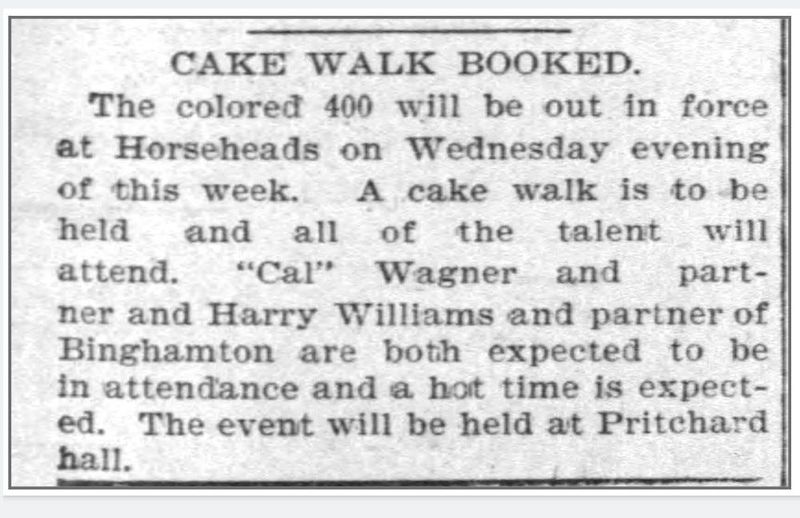
Then on Jan. 24, 1900, the Colored 400 met for a cakewalk at Pritchard Hall in Horseheads. Apparently, “all of the talent attended.”
Again on Oct. 1, 1891, the Colored 400 were in nearby Addison, NY, to celebrate the birthday of Robert Jones, a prominent African American barber. Johnson’s Band of Addison furnished the music. “Refreshments were served to the 400.”
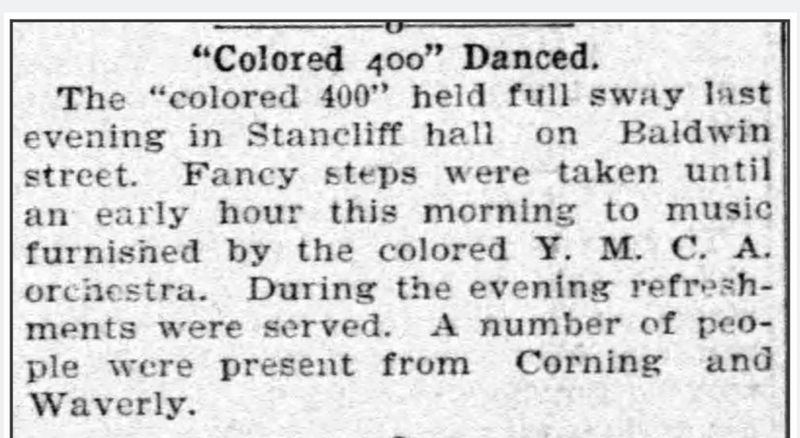
On Thursday, Nov. 28, 1902, the 400 held a fancy evening at the Stancliff Hall on Baldwin Street. The colored YMCA orchestra furnished music. People came from as far as Corning and Waverly.
On Nov. 17, 1910, the Colored 400 enjoyed a dancing party at Waverly’s Masonic Hall. Guests present came from Elmira, Athens, Owego, and Towanda. The last mention of a local cakewalk was on March 18, 1911, in Eagle Hall in Towanda, Pa. It was between two couples that both intended to claim the championship and settle the dispute. There was no follow-up to know who won that event.
— Elmira city historian Diane Janowski writes a biweekly column.
This article originally appeared on Elmira Star-Gazette: Elmira’s Colored 400 put on famed dancing parties | History column
Reporting by Diane Janowski, Elmira Star-Gazette / Elmira Star-Gazette
USA TODAY Network via Reuters Connect
By Diane Janowski, Elmira Star-Gazette | USA TODAY Network