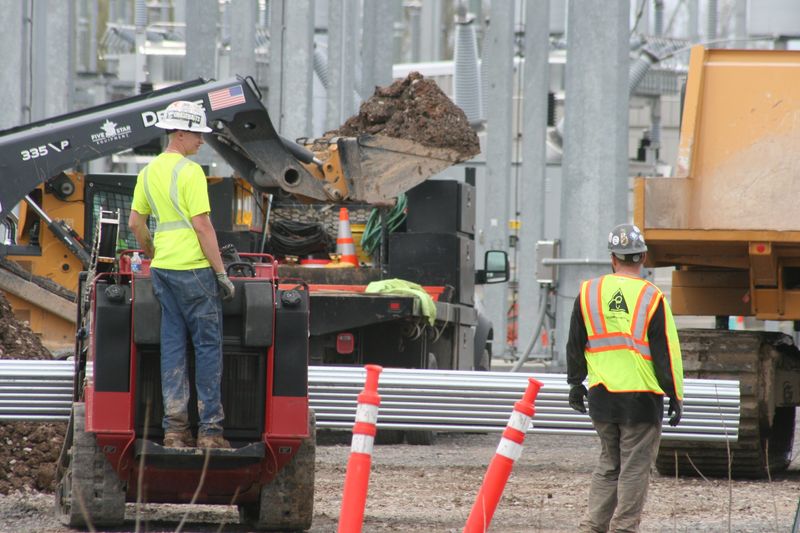
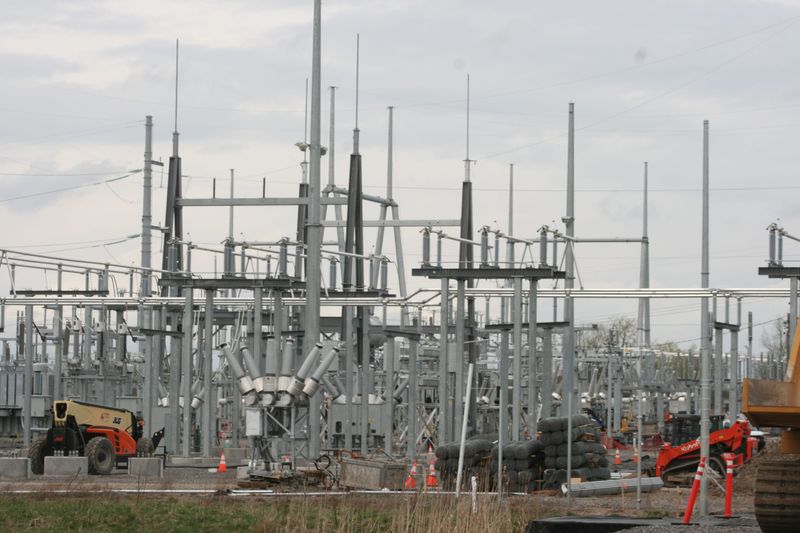
BASOM — Across the road from the finished Edwards Vacuum facility, in a field in Genesee County, a large substation is taking shape.
While crews move dirt and steel in the background on April 16, Stream Data Centers is putting on the media push to defend the 2.2 million-square-foot data center planned for the site. The build would include three buildings on two campuses right near the substation the Dallas-based company has agreed to foot the bill for.

Oisín Ó Murchú, Stream’s chief development officer, framed the local discontent over the project as resistance to the industry, not the company itself. Stream, he argues, shows care for its project in the way it’s built and designed, that the people working there can generate a positive dialogue.
“Some people just don’t want development, so it’s hard to bridge that gap,” Murchú said. “But people that we feel at least come with that mutual respect, we can find common ground with them over time.”
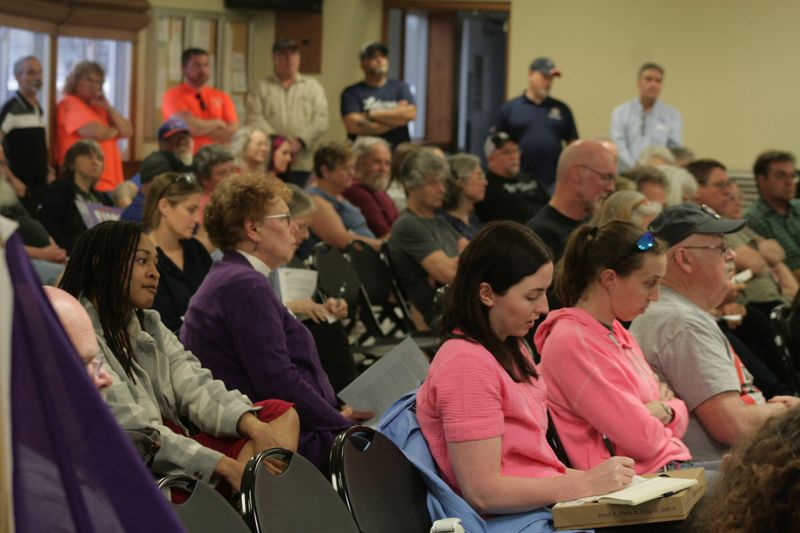
At a public forum in the town of Alabama on $1.4 billion in tax breaks for the proposed data center just hours later, local and regional residents expressed concerns about impacts on water, power, the environment and land occupied by the Tonawanda Seneca Nation.
“Much has been said and written about the economic issues that bear on the proposed data center, but there are huge social and environmental risks at stake. None of those risks will fall on Stream itself. The profits will flow elsewhere, but the risks stay here,” said Frankie Bruno, representing grassroots environmental group Green Orleans.
While data centers of the past were often small and placed unobtrusively in office buildings or business parks, the scale facilities, like the one proposed for Genesee County, require different power demand, land use and tax policy. Stream’s proposed data center complex would claim 500 of the 600 megawatts allocated for the Western New York Science, Technology and Advanced Manufacturing Park, or STAMP.
That’s more than 83% of the complex’s total energy allotment for roughly a tenth of its acreage and just 125 permanent jobs.
Stream officials argue that the imbalance is a positive. Alabama is a small town with limited infrastructure, so a capital-intensive facility with fewer employees but huge investment helps justify the cost of power and utilities before a more labor-intensive venture locates at STAMP. There’s still enough power allocated for nine more Edwards Vacuum-style facilities, the company said, meaning there’s plenty of room for growth.
Murchú balked at suggestions the STAMP site, located at a greenfield development adjacent to Tonawanda Seneca Nation land and the Iroquois National Wildlife Refuge, was an extremely rural site. Located roughly between Rochester and Buffalo, the appeal of a shovel-ready site was a major part of the allure with ready access to water, power and, with a commute of about 45 minutes, workforce.
“I think what we do best at Stream is being able to find great sites that have all those foundational requirements that make sense for this type of development,” said Bradley Wells, site selection and development manager.
Victoria Guite, who lives on the Tonawanda Seneca Nation reservation and is running for state senate, said she has found little common ground between residents she’s spoken with on the campaign trail. One of the few things that seems to cross political ideology is opposition to the STAMP data center.
“The only reason I can think that you would want it there is because of its location, because it’s close to my land, our territory — historically disenfranchised people. And you think that it’s ok to try and get their land polluted? Hasn’t there been enough?” Guite said.
The STAMP site has been approved for data centers since its inception, fitting under the technology manufacturing zoning designation connected to the site. Despite this, the Stream data center project has created a reckoning on the limitations of what the community is willing to support to meet STAMP’s vision.
It’s not just the 2.2 million square feet of facility planned for the site, but the massive tax break incentives being reviewed by GCEDC. The $1.4 billion tax break is designed as a failsafe if the state’s existing tax break policy on internet data centers doesn’t apply to the project, the agency said, and is like deals for manufacturing businesses, which get sales tax breaks on all their equipment under state law.
In addition to the tax breaks on the servers in the data center, Stream is seeking $31 million in mortgage tax abatement. A payment-in-lieu-of-taxes agreement with the town, Genesee County and the Oakfield-Alabama Central School District would pay $285 million over 30 years. That breaks down to roughly $11.7 million in total tax incentives per permanent job at the data center.
GCEDC and Stream remain adamant the huge increase in power demand at the site won’t affect ratepayers, with the New York Independent Systems Operator confirming no impact to grid reliability. The 500-megawatt capacity at the data center complex would be comparable to the residential electricity use in Monroe, Genesee, Livingston, Orleans and Wyoming counties combined. It’s also more than four times the generation capacity in Genesee County.
The substation under construction in Basom will cost more than $100 million but is being paid for by private companies and the agency.
It’s a move that mitigates one of the primary concerns with data centers – ratepayers carrying the burden of infrastructure costs to support massive energy demand. Stream officials outlined the $270 million in sales tax revenue generated from its power usage. But critics of the data center plan don’t think that’s enough to insulate from the cost of that demand.
“Wherever data centers are built, rates do go up. Stream may claim that it will build its own power source, but the local utilities will still need to build up the infrastructure and you’re looking at a room full of people who will bear that cost over a long period of time, because once rates go up, we all know they never come back down again,” said Rev. Barbara Price at the April 16 public hearing.
Residents worried about air quality and noise mentioned concerns about emergency backup systems. The engineering report details two 1250-kilowatt generators and 9,500 gallons of diesel fuel that will be stored in above ground tanks for when power is lost.
Chris Suozzi, GCEDC vice president of workforce and business development, said data centers used to require extensive water use — in the millions of gallons per day. But improvements to cooling technology have created “highly sustainable” closed loop systems.
The only water demand listed in the engineering report is employee use and humidifier consumption, with a maximum capacity of 21,525 gallons for the three-building complex. There will be eight hydrants at the south campus and 16 hydrants at the north campus.
STAMP has been allocated 200,000 gallons per day, with 30,000 of that daily allowance already claimed by Edwards Vacuum.
While a data center can bring the funds to build substations and other critical infrastructure, there is the question of long-term sustainability. While a data center facility could last at least 20-30 years, the constantly updating hardware inside means the economic lifespan is often shorter, just 10-15 years.
“There’s a threat, a risk that if the data center pulls out and goes to a different area because something has changed, maybe tax incentives or XYZ, that now this community has this huge infrastructure that’s been built, and now the cost will be imposed on them,” said Kerri Hickenbottom, a professor of chemical and environmental engineering at the University of Arizona, at a SciLine media briefing on April 22.
There are plenty of cautionary tales in other large-scale industries that developed in a short period of time, said Lauren Withycombe Keeler, a professor at the School for the Future at Arizona State University at the SciLine briefing. One lesson is the need for policy, monitoring and meaningful consequences.
“I think having a model of self-monitoring without external guardrails has not proven to work when we look at things like the fossil fuel industry, the chemical industry, for example,” Keeler said.
Pushback to large-scale data centers isn’t unique to Western New York or the Stream project. A recent analysis by Heatmap found 270 data centers have faced opposition nationwide, a number greater than those opposing onshore and offshore wind turbine projects.
The tremendous growth in artificial intelligence has led to some of the attention and pushback — there are now more than 4,100 in the United States alone. Data centers are the facilities where the data storage systems and servers that power artificial intelligence, cloud computing and similar technology.
Another concern echoed at the public hearing was the ownership of Stream, which was acquired by Apollo Global Management last fall. This April, Apollo president Jim Zelter said the trillions investors have poured into artificial intelligence won’t necessarily translate into the returns investors expect. The firm has faced investor lawsuits and public scrutiny due to associations to disgraced financier and convicted sex offender Jeffrey Epstein.
“Billionaires and massive corporations are currently calling the shots and they are coming into Genesee County, not to benefit the people of this region, but to make billions,” said Patrick Mahoney, a Buffalo resident who spoke at the Alabama public hearing.
On the ground in Genesee County, Murchú emphasized the benefits Stream has already provided to the community even before the project has been approved. That includes $50,000 to the Oakfield-Alabama Central School District for its elementary school enrichment program, paid agricultural internships and purchase of a CNC plasma machine.
“One of the things I love about the work we do and I’m really proud of is our development team really care about what they’re doing and they really genuinely care about the communities they come into,” Murchú said. “So we find ways to proactively invest in the communities even before the project is getting out of the ground.”
Despite Stream’s promised aid and investment in Genesee County, local residents and those in the broader region remain skeptical or in full-on opposition. The ranks of those opposing include the Monroe County Legislature majority caucus and two members of the Rochester City Council.
A bill for a three-year moratorium on data center development from state Sen. Liz Krueger is sitting in committee after being introduced in February. The legislation would freeze state and local approvals until new regulations on the industry are established. The moratorium would affect data centers with energy consumption greater than 20 megawatts.
“This is simply a pragmatic decision to put a pause because we simply need to catch up and make common sense regulations,” Assemblymember Anna Kelles said in a February press conference.
While driving away from the under-construction substation, a killdeer launched into the air from the shoulder of the access road, powering over the still vacant field. The future of that field will be closely watched by many stakeholders — with consequences well beyond the decision made.
— Steve Howe reports on suburban growth, development and environment for the Democrat and Chronicle. An RIT graduate, he has covered myriad topics over the years, including public safety, local government, national politics and economic development in New York and Utah.
This article originally appeared on Rochester Democrat and Chronicle: Data center’s power demand drives backlash in Genesee County
Reporting by Steve Howe, Rochester Democrat and Chronicle / Rochester Democrat and Chronicle
USA TODAY Network via Reuters Connect