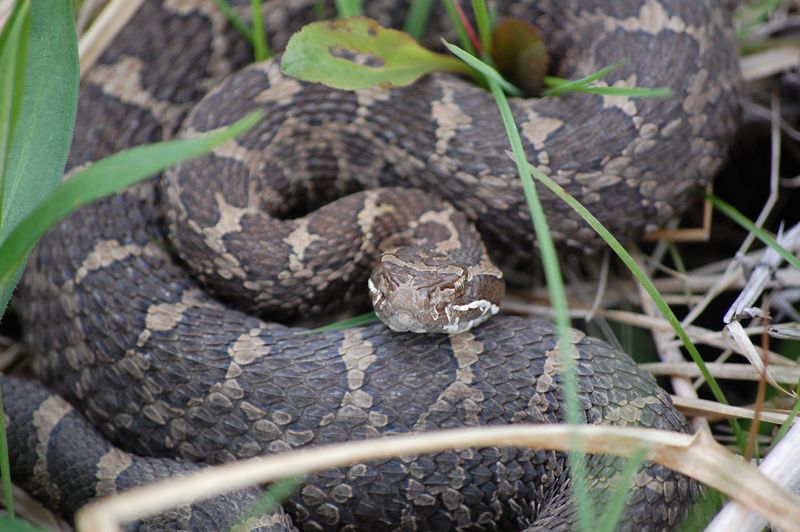
Seventeen snake species reside in New York state, including three types of venomous snakes.
While they aren’t incredibly common, the timber rattlesnake, Eastern massasauga and Northern copperhead can be found in specific parts of the Empire State, according to the New York State Department of Conservation. Of note, the most frequent and widely encountered snakes in New York are the water snake and garter snake.

Snakes play a critical role in their environments, primarily by their position within the food chain, as predators and within natural communities, according to the SUNY College of Environmental Science and Forestry.
Here’s more about the trio of venomous reptiles and where you can find them:
Timber rattlesnake
According to the DEC, the timber rattlesnake is the largest venomous snake in the Empire State. A member of the pit-viper family, the timber rattlesnake typically measures 3 to 4 feet long. It primarily eats squirrels, chipmunks, voles, mice, small birds and amphibians.
The venom, which is used primarily to immobilize prey, can be fatal to humans if the bite is untreated. However, in New York there have been no records of human deaths attributed to rattlesnakes in the wild during the last few decades, according to the DEC.
Timber rattlesnakes are mostly located in southeastern New York, the Southern Tier and on the edges of the eastern Catskills and Adirondacks. Timber rattlesnakes are generally found in deciduous hardwood forests in rugged terrain, according to the DEC.
New York considers the timber rattlesnake a threatened species, in part due to unregulated collection, indiscriminate killing and habitat destruction, according to the DEC.
Eastern massasauga rattlesnake
The adult massasauga, also known as the “swamp rattler,” is a stout-bodied snake with a broad head and frequent wet, lowland habitats, including marshes and floodplains, according to the DEC. It measures 18 to 40 inches in length, though the average length is 27.5 inches. The massasauga primarily eats small rodents, but may also take a variety of small animals including other snake species, shrews and an occasional frog or bird.
Within New York, this snake is found in large wetland areas – one is northeast of Syracuse and the other is west of Rochester. They are normally active during daylight hours
New York considers the massasauga an endangered species, in part due loss of habitat to development, agriculture, unregulated hunting and snake collecting, according to the DEC.
Northern copperhead
The most common of the three venomous snakes of New York, the copperheads are found in the lower Hudson Valley and throughout the Catskills, according to the DEC. Copperheads are named for their distinctive rust-colored heads, which, like all pit vipers, are wide and triangular. The average adult copperhead is around 3 feet long.
Copperheads are most at home in rocky and wooded areas and often lurk under woodpiles and leaf litter on the forest floor, according to the World Atlas. Copperheads are able to survive in close proximity to humans due to their cryptic coloration and secretive, frequently nocturnal behavior, according to the DEC. In New York, their status is considered secure.
Copperheads bite more people than any other species of snake in the nation, but they aren’t necessarily more aggressive. They are often stepped upon accidentally. Their venom isn’t particularly toxic; a bite can be quite painful but is rarely fatal, according to the World Atlas.
This article originally appeared on Rochester Democrat and Chronicle: 3 venomous snakes live in NY. Here’s where they’re found
Reporting by Victoria E. Freile, New York Connect Team / Rochester Democrat and Chronicle
USA TODAY Network via Reuters Connect