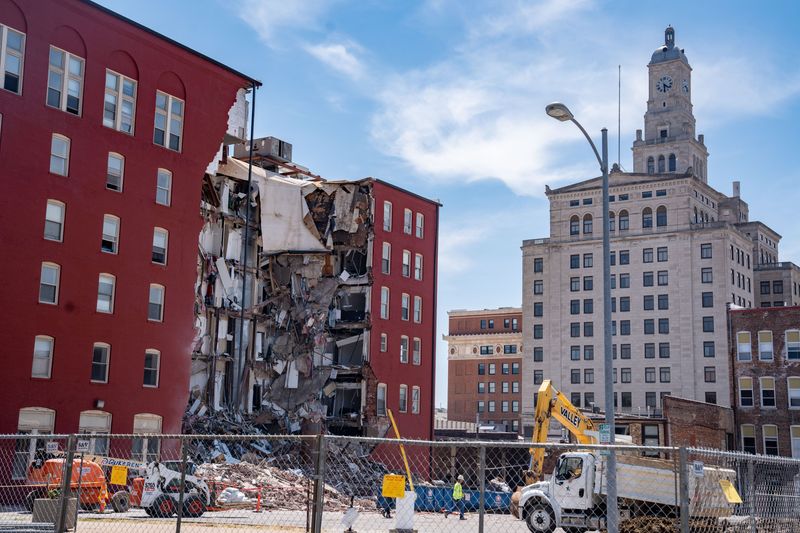
The Iowa Supreme Court cleared the way for dozens of people affected by a 2023 fatal building collapse to continue their lawsuits against the City of Davenport.
The May 2023 disaster saw a portion of a historic downtown building known as the Davenport Hotel crumble. Three residents died, another was severely injured and had her leg amputated, and dozens more had to evacuate and lost all their possessions. The structure has since been demolished.

Subsequent lawsuits accuse Davenport city officials, building owner Andrew Wold and other businesses and contractors of wrongdoing leading to the collapse. The cases have been on hold since June 2024, after the city appealed a preliminary ruling denying its motion to dismiss its part of the case.
The Supreme Court’s Nov. 7 order will let the case move forward again. The unanimous court, with two justices recused, agreed the city is not entitled to dismissal under a recent state law because it doesn’t apply to the plaintiffs’ claims.
At issue is Iowa’s 2021 “Back the Blue” law, which codified a “qualified immunity” for government officials accused of misconduct unless their actions violated “clearly established” law. The law specifically requires that plaintiffs show the alleged violation was clearly established in their initial complaint, or else face mandatory, permanent dismissal of their claims.
Davenport officials are accused of numerous missteps leading to the collapse, including repeatedly failing to post notices informing residents of orders to vacate the building because of structural concerns.
The city had asked the district court to dismiss those claims for failing to meet the new law’s pleading requirements, while the plaintiffs argued the law did not apply to their cases and, in any event, they had included the necessary information in their complaints.
Despite the long wait, Friday’s ruling is anticlimactic: Justice Matthew McDermott wrote that the court has recently resolved the same question in two other cases, finding both times that the qualified immunity law only applies to statutory or constitutional claims, not to general torts such as negligence.
The same result applies here, McDermott wrote.
Davenport had also asked the court to review the judge’s ruling that, at least at this stage, the city is not protected by a seperate legal rule known as the public duty doctrine. The court declined to take up that part of the appeal, leaving the lower court’s ruling in place as the case proceeds.
Attorney Andrew M. Stroth, representing the plaintiff who lost her leg and that plaintiff’s wife, praised the team’s appellate counsel for their work and said his clients are heartened by the court’s ruling.
“Peach and Lexus Berry have seen some very dark days, and Peach and Lexus are still recovering from the 324 Main tragedy,” Stroth said in an interview, referring to the building’s address. “They just shared with me, this decision reinforces and reinstills in them that there’s some hope and light in this tragedy. … The city of Davenport, Andrew Wold and others are responsible for Peach Berry almost dying and losing her leg. They look forward to the city ultimately being held accountable.”
Bruce Braley, an attorney representing the families of deceased residents Daniel Prien and Ryan Hitchcock, also praised the ruling and said his clients have been “patiently waiting” to move forward with their case.
“(The families) applaud the Iowa Supreme Court for recognizing that the Qualifed Immunity statute was never intended to apply to claims of ordinary negligence involving city officials,” he said. “They are anxious to move forward with their case and to take depositions of city employees who had a role in this tragedy.”
Attorneys for the city did not immediately return messages seeking comment.
William Morris covers courts for the Des Moines Register. He can be contacted at wrmorris2@registermedia.com or 715-573-8166.
This article originally appeared on Des Moines Register: Victims can sue Davenport over 2023 fatal building collapse, Supreme Court rules
Reporting by William Morris, Des Moines Register / Des Moines Register
USA TODAY Network via Reuters Connect