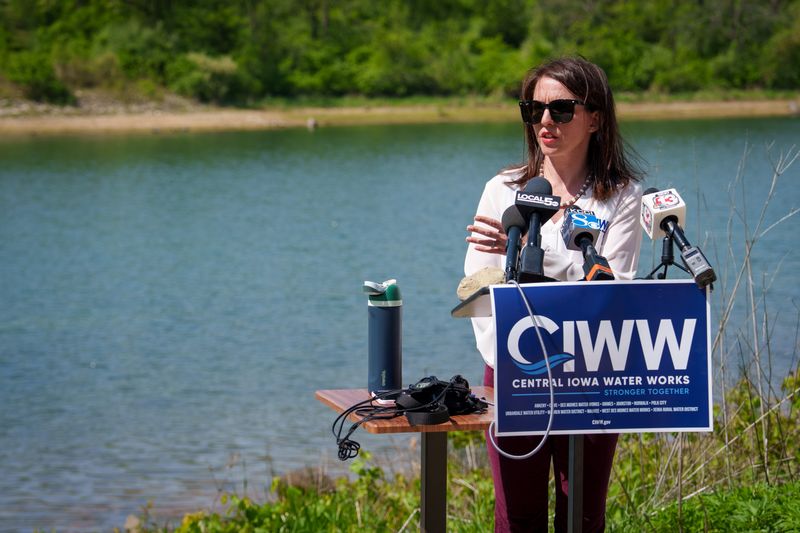
Central Iowa Water Works is once again asking Des Moines metro residents to voluntarily cut their outdoor water use by 50% as nitrates in the region’s drinking water sources spike.
The regional authority’s request Wednesday, May 27 ― effective immediately ― is in “response to increased water demand, persistently high nitrate concentrations in source waters, and ongoing operational strain on the regional water treatment system,” it said in a news release.

“Central Iowa continues to face significant water quality and operational challenges,” Tami Madsen, CIWW’s executive director, said in the release. “Additional conservation efforts are necessary to help reduce stress on the system and support reliable drinking water service for the region.”
CIWW warned earlier in May that a mandatory lawn watering ban, like one imposed last June and July, would be possible as the nitrate levels in the Des Moines and Raccoon rivers climb and summer demand, driven mainly by lawn watering, rises.
But Madsen told the agency’s board at a regularly scheduled meeting following Wednesday’s announcement that “we’re in a really good spot to move slowly through this.”
Kyle Danley, chief operating officer for CIWW member Des Moines Water Works, concurred, telling the board he thinks that with voluntary cuts to watering, another mandatory ban can be avoided for now.
The request for watering reductions comes as central Iowa temperatures are forecast to be in the mid-80s over the next eight days or more. With little chance of rain, “demand (for water) is up,” Danley said. At the same time, he said, “We’re also seeing nitrates continuing to climb in our source waters.”
“Hopefully our customers will respond to this,” he said.
The nitrate level in the Raccoon River on Wednesday was 17.17 milligrams per liter, and 10.4 in the Des Moines River. The federal government limits nitrate levels in drinking water ― mainly resulting from farm runoff ― to 10 milligrams per liter.
High levels of nitrates can cause illness in infants and may be linked to some cancers.
Nitrate levels usually rise in warmer months, but they’ve been high almost all of this year. Des Moines Water Works has had to run its nitrate removal plant, one of the largest anywhere, since March 6. Before that, it ran from Jan. 6 to March 9.
The ban last year was necessary to preserve the plant’s capacity to supply water for essential needs.
CIWW said it and its member agencies continue to meet all federal and state safe drinking water standards, and all seven regional water treatment plants remain in operation.
The call for voluntary water restriction comes as Gov. Kim Reynolds announced in May that the state will give CIWW a $25 million grant to expand and upgrade its nitrate removal facilities, part of a statewide overhaul of Iowa’s water quality funding.
CIWW customers are encouraged to:
The agency also encourages customers to follow the regional watering schedule of even-numbered addresses Sunday, Wednesday and Friday and odd-numbered addresses Tuesday, Thursday and Saturday.
Most lawns do not require watering on all three days and may remain healthy with substantially less irrigation, CIWW said. It added that customers are strongly encouraged to avoid watering on Mondays because of high regional demand.
Waukee said in an online newsfeed that to save water, it temporarily is reducing the hours at its Westown Meadows Park spray ground to 2-7 p.m. until conditions improve. It said the Fox Creek Splash Pad has a recirculation system to treat and reuse water and will continue its usual 9 a.m.-7 p.m. schedule.
Customers can learn more about the Water Use Plan and water conservation measures by visiting CIWW.gov and following CIWW on Facebook or LinkedIn.
Donnelle Eller covers agriculture, the environment and energy for the Register. Reach her at deller@registermedia.com.
This article originally appeared on Des Moines Register: As nitrates rise, Central Iowa Water Works asks for watering reduction
Reporting by Donnelle Eller, Des Moines Register / Des Moines Register
USA TODAY Network via Reuters Connect