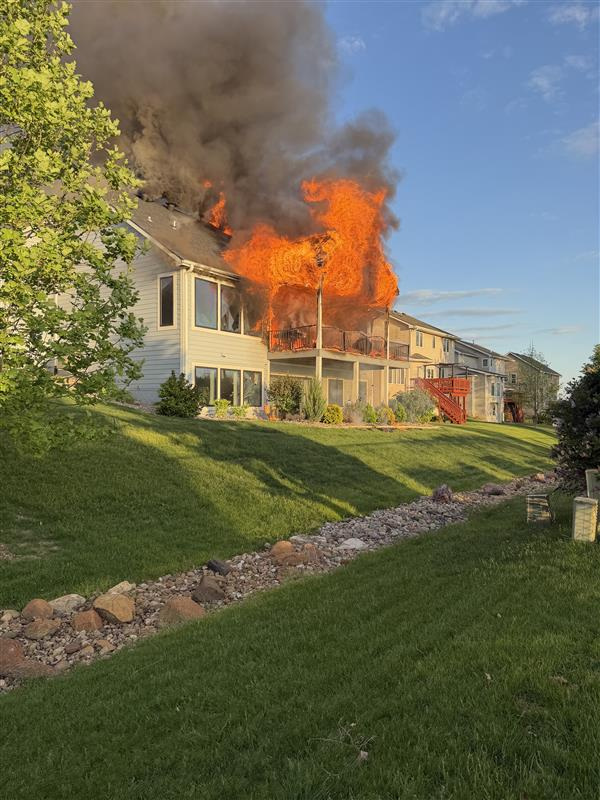
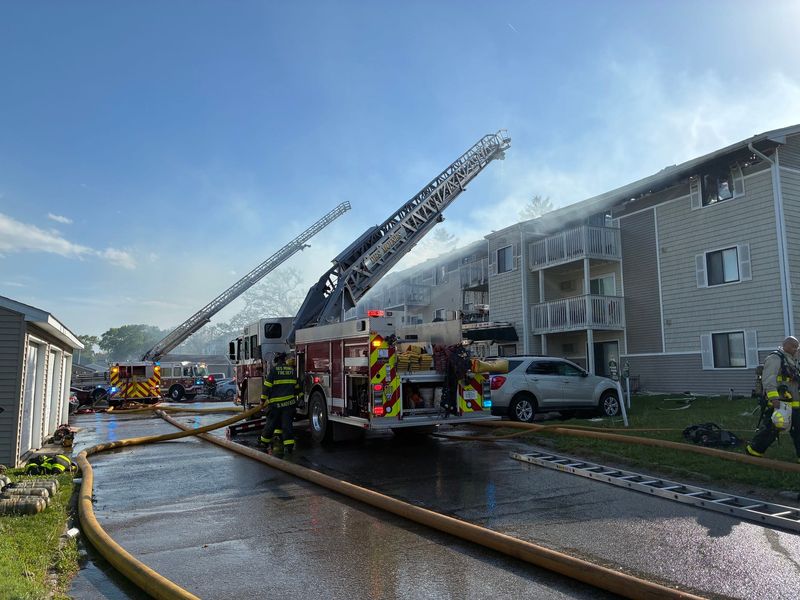
An influx of fires in the Des Moines metro has devastated several homes and apartment buildings since the beginning of May. Residents have been displaced, pets lost, and residences deemed as total losses.
While five separate house and apartment fires occurred within the first two weeks of May, the “timing of the fires is purely coincidental,” according to Jonathan Lund, the chief of the Des Moines Fire Department.

“In my experience, throughout my career, simultaneous fires or clusters of fires are typically coincidental,” he said in an interview with the Register.
Fires in the Des Moines metro are not tied to a certain time of year, Lund said, although more heating fires are reported in the winter and more exterior fires in the summer.
“The reality is the number of fires that we have is relatively consistent year to year,” Lund said.
Jeremy Cross, the fire marshal with the Norwalk Fire Department, said, “In my eyes, I do see it as odd that we’ve had this many structure fires. … It’s just unfortunate that they all happened around the same time frame.”
Fires across the metro claimed multiple homes in less than a week
May 10: A fire left a home on Ridgedale Court in Johnston a total loss. The home’s sole resident was saved by a 17-year-old who was golfing with his parents for Mother’s Day. Crews saved a cat that was found safe in the home’s basement. The fire started on the home’s balcony, and an explosion from a propane tank spread the fire. This was the second fire at this address, the other also a total loss around four years ago.
May 11: A house fire on Pennsylvania Street in Carlisle was called in to the Carlisle Fire Department. The home’s residents were evacuated, and crews recovered one kitten in the home’s basement.
May 11: A home on Chance Court in Adel was left uninhabitable after a fire started in the back of the home before it spread throughout. No injuries were reported. One dog died in the fire, and responders rescued three others.
Two apartment fires displace dozens of residents just days apart
May 4: A fire at the Evergreen Terrace Apartments complex on the south side of Des Moines displaced around 70 residents and left the building a total loss. The Des Moines Fire Department responded to the fire at around 4:15 a.m. and deemed it under control four hours later. The 30-unit apartment building, built in 1977, was not equipped with sprinklers.
Lund said a preliminary investigation indicates the fire started on an upper-level balcony of the apartment building, indicated by burn patterns and how the fire spread.
May 7: A midnight fire claimed an apartment building of the Country View Apartments complex in Norwalk. The fire, which started on the exterior of the northwest corner of the affected building, was under control at around 1:30 a.m. Twenty-two residents were displaced as a result of the fire. Five cats were rescued. The 24-unit apartment building, built in 1995, was equipped with interior sprinklers.
The fire remains under investigation, but the building is “a loss, and it has been turned over to the insurance company of the owner of the building,” Cross said.
Does Iowa fire code require sprinklers in apartment buildings?
Iowa adopted the provisions of the International Building Code of 2009 in 2011, which requires sprinkler systems for newly built structures like apartment buildings. The provisions do not, however, require structures built before that time to be brought up to new standards.
“Whenever a building is built, it has to be in conformance with the code that’s adopted at the time it’s built,” Lund said. “And as long as it is continually occupied as an apartment building, it doesn’t necessarily ever have to be updated.”
Evergreen Terrace Apartments, for example, was up to code when its buildings were built in 1977, and were not required to become compliant with the recent code that requires fire sprinklers.
But when a building changes usage, it must be brought up to the most recent code.
“Maybe I changed an apartment building to a school or an office building. Now I have to bring it into conformance with current code at the time of that change,” Lund explained, adding that if a building is overhauled or an addition is added to an older building, the rest of the building would likely have to be brought up to current code, as well.
“Generally speaking, the codes don’t allow you to make a condition worse,” Lund said.
Iowa operates under the 2024 International Fire Code as the state’s de facto code. Local jurisdictions may have amendments to the code that better fit local needs.
“For instance, Des Moines is really the only city with high-rise buildings … so we have some requirements for high-rise buildings that are different than some of the suburban municipalities,” Lund said.
While not all buildings are required to install sprinklers, the systems are an integral part of preventing fires from growing out of control.
In a May 2 fire in Des Moines, sprinklers “helped delay the fire spreading and our firefighters did the rest leaving limited damage to the building, and allowing residents to remain in the building,” according to a social media post from the Des Moines Fire Department.
The Evergreen Terrace apartment building in Des Moines, deemed a total loss, was not equipped with a sprinkler system. Country View Apartments in Norwalk was equipped with a sprinkler system, but not in the building’s attic space.
“A sprinkler can activate in 60 to 90 seconds and keep the fire in check until the fire department can respond and put the fire out,” Lund said.
What are common causes of fires? How can I prevent house, apartment fires?
Common causes of house fires are dryers and other home appliances, direct fire exposure and heaters, according to the U.S. Fire Administration.
But the number-one cause of house fires is “cooking, specifically, unattended cooking,” Lund said. “That is one of the most frequent causes of fires in Des Moines and throughout the country.”
Unattended fire sources, such as candles, fireplaces, or fire pits, are also leading contributors to house fires.
Homeowners and apartment renters should regularly clean out the lint in their dryers, as well as not leave open flames unattended. Outlets should not be overloaded, and extension cords should not be used for major appliances like washers, dryers and refrigerators.
“We gotta make sure that we’re being smart with whether we’re leaving the stove on unattended,” Cross said. “The same with your outside recreational fires, you can’t leave them unattended.”
The Des Moines Fire Department offers community education programs that teach about fires and their causes, what to do in a house fire, and evacuation tips.
Homeowners should also regularly check their smoke detectors to make sure they work properly.
“It’s really important to have a working smoke alarm in every bedroom, every place, everywhere somebody sleeps and immediately outside of it,” Lund said.
Cross urges apartment complex owners to make sure annual inspections are completed and that their buildings comply with the regulations of the National Fire Protection Association, including testing sprinkler systems and having up-to-date fire extinguishers and smoke detectors.
“There’s a common misconception that ‘fire won’t happen to me,'” Lund said. “We all think about that. It’s infrequent to the point where that’s the common opinion. We just encourage people to be prepared for it.”
Kyle Werner is the breaking news and public safety reporter for the Register. Reach him at kwerner@registermedia.com.
This article originally appeared on Des Moines Register: House fires in Des Moines metro ‘coincidental,’ fire departments say
Reporting by Kyle Werner, Des Moines Register / Des Moines Register
USA TODAY Network via Reuters Connect