In May 2025, Des Moines Public Schools Superintendent Ian Roberts had a new money-making idea.
Roberts, who would be arrested by immigration officials and accused of lying about his legal status on employment paperwork four months later, wanted to publish a book. But unlike some books, this one wouldn’t require much new material.

Roberts, who resigned from the district after his September 2025 arrest, proposed compiling the motivational emails he often sent DMPS teachers and staff, pulling the grist together into something profitable. But he wasn’t sure his concept was a good idea. For advice, he turned to Nicole Price, his professional partner.
Receiving Roberts’ email, Price turned to an artificial intelligence chatbot. The next day, she forwarded the chatbot’s response to Roberts. The chatbot had good news.
“Absolutely,” the AI system wrote, according to emails that the Des Moines Register recently obtained. “His weekly messages could form the backbone of a powerful and compelling book.”
In particular, the chatbot said, Roberts’ writings included the “unique selling point” of “lived leadership experience, Olympic discipline, and radical empathy in public education.”
Roberts, who represented Guyana in the 2000 Olympic games, was pleased.
“Yaaaaaay!” he wrote.
The superintendent asked Price some follow up questions. Price asked the AI system, which spit out suggestions about how he could structure the book.
“I can see this selling well amongst district and school leaders if marketed well,” Roberts wrote in an email to Price.
With the wind of the chatbot’s encouragement at their backs, Roberts and Price began to work on “Unshakable: How Bold Leaders Win Hearts, Inspire Minds, and Obtain Results During Crisis.”
They released the self-published book in late April while Roberts was incarcerated at the Polk County Jail, awaiting a sentencing hearing after pleading guilty to federal charges of illegal firearms possession and lying on employment paperwork.
U.S. Customs and Border Protection officials arrested Roberts in September, revealing that he lacked work authorization throughout his tenure atop Iowa’s largest school district. Federal prosecutors said Roberts falsely claimed to be a U.S. citizen on employment paperwork and gave DMPS officials a copy of a fake Social Security card.
Roberts relied on synthetic material throughout his time at the district, the emails recently released through Iowa’s open records law show. In addition to using AI to determine whether writing a leadership book was a good idea, Roberts relied on the technology to write emails, write speeches, make presentations to the DMPS School Board and answer interviewers’ questions.
At times, according to the emails, the AI chat edited the writing that he submitted to price for review. Other times, he received full outlines for speeches and answers to interview questions from the chatbot. According to the records the Register received from DMPS, Price relayed Roberts’ AI questions to the bot and gave him the information it provided.
His reliance on AI came as educators around the country fretted over how to deal with students’ use of the chatbots. Some educational leaders have complained that students have become too reliant on the programs, rendering them unwilling or unable to read books, write papers or develop vital critical thinking skills.
Teachers have worked to identify AI use in the classrooms. But at DMPS, these same educators were often receiving AI-written messages from their superintendent. It’s not clear whether teachers detected Roberts’ reliance on artificial intelligence.
Des Moines Education Association President Anne Cross said the district does not have a sweeping policy about the use of artificial intelligence in the classroom. Administrators at individual schools make their own decisions. While educators are still learning the best ways to use AI to help students learn, she said, teachers in the district generally expect their students’ writing to be original.
“If they use AI,” she said, “that work would be considered plagiarism.”
Roberts often used AI assistance to write motivational emails to staff
While Roberts’ past emails make up the bulk of his recent book, “Unshakable” includes a publication’s usual filling: a preface, an introduction, an epilogue and some paragraphs setting up various sections.
When the Register ran the book’s preface through GPTZero, an AI detection website, the system was “highly confident” that artificial intelligence wrote the section. The system reached the same finding when it reviewed the book’s conclusion section and epilogue.
GPTZero was “moderately confident” that artificial intelligence wrote the other parts of the book, concluding that a human wrote a small portion of some sections.
A review of Roberts’ emails reveals a similar pattern.
On Oct. 31, 2023, Price emailed Roberts a speech to deliver to mark his first 100 days as DMPS superintendent. GPTZero was “highly confident” that artificial intelligence wrote the speech. The system reached the same conclusion about a Dec. 3, 2023, speech that Price emailed to Roberts for a ceremony celebrating Hoover High School instructor Ann Mincks’ Iowa Teacher of the Year award.
On Feb. 7, 2024, Roberts sent Price a message that he planned to share with DMPS staff about lay offs. Price replied seven minutes later with an AI-edited draft, which the chatbot said would “maintain a compassionate tone while inspiring hope.”
The AI edits turned “I have made many decisions” into “I’ve navigated many crossroads,” according to the emails. It also turned “This is a matter that impacts more than those who received a pink slip” into “I understand the ripples of concern.”
At other times, Roberts sent Price drafts of the weekly “Gratitude and Empathy” emails that he wanted to send DMPS employees. He told Price to “run this through chat for me.”
Cross, the teachers’ union leader, said many district educators discussed how Roberts’ weekly emails seemed to be “recycled” content from his books and social media messages. She was not surprised to hear that he was using artificial intelligence. She does not think many employees read the emails anyway.
“They were quite long,” she said. “And to be honest, teachers don’t have time to sit down and read all that once a week.”
‘When the polar bear must roam, the ice does groan,’ AI chatbot suggested Roberts tell audience
The emails the Register received show Roberts relied on artificial intelligence to guide public appearances.
The superintendent would often provide updates on district initiatives during School Board meetings. In November 2023, Price sent Roberts an AI-generated presentation.
“It’s designed to keep board members engaged and informed,” the chatbot said, “particularly those who might find it challenging to maintain focus on governance issues.”
In April 2024, Roberts attended the Polar Bear Gala, a fundraiser for North High School. Hours before the event, Price emailed him the outline of a speech suggested by a chatbot.
Roberts wanted to use an adage involving polar bears, the school’s mascot. The chatbot said that polar bears are strong and majestic. But, at the same time, the chatbot pointed out that the animals are vulnerable due to melting ice caps.
The chatbot suggested an adage for Roberts to build his speech around: “When the polar bear must roam, the ice does groan.”
“The newly coined adage … can be a powerful metaphor,” the chatbot said. “This phrase can help illustrate the broader implications of educational policies on children and communities.”
Roberts thanked Price for the suggestion in an email just as the gala was starting. It’s not clear whether Roberts used the adage.
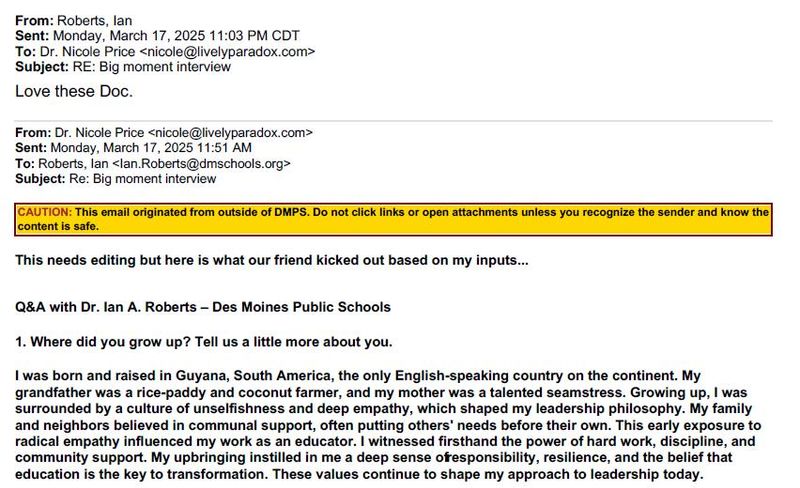
Price also sent Roberts interview answers suggested by an AI chatbot, according to the emails. In one March 2025 exchange, Roberts told Price that he was preparing for a “big” interview.
“I would love to leverage your thoughts on responses to the questions,” he wrote. “Maybe chat’s insights as well?”
About 40 minutes later, she responded, “This needs editing but here is what our friend kicked out based on my inputs.”
“Love these,” Roberts wrote back.
Roberts ignored AI advice to be vulnerable with readers
In their emails, Roberts and Price do not address why the superintendent relied on Price to use artificial intelligence.
He could have asked ChatGPT or a similar service himself. It’s not clear if Price, who did not return a call seeking comment, paid for an advanced AI chatbot that Roberts didn’t have.
The superintendent also may not have known how to use the technology. Other emails showed that Roberts asked Price to convert PDFs into word documents, including one titled “Compensation Description for Superintendent.” He also asked her to post on LinkedIn for him.
Often, Roberts was impressed with the AI’s suggestions.
In November 2024, Price sent Roberts an example of how a chatbot would re-write a book that they were working on at the time. According to an email Price sent Roberts, Price instructed the chatbot to complete sections of the book, “acting as if you can ONLY add 500 words or less.” In a separate email, she forwarded Roberts an example of an AI-rewritten chapter about “The Need for Culturally Responsive Teaching.”
“This is genius,” Roberts responded. “This is genius!”
But he didn’t always take the chatbot’s suggestions. In April 2025, he asked Price to ask a chatbot for feedback on a potential LinkedIn article that Roberts titled “Don’t be a Duck.”
In his draft, Roberts encouraged people to share their emotions more often. Too often, he said, people pretend that their lives are going well. Under the surface, like a duck paddling furiously, these same people are struggling.
After reviewing the article, the chatbot said, “his writing carries deep insight and intellectual leadership.”
“But,” the chatbot continued, “the emotional transparency often sits one degree removed. He reflects vulnerability without fully inhabiting it.”
At that point, Roberts was living alone 11 months after receiving a deportation order. DMPS leaders have said that the superintendent had not told them that he was in the country illegally, much less facing deportation. He had appealed the immigration order, but his lawyer stopped representing him after she said he didn’t pay her.
A couple of weeks later, a second immigration judge would deny Roberts’ appeal, ordering him to leave the country a second time in less than a year. He would continue working for the district, even as investigators would later say that they found a copy of his deportation order in his car.
It’s not clear what the AI chatbot was told about all this. But the chatbot suggested Roberts add a line about the times when his emotions and his public persona were in conflict.
“I led,” the chatbot wanted Roberts to write. “I delivered. I poured into others. And some days, I quietly fell apart.”
Roberts — or Price — posted the article on the superintendent’s LinkedIn page three days later. The article did not include the chatbot’s suggestion.
Tyler Jett is an investigative reporter for the Des Moines Register. Reach him at tjett@registermedia.com, 515-284-8215, or on X at @LetsJett. He also accepts encrypted messages at tjett@proton.me.
This article originally appeared on Des Moines Register: Former DMPS superintendent used AI to write and advise him | Exclusive
Reporting by Tyler Jett, Des Moines Register / Des Moines Register
USA TODAY Network via Reuters Connect




By Tyler Jett, Des Moines Register | USA TODAY Network