Artificial Intelligence chatbots now have guidelines and restrictions under Iowa law.
Senate File 2417, which the Iowa House and Senate both passed unanimously, requires AI chatbots to disclose to juvenile users that they are not human and are prohibited from giving those users incentives to continue talking longer to the chatbot.

It also requires AI chatbots to clearly label and distinguish between things created by humans versus by AI.
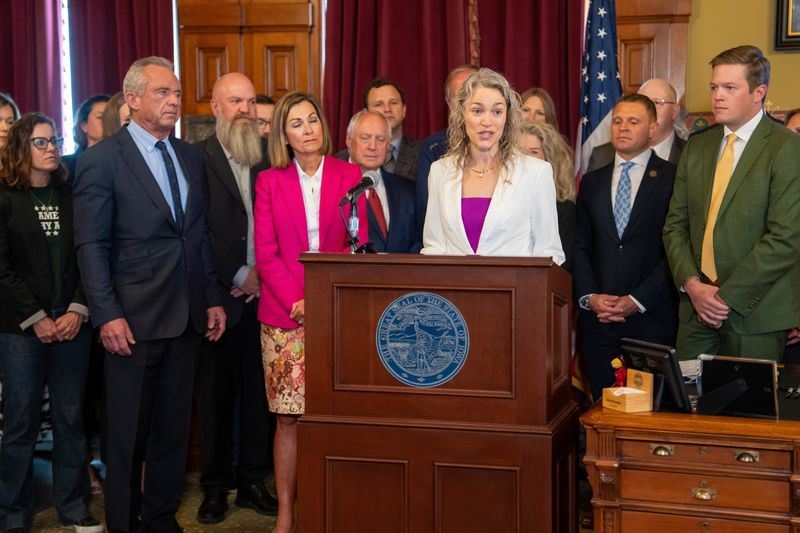
“So the main goal of SF 2417 is to make chatbots safer for users, especially children, by making them more transparent and less deceptive,” Republican state Sen. Kara Warme of Ames said. “We see a lot of value in human connection, and so we want to make sure it’s clear whether you are interacting with a human or something that’s technology or computer based.”
This law went into effect July 1 but won’t be enforced until July 1, 2027, to allow AI operators to alter their programs, according to Warme.
AI operators who violate the law can be held liable for damages and civil penalties up to $500,000 per operator, as determined by the attorney general.
While this law restricts AI operators, Democratic Sen. Cindy Winkler wanted to make it clear that the law isn’t a ban.
“(Legislators) wanted to make sure that companies were held to basic standards when they profit from highly persuasive technology,” Winkler said. “It applies only to public facing conversational systems whose main purpose is human-like interaction.”
The law says AI chatbots are required to refer any user at risk of suicide or self harm to professionals and hotlines rather than offering advice. Chatbots are now restricted from offering any mental or psychological advice.
“We have a lot of emerging new technology, and there have been several extremely sad cases in which people using chatbots, especially children, have harmed themselves or someone else following use of a chatbot or a conversational AI service,” Warme said.
The law prevents AI chatbots from producing visual sexually explicit material, encouraging children to engage in sexually explicit acts, and sexually objectifying minor users.
On July 8, Iowa State University student Jack Erselius was sentenced to 15 years in prison after pleading guilty to creating AI-generated child pornography. Over the course of three years, Erselius used AI to create nude deepfakes of of women he knew. He posted them online with private information of the victims and descriptions of acts of sexual violence he wanted to see committed against them.
According to Dubuque County Sheriff Joe Kennedy, such cases aren’t uncommon, but they are hard to deal with. Kennedy’s county faced something similar in April 2025, where three students produced sexually explicit images of more than 40 female classmates.
“When one does happen, it seems like it’s largely involving a lot of different images and people, so you know it’s kind of a scary thing that it takes us that long for someone to step forward and tell us what’s going on. Unfortunately, it’s gone pretty far by that point,” Kennedy said.
After the incident was taken care of, the Dubuque County Sheriff’s office hosted a presentation with tips on how families can stay safe from AI deepfakes. Kennedy warned against sharing photos over text or through social media. He also told attendants to immediately report any AI-generated sexual content.
Mahaska County Attorney Andrew Ritland said part of the issue is a lack of AI understanding. According to an AI attitudes report published by Common Sense Media, 58% if parents know little to nothing or nothing about the safety features in AI products.
“There is no parental consent component with AI. So the parents don’t know what systems their kids are using,” Ritland said. “They have no insight to how they’re using these systems. There’s no requirement that the parent be informed of this, and they agree that their children can be exposed to these models.”
Warme advises parents to be engaged and informed with the technology their kids are using.
“I would encourage Iowans to talk with their kids and their friends about those risks to check in with each other and support one another,” Warme said. “And to take breaks from technology that they’ve been using to make sure that they have real life interactions and a chance to get outside as well.”
As technology changes, Warme said Iowa is not immune to the change and that the Iowa legislature wants to “stay ahead of new technology and risks for kids that exist.”
Winkler said this legislation is only the beginning in understanding AI.
“We don’t know where it’s going. We don’t know where AI will go, what the challenges might be down the road,” Winkler said. “But, this was the first step to think about our kids and how they need to be protected.”
Veronica Meiss is a reporter for the Des Moines Register. You can contact Meiss at vmeiss@gannett.com.
This article originally appeared on Des Moines Register: Iowa law now restricts AI chatbots in interactions with juveniles
Reporting by Veronica Meiss, Des Moines Register / Des Moines Register
USA TODAY Network via Reuters Connect
By Veronica Meiss, Des Moines Register | USA TODAY Network