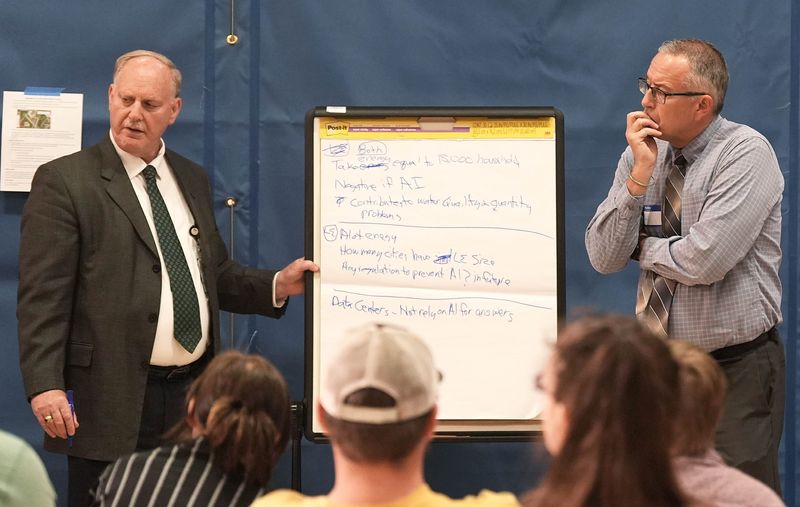
Ten acres. Twenty-five megawatts. Fewer than 10 permanent jobs. That’s the LightEdge data center proposal close to U.S. Highway 30. On paper, it’s a fairly small land-use question for the Ames City Council to sort out.
The relatively small size of the footprint isn’t why crowds showed up at public forums. The data center is a stand-in — a screen we’re projecting a bigger set of worries onto. So when neighbors show up to a council meeting about a data center, they’re talking about increased electrical rates, while worried about the cost-of living. They’re talking about watching land and water get treated as just another line item — as another cost for the public to pay.

They are concerned about the connection between phones, screen time, and their child’s emotional and mental development. They’re also sensing that the game is rigged for people who already have the connections, and that the rest of us are asked to trust a system that keeps shortchanging the public.
Due to little regulation happening at the state or federal levels, the Ames City Council is giving Ames residents a chance to weigh in.
AI and social media have made a handful of companies more powerful than most governments, and most of us have no vote in how that power gets used. A data center is the one tangible piece of that system that shows up in our own backyard. Everything else — the algorithms, the data harvesting, the profits — happens somewhere we can’t see and can’t touch.
These projects run on our land, our water, our power grid, sometimes our tax breaks — and the profits don’t stay here (without a contractual agreement to re-invest in the community, which would be laudable). People are tired of hearing that a project is good for the community, when its benefit primarily accrues to a single industry (eminent domain and pipelines is an example still present).
Our current federal administration is not addressing the pace of growth, from AI to data centers; thus, the burden falls on local (or state) governments. Due to this, our smaller data center is becoming a spotlight for bigger issues.
None of that means the Ames LightEdge project should be blocked. Ames will be addressing its own questions: what this does to the grid, what it does to the land, and what are the “economic development” trade-offs.
A data center is concrete. The power of Big Tech, AI, and the impact on communities is not so tangible — until a proposal like this lands in your town and gives the abstraction a street address.
Because we are all in this together.
Ralph Rosenberg is a retired legislator and attorney and has worked for state and national environmental groups.
This article originally appeared on Des Moines Register: A data center in Ames is a proxy for larger issues | Opinion
Reporting by Ralph Rosenberg, Guest columnist / Des Moines Register
USA TODAY Network via Reuters Connect
By Ralph Rosenberg, Guest columnist | USA TODAY Network