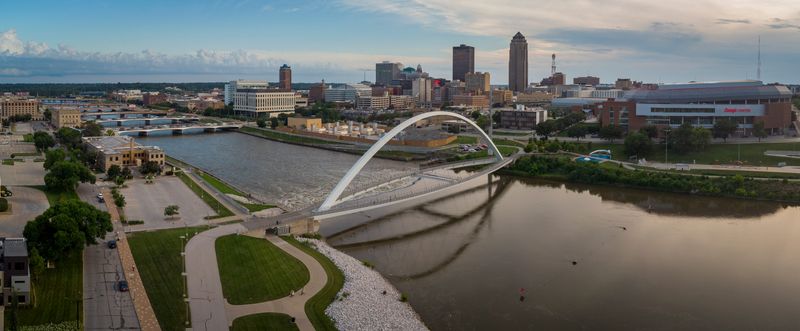
Des Moines may not remain the fastest-growing major metro in the Midwest for long.
If its growth rate flattens and other cities in the region keep ramping up their growth, an economist warned, Iowa’s Capitol city may lose out on fastest-growing bragging rights.

From 2020 to 2024 the Des Moines metro population increased 6.26%. The growth rate was more than one-third higher than No. 2 Midwestern major metro, Indianapolis, and was on par with Sunbelt cities like Atlanta, Nashville, Tennessee, and Las Vegas.
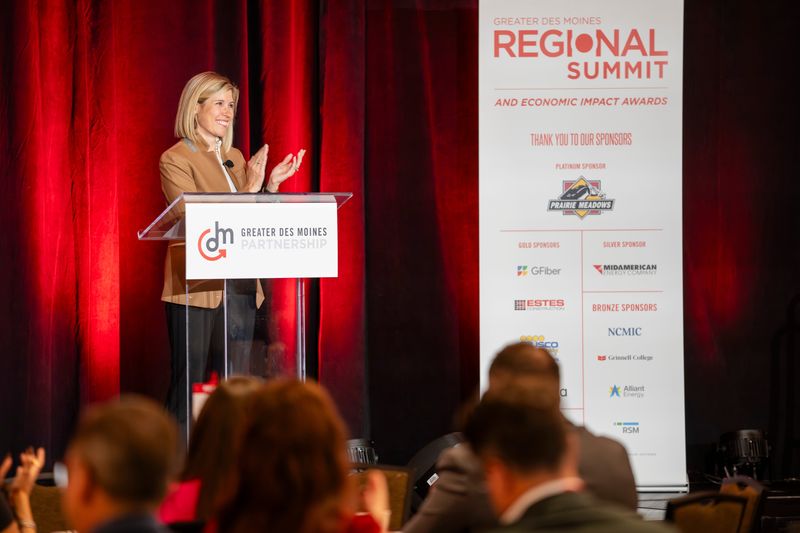
But while the city’s economy is still growing, it could be at an inflection point, James Chung, president of Reach Advisors, a Boston-based finance analytics firm, told members of The Greater Des Moines Partnership on Wednesday, Sept. 17. They were gathered at the Iowa Events Center for the organization’s Greater Des Moines Regional Summit.
Chung recently completed his third financial analysis of the Des Moines market since 2018 for the Partnership, the chamber of commerce for 12 central Iowa counties. He said that emerging from the Great Recession in 2009, Des Moines has grown 2.7 times faster than comparable Midwestern cities the same size or larger. And since 2010, Des Moines’ regional gross domestic product has expanded by 53%.
But since 2020, he said, the rate of its growth has slowed while in other comparable Midwestern cities have seen theirs accelerate.
“We’re at this cusp period… where the Des Moines economy is seeing a little bit of softening that others aren’t,” he told the crowd.
Several years ago, Chung said he noticed Des Moines was outperforming Wichita, Kansas, his native city, on several metrics when he was conducting an economic analysis. The Des Moines metro accounted for 85% of Iowa’s growth in the most recently completed decade. And it has an “outsized” corporate base for a region its size, with corporate investments of about $1 billion per year, Chung said. Any other metro area of a similar size would be lucky to see corporate investments of $100 million per year, he said.
“It’s why it lives as a much bigger and much more interesting city than other cities this size,” he said.
In an interview, Chung said companies make such Des Moines investments because the city has a highly skilled workforce, which allows the region to punch above its weight.
“You can run major, major businesses out of Des Moines because you’ve got more likelihood that you can build the workforce that you want because the talent is stronger,” Chung said. “I look at some (communities) that are 50% larger or three times larger that don’t have this level of investment.”
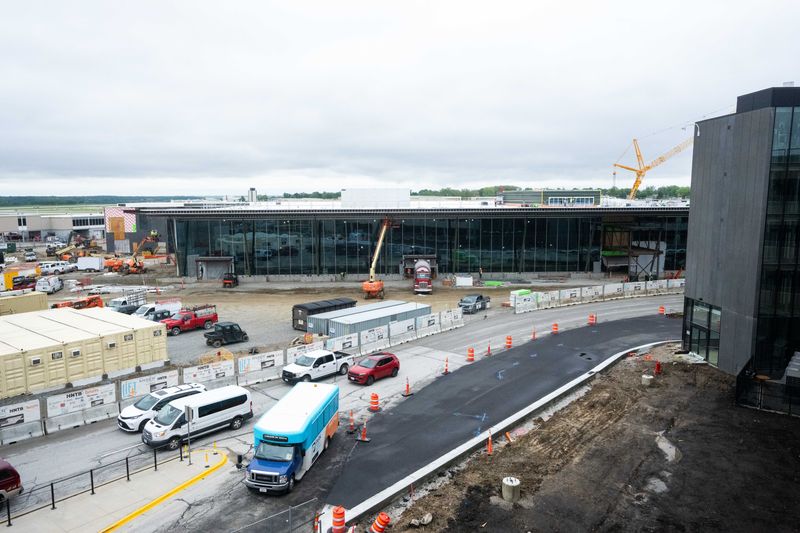
Des Moines also is far easier to reach by air than similar cities, he said, a product of regional focus on improving and expanding Des Moines International Airport. The airport is in the midst of a $445 million project to build a new terminal, he said.
“It’s an example where concerted civic effort creates conditions that makes it easier to operate a bigger economy than what would otherwise be here in a city this size,” he said.
Even “Iowa nice” has played a role in Des Moines’ growth, he said, citing past surveys showing that its residents are more likely talk to and help neighbors than residents of comparable cities. That positive outlook manifests in economic data as “overperformance” among Iowans believing they can do more than outsiders think they are capable of, he said.
“A lot of Midwestern cities will say that they are friendly and nice, but we actually see it in data” for Des Moines, he said. “It’s clear it’s one of the contributing pieces. It’s why the Des Moines economy has been operating at a higher level.”
A worrying sign: Central Iowans getting a little less nice
But worryingly, recent surveys have shown that Iowans are helping and talking to neighbors less, he said. And that’s not the only shift.
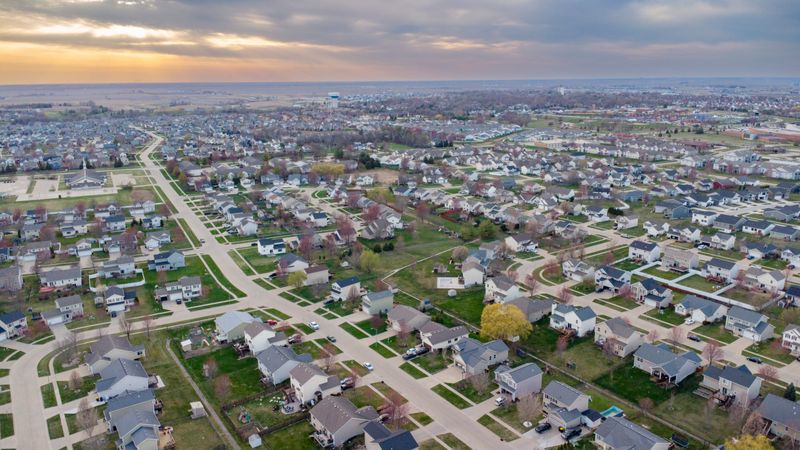
For instance, while the metro’s core city, Des Moines, has long been growing more slowly than its suburbs, the U.S. Census estimate of its population change from 2020 to 2024 showed the city’s population shrunk slightly to 213,096 people from 214,133. If that pattern holds, the city could be headed for its first decade of population loss since the 1980s, despite a continuing boom in its downtown population, Chung said.
In addition, a 2024 Des Moines Register series found that the metro’s No. 1 employment sector, banking, finance and insurance, has gone from strong growth to job losses, even while the industry is growing nationally.
Wells Fargo, at one point the metro’s largest employer, has laid off at least 1,200 workers since April 2022, many of them in its home mortgage division and sold its downtown campus in August.
High interest rates have hurt mortgage-service providers in the city, Chung said, adding that there is a correlation between new home starts and the Des Moines economy. A decline in new construction, “impacts most cities, but it’s further amplified because of Wells Fargo,” he said. It also feeds a cyclical variation in the economy of Des Moines, with higher highs punctuated with lower lows than those of its peers.
Finance industry jobs have only grown at half the rate of jobs in other central Iowa sectors, he said, noting that the job growth rate in financial and analytical fields is likely to continue to decline as AI advances.
In addition, the Des Moines metro is about 25 years into its high-growth phase, he said, while historically, cities tend to sustain double-digit growth rates for two decades at most.
Now, as leaders convene at events like the Regional Summit, he said, they must consider what comes next, and how to sustain central Iowa’s success.
“There’s no reason why Des Moines can’t be one of those three-to-five decade growth plays like Salt Lake City, like the Boise area, which have remarkable outcomes for the residents and businesses in the city,” Chung told the crowd. “But we’re at a crossroads.”
Partnership chief: 1 million is in reach
Also speaking at Wednesday’s summit, Greater Des Moines Partnership CEO Tiffany Tauscheck pointed to reasons for optimism. She noted that the region includes 940,000 people who in the 12 central Iowa counties the chamber of commerce represents. That includes Iowa’s fastest-growing county, Dallas. The region may soon hit 1 million people.
“Getting to that 1 million population mark is significant because once we reach 1 million, we are instantly eligible for all kinds of additional large economic development projects,” Tauscheck said.
And Iowa Gov. Kim Reynolds, who spoke briefly, touted Iowa’s new flat income tax rate, saying the flat tax rate makes the state a great place for business. She also pointed to a highly skilled workforce and cheap, sustainable energy.
“I think it’s easy to see why companies are eager to put down roots in our state,” Reynolds said. “There is an expectation that it will continue to be replicated. Success drives momentum for further success.”
Philip Joens covers retail and real estate for the Des Moines Register. He can be reached at 515-284-8184 or pjoens@registermedia.com.
This article originally appeared on Des Moines Register: Don’t assume Des Moines metro’s rapid growth will continue indefinitely, analyst warns
Reporting by Philip Joens, Des Moines Register / Des Moines Register
USA TODAY Network via Reuters Connect