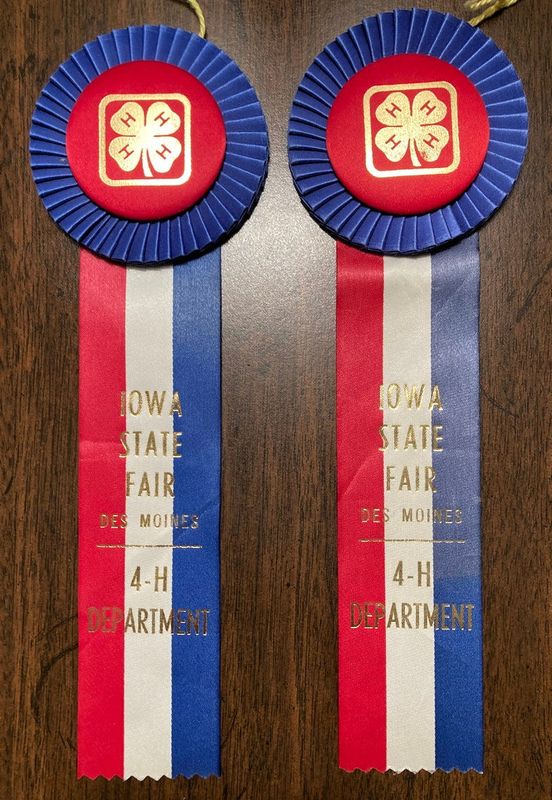
2026 marks the 30th anniversary of the most notorious ribbons ever handed out at the Iowa State Fair.
Under a three-year pilot program from the Iowa State Fair 4-H Advisory Committee, every 4-H project at the fair in 1996 received an identical, tricolor participation ribbon, on the grounds that “the learning experience is more important than the color of the ribbon.”

Even before the ribbons were attached to 3,893 exhibitors’ projects, including mine, the concept was under fire.
In the middle of the education section of the lengthy state Republican Party platform for 1996 is this double-whammy: “We protest the teaching to 4-H’ers that homosexuality is an acceptable alternative lifestyle and we oppose the encroachment of socialism in 4-H competition at fairs.”
The plank came from Dean and Linda Mohning of rural Remsen. The Mohnings had been fired as 4-H leaders, they said, for refusing to sign Iowa State University Extension pledges to “support and promote” a new vision “ordained” by the university. They believed the idea of competition was being squeezed out. “If Karl Marx were our state 4-H chairman, he might say, ‘We must take from each 4-H’er according to his ability and give to each 4-H’er according to his need,’” Linda Mohning told the Register.
The actual state 4-H director, Joe Kurth, found himself on the defensive. The pledges “outlined goals like teaching children citizenship, leadership, and a positive self-concept, and described values including favoring voluntarism, diversity and prevention programs,” he told the New York Times when the ribbon became a national story. He told the Associated Press that some conservatives did not like the direction 4-H was going nationally while trying to meet the needs of current youth.
Such a controversy could not have been imagined nine decades earlier.
Head, heart, hands, health, history
O.H. Benson was the schools superintendent for Wright County from 1907 to 10. During that time, he came up with the idea of the 4-H emblem. Here’s the version of the story reprinted in the Wright County Monitor in 1953:
“Mr. Benson, on a visit to the Breckinridge school one day, was presented with a bouquet of four-leaf clovers the children had found during their recess period. A three-leaf clover was symbol of agricultural clubs or ‘corn’ clubs at the time, with one leaf each for head, heart, and hands. Mr. Benson called the fourth leaf health. Mrs. Jack Munnis, who now lives in Clarion, was the teacher at Breckinridge school when Mr. Benson made his historic visit.”
Munnis was Olive Lyons, sister of my great-grandfather Walter Lyons. Breckinridge school, Lake Township No. 6, became a museum for the “Birthplace of the 4-H Emblem.” In 2017, the building was relocated from Gazebo Park in Clarion to the Heartland Museum there.
Benson took a job with the U.S. Department of Agriculture in January 1911. His ideas and those from elsewhere, including by Page County schools superintendent Jessie Field Shambaugh, were incorporated into development of a national 4-H program.
Fair-going: A family tradition
“Mrs. Charles Cleveland and daughters, Ruth and Marjorie[,] and Mr. Homer Lyons drove to Des Moines Sunday to attend the State Fair.” — Goldfield Booster, Aug. 28, 1930
Marilyn (Lyons) Irelan recalled in a letter that the Lyons family — Homer, Ruth, and children — began camping at the fair when she was about 10 or 11, in the late 1940s. “That first year straw was put on the ground, a tarp was held in place by shutting it in the drivers side door and pegged on the ground. We slept on blankets over the straw,” wrote Irelan, older sister of my mother, Judy.
Ruth “spent a lot of time in the 4-H Building watching all the girls demonstrations,” Irelan wrote. “She also went through the sewing exhibits under the Grandstand. Dad, of course, went through all the barns and machinery displays. He always found someone to talk to.”
One of our earliest family videotapes shows me, age 5, in front of Grandma Lyons’ trailer at the campgrounds showing off my participation ribbons for cookie decorating and the “Pedal Power Pull.”
The fair has been on our calendar every year, until it wasn’t. The COVID cancellation in 2020 created the longest period I have ever been away from the Iowa State Fairgrounds or campgrounds.
More from this author: Time runs out on Manilla school | Opinion
The first year I took a presentation to the Iowa State Fair was the last year Ruth Lyons attended it. I would take presentations twice more. Overall, I had nine 4-H projects advance to the Iowa State Fair, and all received blue ribbons — except in 1996.
At the end of 1996, after the single-ribbon project had been officially torn to ribbons, a Quad-City Times article said the striped version would become a “collector’s item.” For the majority of that year’s 4-H’ers, that’s where their story stops, but not mine.
I have something that many of those 3,893 exhibitors don’t.
I have a second ribbon.
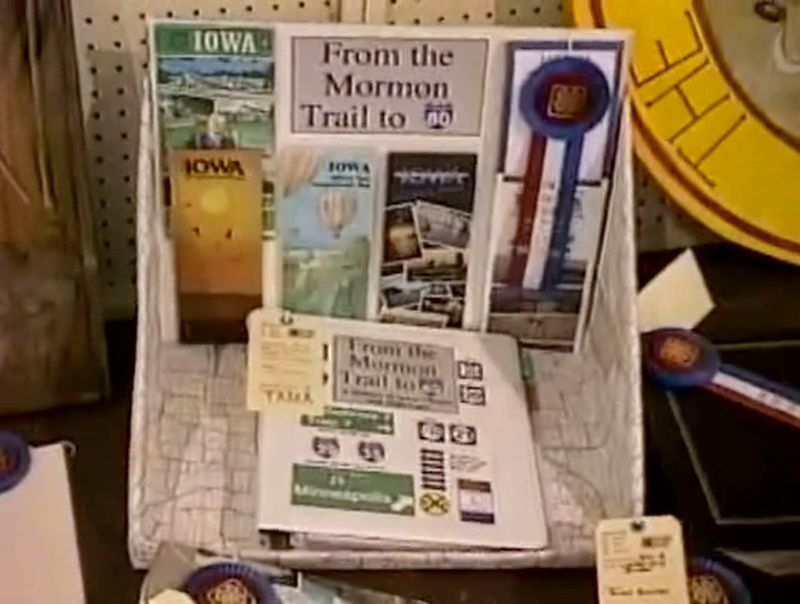
My two State Fair projects for 1996 were in the Self-Determined and Computer categories. The first was ambitious: “My goal was to learn the history of Iowa’s roads and highways by county fair.” The second: creating a complete page for the World Wide Web, with images, a table, and hyperlinks. Given that my website about Iowa highways turns 25 years old later this year, the pairing is serendipitous.
The Iowa State Fair Museum on the Fairgrounds, by Pioneer Hall, has a wide array of memorabilia of fairs past. After communicating with museum director Ellen Hammond, I stopped by the fair office this March to donate one of my 4-H ribbons from 1996. Now a piece of Lyons and Morrison family history is preserved at a place my family loves, commemorating the past and speaking to the future.
Jeff Morrison was a member of the Buckingham Boosters 4-H club in Tama County from 1991 to 2000. In 2016, Morrison became the first person to visit every incorporated community in Iowa. Morrison, a member of the Iowa Writers’ Collaborative, writes at betweentworivers.substack.com, where this piece was first published, and iowahighwayends.net.
This article originally appeared on Des Moines Register: 4-H ribbon experiment sparked a 1996 Iowa State Fair tempest | Opinion
Reporting by Jeff Morrison, Guest columnist / Des Moines Register
USA TODAY Network via Reuters Connect
By Jeff Morrison, Guest columnist | USA TODAY Network