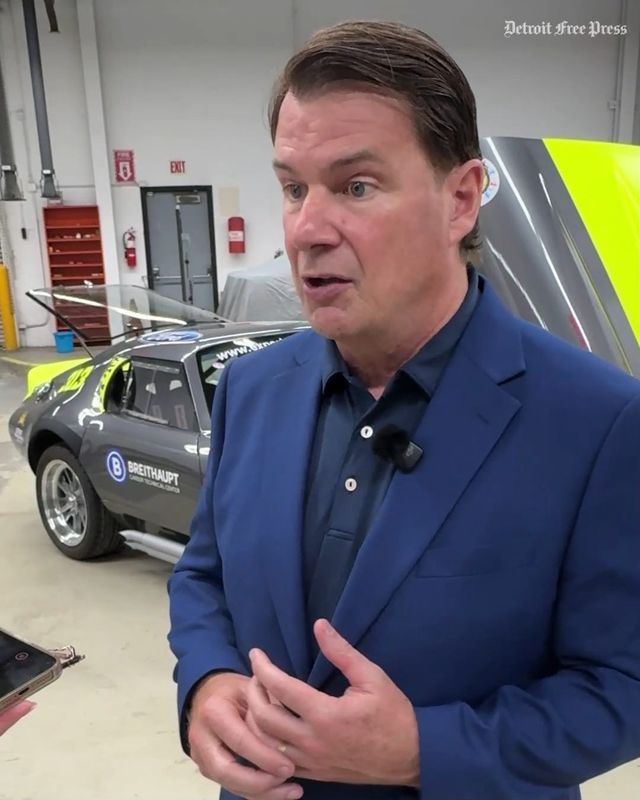
Ford Motor Co. CEO Jim Farley said the automaker’s decision to move production of its Lincoln Nautilus midsize SUV from China to the United States by the end of the decade was not made lightly and it centered around two big considerations: Ford will design all-new Lincoln vehicles in the next few years and the present economic burden of tariffs on Ford.
Also, Farley said in an exclusive interview with the Detroit Free Press that with quality improving in Ford’s U.S. manufacturing facilities, it was a good time to make the move. On June 25, Ford was ranked No. 1 among mainstream brands on the JD Power’s Initial Quality Survey.

“We now have the confidence that we can compete with Genesis or Lexus imported outside the U.S. We made a lot of progress,” Farley told the Detroit Free Press. “Now, we’re fully confident that we can make these Lincolns in the U.S. and be fully competitive with the global standard that we see for the luxury business.”
Analysts, meanwhile, said the decision to move Lincoln production offers Ford the chance to relaunch the luxury brand with a big splash.
“With new models due to hit showrooms around the 2031 model year, Lincoln has a unique opportunity to relaunch the brand in spectacular fashion,” Sam Fiorani, vice president of global vehicle forecasting at AutoForecast Solutions, said. “Lincoln has always lagged behind the major players in terms of volume even with a range of excellent products.”
The changes coming
The Dearborn-based automaker announced on Aug. 12 that starting in 2030, it will increase the production of Lincoln vehicles in the United States, creating thousands of jobs in the process. It means Ford will stop importing the Nautilus — which it makes in China.
In an interview with the Detroit Free Press on Aug. 13, Farley declined to specify which U.S. plants would get the extra Lincoln production or where the added jobs would land. He also declined to specify any changes to Lincoln’s lineup of vehicles other than to confirm that Lincoln will design all-new vehicles in the next few years.
“We won’t want to be specific. We want to talk to the UAW about the specifics first,” Farley said. “But I would say, just the employment for moving high-volume Lincoln models to the U.S., obviously, will be thousands of (jobs) for people.”
In the states, Lincoln sells three vehicles: the midsize Nautilus and Aviator SUVs and the Navigator large SUV. It had also sold the compact SUV, Corsair, but discontinued it and the Ford Escape in December. Those two vehicles had been built at Ford’s Louisville Assembly Plant in Kentucky but Ford is retooling that plant to start making an all-electric midsize pickup called Fathom there early next year.
Ford currently builds the Nautilus, its two-row SUV, at its plant in Hangzhou, China, and sells the vehicle in North America and China. Ford also builds the midsize luxury sedan, Lincoln Z, in China through its Changan Ford joint venture. It is sold only in China.
Fiorani said a redesigned lineup built in the United States will allow Lincoln to capture a new buyer.
“A convergence of new vehicles arriving in a 12-month period opens the door to introduce Lincoln to a new generation of buyers making it an alternative to the better-known players,” Fiorani said.
Showcasing redesigned luxury SUVs and possibly new models, Fiorani said, gives Lincoln “a chance to move up the ranks of luxury brands, if harnessed properly.”
The making of the decision
Farley said Ford’s decision to move Lincoln production to the states took a year and it was brought on by the idea of giving Lincoln an all-new designed lineup — which costs a lot of money in terms of retooling plants and securing suppliers — as well as considering the economic impact from President Donald Trump’s tariffs.
“The Trump administration came in and they were very crystal clear to us that they want, even the most American company, like Ford, in terms of production, to build more in the U.S.” Farley said. “When they put in the tariffs on automotive, in some cases, they’re 50-plus percent higher on these vehicles we’re importing (from China), very quickly it became obvious to us that we have to make a tough choice here.”
In March 2025, President Donald Trump put 25% tariffs on all imported vehicles and car parts. There were already some tariffs in place on exports from China, which is why the additional 25% tariff could add up to more than a 50% tariff an importer must pay. A tariff is a tax an importer pays to bring a good over a border. For Ford, its total tariffs amounted to a roughly $2 billion expense last year.
Farley said the Lincoln production move was a tough choice also, in part, because under former CEO Alan Mulally and with Farley’s input at the time, Ford relaunched Lincoln in China in 2014 and started manufacturing there in March 2020 at the Changan Ford joint venture factory.
“We decided to position Lincoln as an American brand. Our concept was to have American vehicles, like Navigator, sold in China and that allowed us to have one model for both markets,” Farley said. “It didn’t make sense for us to have the same model built in the U.S. and in China. Our quality in China was excellent and … because there were no tariffs, we decided to save money in a way and tool up our one or two Lincolns in China, just like GM did with Buick and other companies did.”
Ford eventually shifted to build the Nautilus in China for sale in the United States and the vehicle is the brand’s top seller. In the second quarter, Lincoln sold 10,505 Nautilus vehicles, up 6.4% from the year-ago quarter. It was the strongest second quarter ever for the nameplate and nearly two-thirds of the buyers were conquest buyers — those buyers who had previously purchased other premium utility brands.
A new Nautilus
Farley said his team considered the high cost of tariffs and the fact that vehicle quality in its U.S. plants was “getting so much more competitive,” so “why don’t we localize (production) because monetarily, it will make more sense? So that’s what we’ve done.”
When asked whether Ford plans to dramatically redesign the Nautilus, Farley again declined to be specific about models, but he said Ford will be investing in a “pretty major change for Nautilus.”
On Aug. 13, Ford put out a media release outlining some of the design changes to the 2027 Nautilus saying it will have “a bold new face, more opportunities for personalization and intuitive technology designed to make every drive feel more effortless, personal and restorative.” It will also have a more detailed grille, a redesigned hood and offer buyers several wheel options and new exterior paint colors, Ford said.
Farley said Ford’s improving quality story helped make the decision to move production to the U.S. easier.
“Just like Ford, the Lincolns are made in our North America plants and the quality is going from like 23rd to first in initial quality,” Farley said. “Three or four years ago, when we were making these kind of choices, that was less clear. We were working really hard. I love the fact that Ford’s quality story is now an overnight story that took three years or four years. The good news is that we’ve landed pretty well, but it’s the first inning of a nine inning game. You’re never done with quality.”
Jamie L. LaReau is the senior autos writer for USA TODAY Co. who covers Ford Motor Co. for the Detroit Free Press. Contact Jamie at jlareau@freepress.com. Follow her on Twitter @jlareauan. To sign up for our autos newsletter. Become a subscriber.
This article originally appeared on Detroit Free Press: In exclusive interview, Ford CEO explains change in plans for Lincoln
Reporting by Jamie L. LaReau, Detroit Free Press / Detroit Free Press
USA TODAY Network via Reuters Connect
By Jamie L. LaReau, Detroit Free Press | USA TODAY Network