Robert Stanaj was so opposed to roadside cameras tracking license plates, that he took matters into his own hands.
After dark, he would slip out of his truck with a paint roller on an extension rod and paint over the lenses of the cameras.

The 50-year-old from Bloomfield Hills was eventually caught, charged with felonies, pleaded them down to a misdemeanor and now says he’s learned his lesson. He’s even written a bill to ban their use, which he hopes to see become law.
“Probably shouldn’t have went that route,” Stanaj told the Free Press this week. “Should have gone the bill route but you’ve got to protect our privacy. It’s getting out of control.”
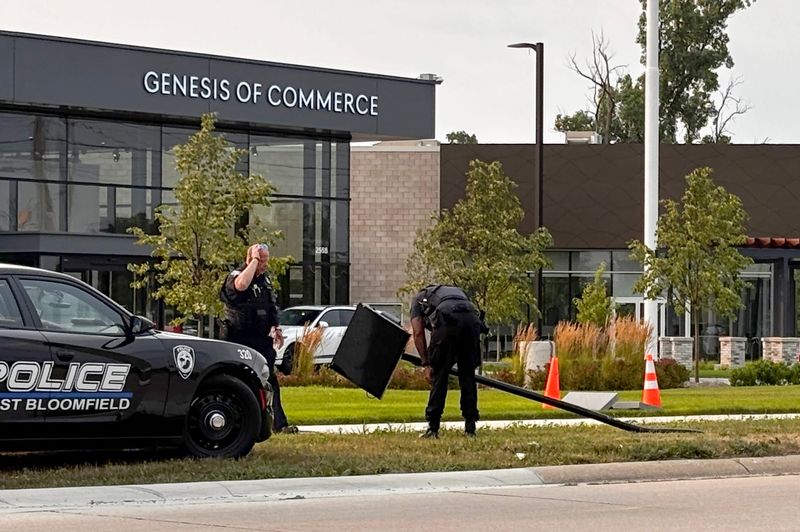
Stanaj’s concerns related to the cameras are shared by others across metro Detroit and around the country, including some who’ve taken their frustration out on the cameras themselves. Vandals have been downing, damaging and even stealing the devices in more than a dozen places across Michigan.
Among the metro Detroit communities where cameras have been hit are Birmingham, Commerce, Farmington Hills, Independence Township, Novi, Orion Township, Pontiac, Rochester Hills, Waterford, Wayne and West Bloomfield. Cameras have been damaged or disabled in Kent and Kalamazoo counties as well.
It’s unclear whether the attacks are coordinated, though online chat groups offer instructions and encouragement.
“It does absolutely speak to how people feel about this technology and how they feel about being surveilled,” said Gabrielle Dresner, a policy strategist for the ACLU of Michigan. “Part of that is the civil liberties concern of having this mass surveillance police state being installed, mostly without any community say or in fact, in opposition to what the community is saying.”
Dresner stressed that while she doesn’t condone vandalism she does encourage people to make their concerns known to policymakers at all levels of government. She acknowledges the cameras can serve a legitimate function but said proper regulations are needed to protect privacy and constitutional rights.
“These cameras are installed across the state and across the nation and they are tracking every car regardless of whether or not they do anything wrong,” she said. “So, this is kind of counter to what we typically think of when we think of policing, right?”
New technology
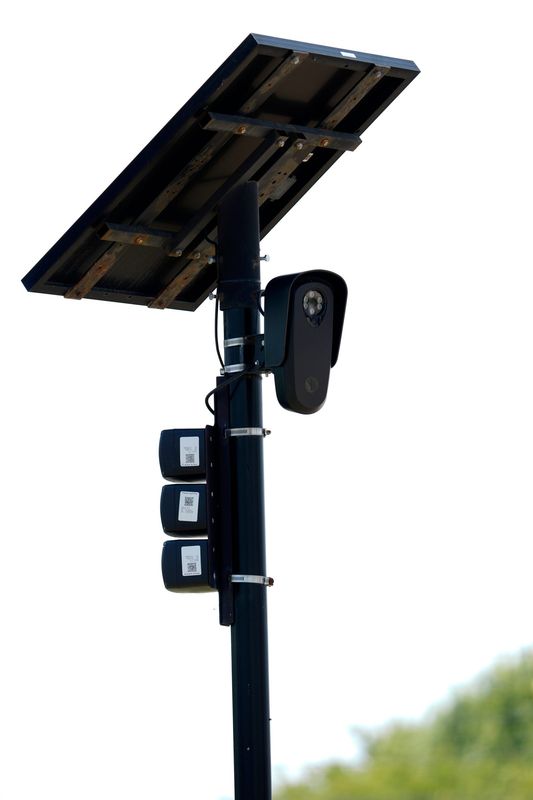
The cameras are often referred to as Flock cameras for those made by a leading brand, Flock Safety. Other companies offer similar technology.
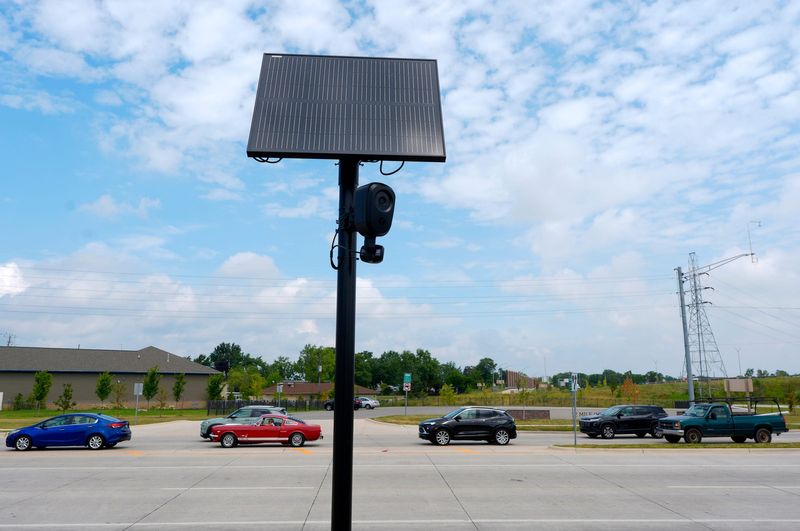
They cost thousands of dollars apiece, and communities pay annual fees to keep them operational. They’re typically mounted on poles near intersections to photograph passing vehicles and their license plates. Those plate numbers and vehicle images form a searchable database for police looking for a car associated with a crime or a missing person.
Police say they are instrumental in locating suspects and, ultimately, in solving crimes. They are especially helpful in finding dementia patients who may drive off and become lost.
Flock Safety said its cameras have assisted in many high-profile cases in addition to more routine matters.
“Our technology helped investigators locate the Brown University mass shooting suspect, even after he changed license plates,” Flock spokesman Paris Lewbel told the Free Press in an email. “In another case, Flock cameras helped authorities locate a man accused of planning a mass shooting at a New Orleans festival before a tragedy could occur. In cases like these, every lead matters.”
Lewbel said people are free to express their concerns but that vandalizing cameras is a crime that can make it harder to solve other crimes.
“When a camera is taken offline, an investigative lead can disappear, and a time-sensitive alert tied to an AMBER Alert, a missing-person case, or a violent crime suspect on the move may never reach the officers who need it,” he said. “These are tools agencies rely on to respond quickly and help keep people safe.”
The Flock website says the cameras do not employ facial recognition technology and can’t detect the race or gender of drivers.
Privacy concerns
Dresner of the ACLU acknowledged the good the cameras can do, but said they must be regulated.
“There is no state law in Michigan governing the use of license plate readers or their public reporting,” she said. “So this is pretty much up to every municipality or every police department who uses them to kind of make up their own policy or fall back on the internal policy of the company who they are using, which again in this case is Flock.”
Dresner said data retention is especially concerning because of how it can be used.
“The longer you hold on to that data, the easier it is to create a pattern of movement of where a person is coming and going over time,” Dresner said. “If you have a snapshot, a point in time, that’s pretty distinct and unique and you can’t really figure out a pattern. However, if you have two weeks, three weeks, a couple of months’ worth of data, then you can say, ‘Oh, every Tuesday this person goes from point A to point B.'”
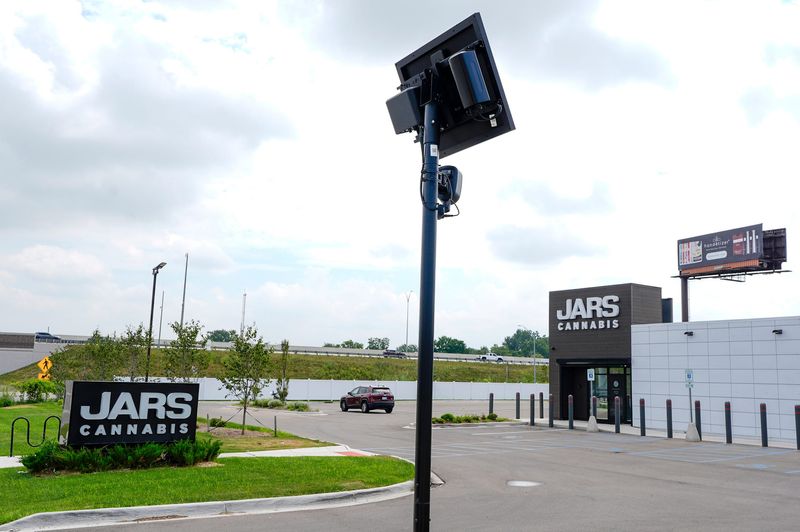
Madison Heights police placed a Flock camera facing the JARS Cannabis Dispensary on 12 Mile Road, prompting a backlash from customers. The company placed a sign reading “No Flock Zone” in front of the camera.
“After we installed our No Flock Sign, the city issued a demand letter warning of sanctions if we didn’t remove it [within] 48 hours,” the company said in a statement, which went on to say it was working with the city on a resolution.
Other privacy concerns involve police using the cameras to track political protesters.
Flock Safety does operate what it calls a transparency portal, which communities can enable and link to on their websites. It provides data to the public on things like the number of cameras operating in the community, the number of individual license plates scanned and the number of so-called hotlist hits. Those are license plate numbers being sought by police in connection with an investigation or a missing-person case. In some cases, police departments note on their portal which other police agencies have accessed their data.
The portal for Bloomfield Township notes the community operates 20 cameras, stores the data for 30 days and has scanned more than 1 million unique license plates in the past 30 days, including more than 9,300 that appeared on a hotlist of one type or another.
Communities that border Bloomfield Township, including West Bloomfield, Farmington Hills and Pontiac, do not link to a transparency portal from Flock.
“So there is really a wide variety of sharing and it’s optional, so they don’t have to share it,” Dresner said.
A website known as Eyesonflock.com posts links to Flock transparency portals for communities across the country, though it doesn’t appear too comprehensive. It asks people to submit links to portals it has not yet listed.
Pending legislation
Two bills pending in the state House seek to regulate the use of such cameras in Michigan. They would require a warrant for police to access the data in most situations.
Courts would be required to approve the release of the data “if presented with facts showing reasonable grounds to believe the captured plate data are relevant and material to an ongoing criminal or missing persons investigation or a criminal prosecution or defense.”
The bills would limit data storage to 14 days.
State Sen. Jim Runestad, R-White Lake, last month introduced a Senate version of the proposed legislation.
“Passively collecting information 24/7 as people go about their daily lives is a drastic overreach and goes well beyond public safety needs,” Runestad said in a statement announcing the Senate bill. “This legislation acknowledges that certain emergency situations can be greatly assisted by this technology, but sensible safeguards need to be put in place.”
Public backlash
Residents in communities across metro Detroit have been complaining to city councils and township boards about the use of such cameras.
In April, Flock camera opponents packed an Oakland County Board of Commissioners meeting to oppose a contract with the company to provide a surveillance drone to the Sheriff’s Office on a pilot basis. Commissioners approved the contract despite the public opposition.
Some communities like Westland have decided to end their contracts with Flock, while others say they are reviewing it.
While those debates continue, vandals continue to take matters into their own hands.
Damaged cameras
Spencer Anderson, 24, of Clarkston, is accused of damaging Flock cameras in Waterford and is charged with malicious destruction of property. His case is pending in district court. His attorney, Layne Sakwa, declined to comment.
Novi Police Cmdr. Bob Manar said someone damaged two cameras on the Novi Road corridor in July.
“I don’t really want to advertise how it was done, but suffice it to say they sustained damage to parts,” Manar said. “We have no charges yet and no suspects yet, but I can tell you that if we do locate the person that did this, we will be seeking charges on that individual.”
Other police have seen damage as well.
Cameras have been hit repeatedly in West Bloomfield. Two cameras near the intersection of Haggerty Road and Pontiac Trail remain down after being damaged.
One on the west side of Haggerty Road north of Pontiac Trail was damaged July 17 by a man in a truck. No charges have been filed yet, but West Bloomfield Deputy Police Chief Brian Tash said investigators have a suspect and hope to present a warrant request to prosecutors soon.
Most of the camera attacks have happened at night with few witnesses around to see the damage taking place. But the attacks have been seen by other cameras, notably security cameras used by businesses.
“We were able to obtain some video and the suspect’s driving his truck and he drives it right up on the curb, knocks the pole, camera falls down and he takes off,” Tash said.
Tash said the attacks on the camera have happened before. Private security cameras also figured in cracking the case against Stanaj.
Cameras watching cameras
In early 2024, West Bloomfield police began investigating a series of attacks on Flock cameras, including one near the intersection of Hiller and Coomer roads. In May of that year, police reviewed security camera video from a business near the intersection of 14 Mile and Middlebelt roads, where another camera was damaged.
When they shared what they had learned with other area police, they received word from their counterparts in Birmingham and Farmington Hills, who had investigated similar camara attacks. Birmingham police had identified Stanaj as a suspect through a license plate on his pickup. Farmington Hills police were onto Stanaj as well, and were granted a search warrant to place a GPS tracking device on his pickup.
As part of their investigation, West Bloomfield reviewed the tracking report from that GPS device.
“The tracking report shows that Stanaj’s vehicle stopped at or near the Flock camera located at Middlebelt and Orchard Lake Rd. at almost the same time the camera stopped working,” West Bloomfield Police Det. Phillip Beasley wrote in his report.
The report goes on to note that investigators obtained a search warrant for Stanaj’s cell phone records. An analysis showed the phone was in the area of the Orchard Lake Road and Middlebelt at about 11:08 p.m. June 30, 2024, near another damaged camera.
“The Flock camera at this location last captured a photo on 6/30/2024 at” 11:07 p.m., Beasley wrote. “The GPS stop report I obtained [from Farmington Hills police] shows Stanaj’s vehicle stopped near the Flock camera at” 11:07 p.m.
Oakland County prosecutors eventually charged Stanaj with three counts of malicious destruction of police property in Farmington Hills, two counts in West Bloomfield and two more in Birmingham. The charge is a felony with a maximum penalty of four years in prison and a $5,000 fine.
In Oakland County Circuit Court, the cases were consolidated and Stanaj agreed to plead no contest to one misdemeanor count of malicious destruction less than $1,000. The other counts were dismissed as part of the deal.
Two days in jail
Judge David Cohen sentenced Stanaj to two days in jail, crediting him for two days he’d already served after his arrest. He also ordered Stanaj to pay $125 in fines and court costs and to pay restitution for the cameras. The records don’t indicate how much restitution he was ordered to pay.
In a phone interview with the Free Press, Stanaj said he continues to pay restitution for the damage he caused, but he declined to say how much it was.
“When I first saw those things, I thought it was a private company doing this. I thought it was just Flock,” he said. “Those things have no sign saying they are considered police property.”
Stanaj insists he has no beef with police and has law enforcement members in his extended family. He said he has learned from the experience and would not repeat it.
“If I knew these things were owned by the city, I wouldn’t touch them in a million years,” he said.
Contact John Wisely: jwisely@freepress.com. On X: @jwisely
This article originally appeared on Detroit Free Press: Vandals target Michigan license plate cameras amid growing privacy concerns
Reporting by John Wisely, Detroit Free Press / Detroit Free Press
USA TODAY Network via Reuters Connect
By John Wisely, Detroit Free Press | USA TODAY Network