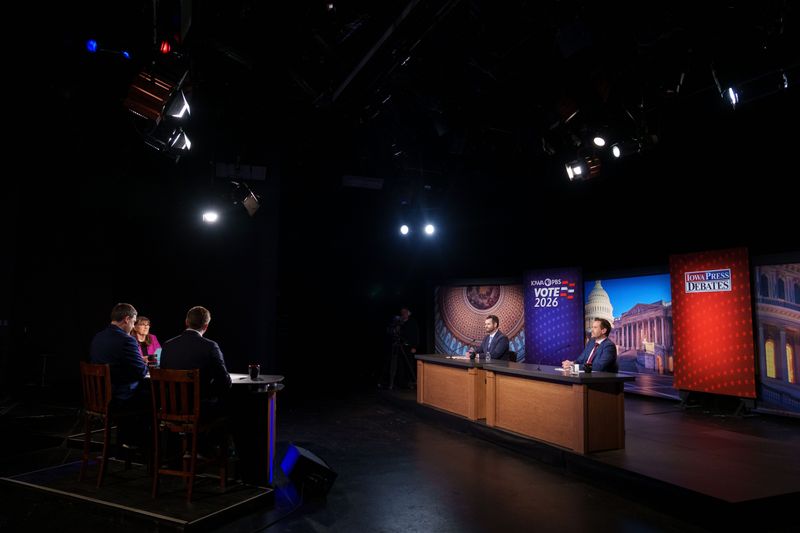
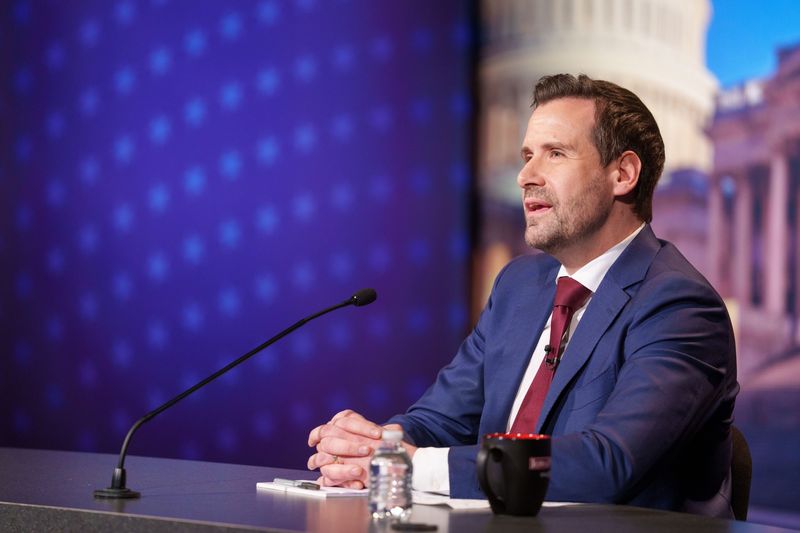
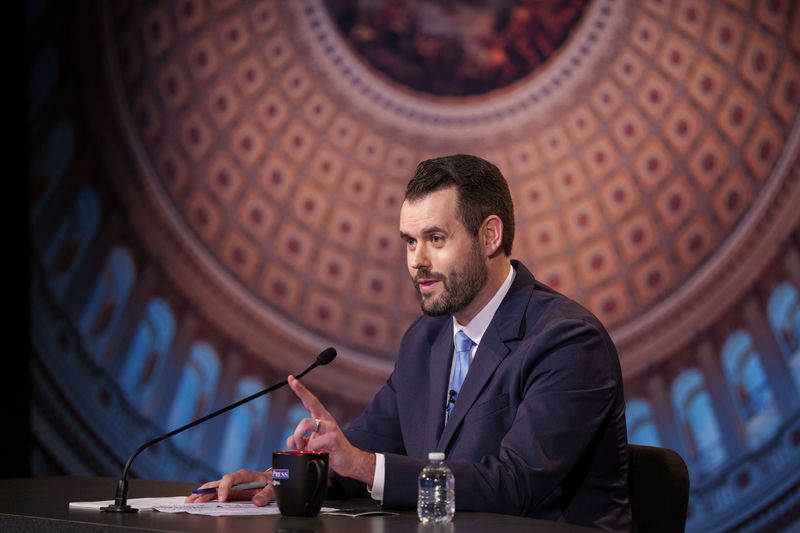
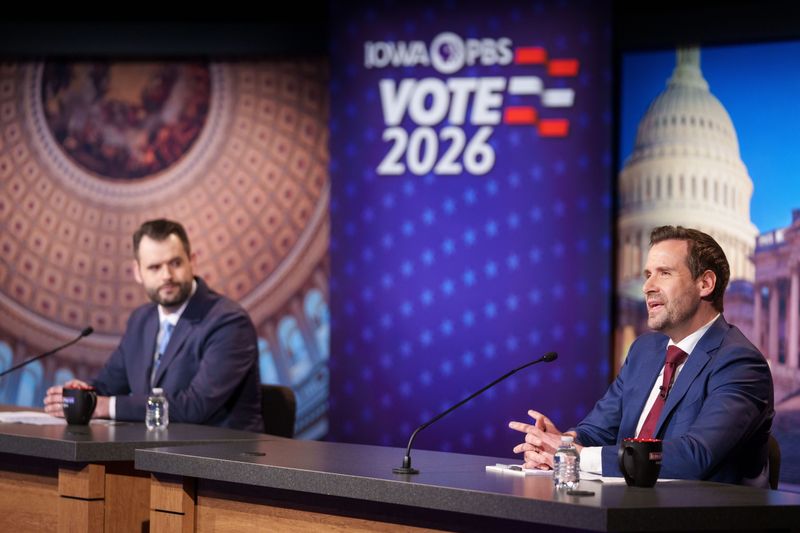
Iowa’s Democratic U.S. Senate candidates in a closely watched primary race sparred over outside spending and immigration policy during the first televised debate of the election May 5.
Josh Turek, a state representative from Council Bluffs, and Zach Wahls, a state senator from Coralville, made their cases on why they are the strongest candidate to earn their party’s nomination in Iowa’s open U.S. Senate race after Republican U.S. Sen Joni Ernst announced she would not seek reelection.

The two Democrats attempted to draw contrast on electability and ideology despite aligning on many key issues during the Iowa PBS debate ahead of the June 2 primary.
Democrats view it as a chance to flip a seat that the party hasn’t held since 2008, when former U.S. Sen. Tom Harkin last won reelection.
The hourlong debate was moderated by Kay Henderson of Iowa Press, Erin Murphy of the Gazette and Stephen Gruber-Miller, the Register’s capital bureau chief.
Both candidates were aligned on many key issues, including creating a public health insurance option to improve health care access, removing the payroll tax cap for Social Security, raising the federal minimum wage and combating wealth inequality.
But contrasts arose on immigration policy and beliefs over which was best suited to win over independent and Republican voters.
Turek or Wahls will go on to face U.S. Rep. Ashley Hinson or former Iowa state lawmaker Jim Carlin, both seeking the Republican nomination. Early voting begins May 13.
Here are three takeaways from the Democratic debate:
Wahls, Turek pitch electability, spar over campaign finance
A months-long back-and-forth on the role of outside spending and national political influence carried over onto the debate stage May 5.
Wahls has criticized Turek for being too closely aligned with the Democratic political establishment, including accepting “dark money” from VoteVets, a PAC that helps elect Democratic veterans that Wahls contens is aligned with Senate Minority Leader Chuck Schumer.
VoteVets has spent over $2.6 on television and digital advertising for Turek. The group announced an additional $800,000 ad spend for him Tuesday.
Turek is not a military veteran, but was born with spina bifida that he contends was the result of his father’s exposure to Agent Orange while serving in the Vietnam War.
Wahls has openly criticized Schumer’s leadership, refusing to vote for him as Senate leader if elected.
“I will not vote for any leader who thinks that our party should write off rural voters and blue collar voters,” Wahls said. “We are not going to be able to win them back until we have a new vision and new leadership for this party.”
Turek said he agreed with Wahls that the party’s path forward needs to move away from “corporate democrats” but said his backing of party leadership if elected would be based on how they answer three questions, including what they plan to do for Iowans and who is going to be best aligned with his “prairie populist agenda.”
He also made the case for his electability by touting his ability to win in traditionally red areas of the state, including his two victories in his Iowa House seat which President Donald Trump also carried.
Turek returned fire on Wahls on campaign contributions, pointing to his role as executive director of The Next 50 and his acceptance of $250,000 in campaign contributions eventually tied to the crypto currency exchange FTX during his time as Senate minority leader.
“When he was in leadership, he took $30,000 five times more than any other person in minority leadership,” Turek said. “He was the director of a dark money PAC. I’ve been the director of a nonprofit organization for disabled kids. We are not the same.”
Wahls called Turek’s claim “categorically false.”
Criticism over immigration vote
The most significant divide between the candidates came over immigration policy.
Wahls criticized Turek for voting for a Republican-backed law in 2024 that would allow Iowa law enforcement to arrest undocumented immigrants who previously were denied entry into the United States. The law is currently blocked by courts.
He called the bill “anti-immigrant,” saying he opposed the bill alongside the American Civil Liberties Union of Iowa and immigrant rights groups over concerns it would erode community trust in law enforcement and lead victims to avoid reporting crimes.
“It’s something that, unfortunately, made Iowans not more safe, but less safe,” Wahls said. “This is a place where there’s a real disagreement in our record and in the United States Senate.”
Turek rebutted Wahls’ statement, referring to recent actions by Immigration and Customs Enforcement as “fundamentally wrong” and “un-American.” He said he voted for the legislation during the Biden administration and said there need to be more regulations on ICE and immigration enforcement while emphasizing the need for broader immigration reform.
Pointing to his personal ties to the issue, Turek underscored the difficulties his wife, who was born in the Dominican Republic and became a U.S. citizen, has faced in the current political climate. He said families like his are “scared.”
“I have gone through this process myself, and I want to make this country easier to be able to come here as an immigrant and work here and make their communities better,” Turek said. “We can have two things, and they do not have to be mutually exclusive. You can recognize the need for safe and secure borders, but also the need to have fundamental immigration reform.”
Both candidates said if they were in Congress, they would not have voted for funding for the Department of Homeland Security without significant reforms to ICE after the killings of Alex Pretti and Renee Nicole Good in Minneapolis.
Wahls, Turek differ on eliminating Senate filibuster
Turek and Wahls both acknowledged that the Senate’s filibuster, a procedure used to delay or prevent a vote on a bill, needs to change.
But both also differed on whether to fully dismantle it.
Wahls said the filibuster has prevented Senate lawmakers from getting significant policies across the finish line, including approval of a public health insurance option and pharmacy benefit manager reform.
“It is not time for the filibuster to be talked about, reformed. It is time for the filibuster to end,” Wahls said.
Turek agreed with Wahls that the filibuster needs to change, but cautioned eliminating it would remove a potential check and balance on the majority party’s power.
“I would like to see it moved back to the pre-1974 standards and move away from the filibuster,” Turek said. “If you’re going to use the filibuster, you must speak the entire time and you must be present actually on the Senate floor.”
This article originally appeared on Des Moines Register: 3 takeaways from the Iowa Democratic U.S. Senate primary debate
Reporting by Maya Marchel Hoff, Des Moines Register / Des Moines Register
USA TODAY Network via Reuters Connect