During the 1950s and 60s, most of the largest high school gyms in the country were built in Indiana. Today, a dozen that hold 6,000 fans or more are still in use, with 32 holding 5,000 or more.
What caused the building boom – and why so darn big? Not so much bragging rights of having the biggest gym ever built as much as to simply meet the demand and to act as hosts for postseason play.

Those communities who built big gyms take great pride in what they have, even if their temples to high school sports seldom fill up the way they used to. The history still oozes from them: the smells, the banners, the photos of the local team’s heroes. The memories help celebrate the state’s pastime.
Muncie Central currently boasts the oldest of the large palaces still in use, building the revered Fieldhouse in 1928. It currently seats 6,578, which now stands as only the ninth largest. Many more of similar stature would follow, including the legendary Wigwam in Anderson that sat nearly 9,000. It was built in 1961 and closed 50 years later.
It made sense to build big gyms in communities such as Anderson, Marion, Kokomo, Elkhart, Columbus, Huntingburg and Washington. The bigger gyms they built guaranteed they’d host sectionals, regionals and semi-states every year, which never hurts a playoff run.
In 1954, the construction of Elkhart’s North Side Gym, a 7,345-seat monster that was the biggest of its time, was completed. Southport Fieldhouse, with seating for 6,744, was completed in 1958.
New Castle became the granddaddy of them all in 1959, but the ‘Largest and Finest’ left the town wondering if they’d built too small as standing room-only crowds well over the original capacity of 9,300 filled the place for postseason games immediately after its opening.
Seeing all that, Seymour wanted in on the fun. In 1968, they got to work.
‘You couldn’t hardly breathe in there’
Seymour’s old gym held a little over 4,000 seats. It stayed in use at what became the junior high after the new high school was built in 1960.
“There were only three classes at the high school,” said Bud Shippe, now retired radio voice of the Owls for 44 years. “Nobody could take PE because there was no gym, so they decided to do an expansion. They needed room for the freshmen, a new gym, new pool, all of that.”
Seymour boys basketball was on a nice run in the late 1960s, winning 15 of 17 sectionals from 1951-67 and making it to semi-state in 1963-65. When time came for the eight-team sectional, Seymour season ticket holders were often left out. Tickets were allotted based on enrollment, and the smaller schools gobbled up their share.
Going to regional often meant taking on Jeffersonville or New Albany in their home territory, or Bloomington when Seymour’s winner was shifted north.
“Barney Smith, who was the coach and the athletic director, wanted to host a regional,” Shippe said. “So that played into the size. He’s the one who spearheaded the effort. He traveled around the state and looked at other gyms and helped design it.
“Eight years later, he retired and they named the gym after him.”
Shipps’ father had a hand in the design, too, suggesting the media overhangs on all four corners.
Work started in 1968. Thousands of bricks later, it was ready in November of 1970.
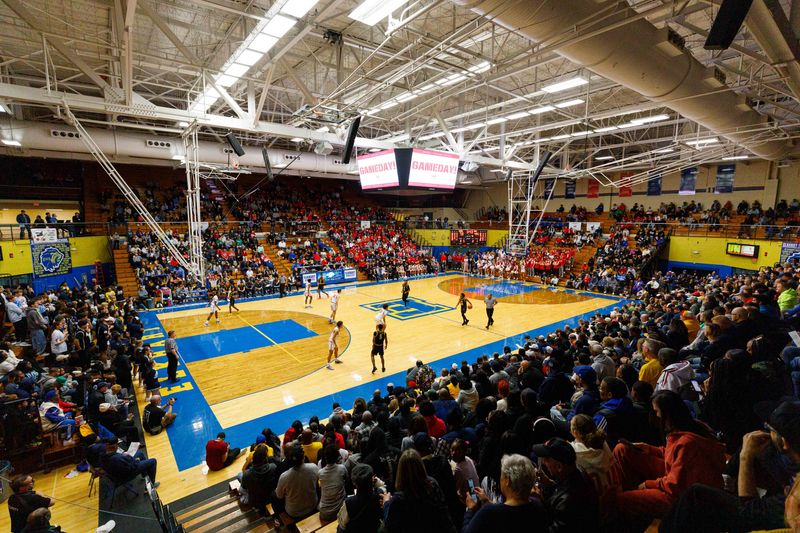
Before long, New Castle and Seymour took turns claiming the title of biggest gyms in the country. An actual recent survey of the seats concluded New Castle (8,424) has just a few more than Seymour (8,228). Interestingly, Shippe noted, the two schools have played just once, in the 1932 state tournament.
But building the ‘biggest’ wasn’t the goal at the time, Shippe said.
“I’m sure some thought it was over-reach,” he said. “But it was not. Especially since we had to build a gym anyway, let’s just build something nice. And in the ’70s, we were really good. We were selling it out or close to it.”
The gym has had its moments in the sun since then.
All three Zeller boys led their Washington squads through Seymour at some point in the postseason.
Former Bedford North Lawrence star Damon Bailey played nearly two dozen games there between regular season and postseason. Once, Shippe said, Salem rented out Lloyd E. Scott Gymnasium for a ‘home’ game vs. Bailey’s BNL squad. At regional, then Indiana University coach Bob Knight would take a seat up in one of the highest corners to watch Bailey, Shippe noted.
All that seating has seemed superfluous in recent times as Class basketball and other factors shrank crowds. But back in 2016-18, New Albany and Romeo Langford packed ’em in like the old days. The 2018 semi-state against undefeated Warren Central was the last time the old barn was sold out.
“You couldn’t hardly breathe in there,” Shippe said. “The IHSAA a few years before had gotten rid of reserved seating, so it was first in the door to get whatever seat you could.
“We had people lined up at the front door all the way to the street. The other door, they were lined up past the baseball field and across the street. They were waiting for hours. It was crazy.”
New Castle still rules
New Castle has the feel of a college gym, the floor sunken down below 24 rows of bleachers, overhead scoreboard and signature parquet floor. Every wall is covered in history.
In 2021, renovations helped the gym recover its place at the top with 8,424 seats.
New Castle’s sunken gym design is one of 21 of similar nature in Indiana, all in the southern portion of the state, based on a design patented by Evansville’s Ralph Legeman. The largest of his high school gyms are Connersville and Southridge.
In the early 1950s, New Castle was still playing in tiny 1,800-seat Church Street Gym. Season tickets were only good for half the home games to meet demand, with 100 standing-room only spots available for each game as well.
But amazingly, when plans for a new high school were announced in 1956, the gym, fans were told, would have to wait. They did not.
According to hoopsinhenry.com, an advisory committee was formed and a fund drive began. The goal was $200,000 and students even worked to raise $4,000 of it.
Construction began, but hit a big snag when the steel skeleton to hold the roof collapsed. A beefed-up version replaced it. Good thing, considering what happened in February of 1961.
The gym was hosting sectional and a terrific blizzard hit right before the first Saturday afternoon game started. Hours later, cars were buried, roads blocked. Thousands of fans were stuck in the gym overnight.
Looking at the other biggest gyms around the state
We’ve covered New Castle and Seymour. Now, let’s take a look at the other gigantic gyms around Indiana.
No. 3: John A. Baratto Athletic Center, East Chicago Central
East Chicago is owner of the third 8,000-plus seat gym in Indiana.
Athletic director Grayling Gordon remembers back to his playing days in the early 1980s, the town still had two schools, Roosevelt and Washington, which shared a gym that held 6,266. That wasn’t nearly enough.
“When I played, there were people who couldn’t get seats,” Gordon said. “There were waiting lists for seats.”
East Chicago Washington won a state title in 1960 and 1971 and was runner-up in ’62, ’66, ’76, ’77 and for a last time in 1985. Roosevelt won the title in 1970.
But after the layoffs and the decline of the steel industry, East Chicago decided to merge both schools. In 1988, they built the John A. Baratto Athletic Center. The school was designed to hold 4,000 students.
It’s now down to 1,100.
“They thought because the sports program was so popular, it would increase attendance,” Gordon said. “But a lot of industries folded and people moved away. We lost a lot of population.”
ECC made it to semi-state four times before winning the 4A title in 2007. The past two seasons have ended at semi-state. The gym also sees a big crowd annually as host of a wrestling semi-state.
“We love it,” Gordon said. “Plus, we were 2007 state champions. And we’ve been very competitive in a number of sports and had state champion wrestlers.
“It holds great memories, and they do a good job preserving the older memories.”
No. 4: Elkhart’s North Side Gym
When North Side Gym in Elkhart opened in the fall of 1954, it was billed as the “world’s largest high school gym” with a capacity of 8,248. It’s now listed at 7,435 seats.
The gym has been an extremely busy place with the junior high getting first dibs on court time. Elkhart Central and Elkhart Memorial also used it before the two high schools were merged in 2020.
No. 5: Washington’s Hatchet House
The 7,090-capacity Hatchet House opened in 1967, replacing the old gym that held around 4,000 (and still stands today, used by the middle school).
Washington made it to state in 1925 and 1927-29 before winning in 1930 and has been a powerhouse ever since, winning more titles in 1941-42 and the Zeller-powered run of four titles from 2005-11.
The building was originally slated to hold 8,000, but according to Don Spillman, Washington’s long-time PA announcer, during the planning stage, the Indianapolis Coliseum fire occurred. As a result, the state implemented new standards for seating capacity that included exit space.
The largest basketball crowd for a game Spillman has seen was the 2008 regional when the No. 4 Hatchets had to get past No. 2 Edgewood and No. 1 Evansville Memorial. “Fire Marshall closed the doors,” Spillman said in an email.
Spillman noted the largest crowd of any type occurred in 1968, when Richard Nixon gave his first public speech after announcing his candidacy for President.
No. 6: Bill Greene Arena, Marion
Marion renamed its 6,974-seat gym in 1996 after its six-time state champion coach. The Giants three-peated from 1985-87, creating one of the greatest basketball dynasties in state history.
No. 7: Southport Fieldhouse
The Fieldhouse needed all 7,100 seats when built in 1958 (now official capacity is 6,744). Louis Dampier was a draw in the early 1960s, and the state wrestling meet and the boys county basketball tournament found homes there as well.
No. 8: Muncie Central Fieldhouse
Perhaps not surprisingly, the highly competitive North Central Conference with New Castle, Marion (6,974), Muncie Central (6,576), Richmond (reduced to 5,700), Kokomo (5,203), and Lafayette Jefferson (now down to 4,700) had many of the state’s largest facilities, so there was certainly a ‘keeping-up-with-the-Jones’ effect in those basketball mad communities.
Muncie was the state champs in 1929, so interest was high in the Bearcats when the Fieldhouse opened. It cost $407,429.89 to build.
The building was renovated in 1983 and rededicated in 2019 after the building was hit by a tornado.
No. 9: Gary West
The Cougar Den was built in 1969 and seats 6,402, remaining one of the largest with seating only on two sides of the court.
No. 10: Memorial Gym, Columbus North
Columbus North’s gym, with seats on three sides of the floor and a stage on the other, was opened in 1954 and seats 6,066.
No. 11: Memorial Gym, Southridge
Southridge’s pit gym was built in 1951 in Huntingburg and renovated in 2010. It seats 6,032 and is a regular host for regional and semi-state games.
NOTE: This story is part of a special “America 250” project on the history of Indiana high school basketball by journalists within USA Today Co. at the South Bend Tribune, Journal & Courier (Lafayette), The Star Press (Muncie), The Herald-Times (Bloomington) and The Courier & Press (Evansville). All stories will run on those respective sites between July 6-17, with select stories in printed copies of the paper as well.
This article originally appeared on The Herald-Times: ‘We were selling it out.’ The history of Indiana high school’s big gyms
Reporting by Jim Gordillo, The Herald-Times / The Herald-Times
USA TODAY Network via Reuters Connect
By Jim Gordillo, The Herald-Times | USA TODAY Network