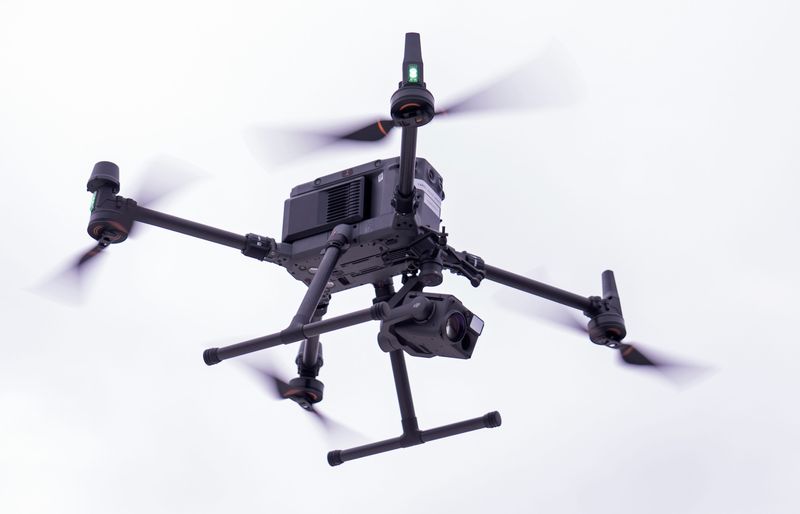
EVANSVILLE — Starting in July, the Evansville Police Department will begin using a drone as the first line of response to some 911 calls.
Evansville Mayor Stephanie Terry briefly mentioned the program in her State of the City address earlier this month as an example of how the administration is expanding “technology and data-driven strategies.”

“We are launching ‘Drone as First Responder’ program on a one-year, free trial very soon,” Terry said. “Early ‘Drone as First Responder’ data shows us that with a 70-second drone arrival that one in four (are) calls cleared without dispatching a patrol unit.”
Following the State of the City, the Courier & Press reached out to EPD spokesman Sgt. Anthony Aussieker, who confirmed the program − using BRINC drones − would be launching soon, with a launch date of July 6. The program involves one drone.
According to BRINC, drones are placed on charging stations around the city. When a 911 call comes in, the closest drone launches. From there, the drone offers dispatchers and police live video of the scene.
Aussieker said the contract was approved during the Dec. 17, 2025 Board of Public Safety meeting.
The Courier & Press attempted to search city meeting archives for key words to find where this had been discussed in a public forum. After receiving the meeting date from EPD, the Courier & Press found the agenda item listed as “Request For Approval Of Contract With Motorola Solutions.”
The contract approved is for four years, including the free first year on a trial basis. Evansville Police will have the chance to opt out of the contract, without charge, after the trial if the department doesn’t feel it’s a good fit. If the city continues the program, it will cost $59,999 annually for the length of the contract.
EPD Capt. John McQuay presented the contract to the board, describing the program as a “really cool setup” where the department would be able to launch a semi-autonomous drone to get ahead of a call for service.
“That way, when officers are approaching they know what they are getting into,” McQuay said.
When will EPD use the ‘Drone as First Responder’?
Aussieker said EPD doesn’t yet have a list of which calls the drone will be tasked with responding to, but shots fired runs are their priority.
“We will need to test further to decide,” he said.
EPD already has drones in use, including from manufacturer BRINC, and this program will not be a replacement for those, Aussieker said.
What does BRINC say about its program?
According to program information from BRINC, the average response time to a 911 call from one of their drones is 70 seconds. From agencies using the program, BRINC states that one in three calls are able to be cleared without having to dispatch an officer.
Are these programs already in Indiana?
Fort Wayne, Indiana, became the first city in the state with a “Drone as First Responder” program. In 2024, Carmel, Indiana became the second city. Both programs are still active.
South Bend, Indiana, announced the start of its “Drone as First Responder” program last month in a news conference. Its provider is Flock Safety.
As reported by WPVE, flight paths and maps of the drone’s responses are available on the city’s Transparency Portal eight hours after the flight, according to the department.
According to reporting from WSBT 22, South Bend was also offered its first year free from the provider.
Critics of the programs want safeguards
In 2023, the American Civil Liberties Union Senior Policy Analyst Jay Stanley released a report titled “Eye-in-the-Sky Policing Needs Strict Limits: We’re on the cusp of an explosion in law enforcement use of drones. Is America ready?”
“We’re very concerned that we may be moving toward a future where we find ourselves constantly scanning the skies, seeing drones overhead, and feeling like the eyes of law enforcement are always upon us,” Stanley stated. “That’s no way for anybody to have to live.”
The ACLU acknowledged how new the programs still were, and laid out a list of proposed guidelines. But before invoking the guidelines, the ACLU maintains a program like this should only come after a community is fully informed of the technology.
“A police department should not, and should not be permitted to, deploy surveillance technologies without the consent of the community it serves,” Stanley stated. “Good policies, including on usage limits, transparency and privacy, should not be left up to police departments, but should be given legal force by a city council or other legislative body as part of a vote to approve a DFR program.”
Guidelines from the ACLU include implementing usage limits, having transparency plans in place and rules on data sharing.
In 2025, Stanley told the Washington Post that oversight bodies could help soothe some concerns around the technology by regulating strict limits.
“This is really a brand new technology,” he told the newspaper, “and the jury is still out on it.”
This article originally appeared on Evansville Courier & Press: Some Evansville 911 callers will get a drone as their first responder
Reporting by Sarah Loesch, Evansville Courier & Press / Evansville Courier & Press
USA TODAY Network via Reuters Connect