“Are those bats?” That is often the question heard when people notice chimney swifts.

With their rapid, stiff-winged, jerky flight, these small brown birds can be mistaken for bats. Listen! If you hear a high-pitched, nearly constant chittering, then you likely are watching chimney swifts.
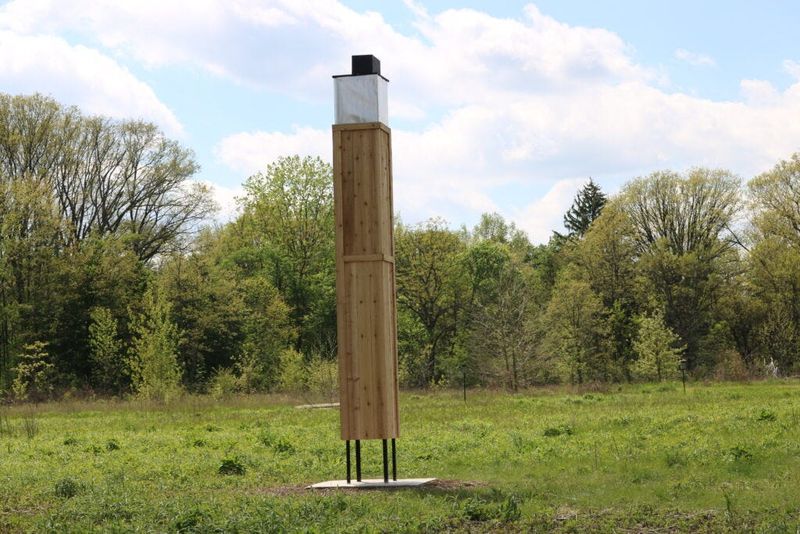
Our area swifts now have a new housing option at Red-tail Land Conservancy’s Dutro-Ernst Woods, where the Robert Cooper Audubon Society has erected a chimney swift tower.
Often described as flying cigars, these birds have a football-shaped body, long straight wings, tiny bills, and short, stiff tails. Chimney swifts are about 5 inches long, are a fairly uniform gray-brown, and are the only swift species in the eastern United States.
They spend most of the year in South America, in the Amazon basin of Chile, Peru, and Brazil. In early spring theybegin their migration back to North America, traveling up through Central America.
They breed in eastern North America from the Gulf to southern Canada. They arrive back in Indiana in April.
These little birds are full of surprises! For example:
Chimney swifts spend nearly all their waking hours in flight, and are at rest only when roosting or nesting. They eat and bathe while in flight, catching insects “on the fly” and flying through water to bathe. They do not perch. They have long claws, which allow them to hang from vertical surfaces but make perching difficult.
Chimney swifts produce a specialized saliva that hardens, allowing them to secure twigs together into a nest attached to a vertical structure, such as the inside of a chimney.
During pre-migration and migration in late summer and early fall, large flocks of chimney swifts come together. At dusk, they swirl above community roosting sites, such as large chimneys, at dusk. As they circle in a constricting vortex, a few birds at a time will suddenly drop straight down into the chimney and find a place to hang for the night. This continues until they are all tucked in. It is an amazing show!
Chimney swifts have an interesting relationship with human populations. They originally adapted to roost and nest on natural vertical surfaces such as hollow tree snags, caverns and cliff faces. When European colonists began settling and building in the Americas, the birds readily started to use chimneys for roosting and nesting. There is some evidence that chimney swift populations grew with the increase in chimneys even as old growth forests, with their many hollowed, dead trees, were cut down. Chimney swifts became familiar urban birds.
Over recent decades, chimney design has changed, becoming unusable by swifts. Fewer chimneys are built, and more chimneys are capped. These changes are thought to be responsible in part for large declines in populations. We have only half as many as we had 50 years ago.
Swift towers are chimney-like structures built by conservationists to provide nesting and roosting habitat for chimney swifts to help slow the decline in their numbers. The Robert Cooper Audubon Society has recently erected a tower with the generous financial support of Josie and Geoff Fox.
We hope to see chimney swifts using the tower soon, and we hope that joggers, hikers, and nature-lovers at the preserve will share in the enjoyment of these fascinating creatures.
Rosemarie Jeffery is a retired physician serving as the president of the Robert Cooper Audubon Society and a volunteer at Red-tail Land Conservancy.
This article originally appeared on Muncie Star Press: Red-tail conservancy: New real estate for local chimney swifts
Reporting by Rosemarie Jeffery, Muncie Star Press / Muncie Star Press
USA TODAY Network via Reuters Connect
By Rosemarie Jeffery, Muncie Star Press | USA TODAY Network