This story has been updated with new information.
Monroe County Sheriff Ruben Marté says a rising number of inmates has pushed the Monroe County Jail beyond its functional capacity and created constitutional and operational concerns, prompting him to seek authority to transfer inmates to other Indiana jails at a potential cost to the county of millions of dollars.

Marté declared a jail emergency this month, and county commissioners ratified a resolution acknowledging the sheriff’s determination that the jail exceeds its functional capacity.
The sheriff’s office estimates that housing 50 to 100 inmates outside Monroe County, transporting them to court appearances, medical appointments and other proceedings could cost between roughly $3 million and $5 million annually until a new jail is built. The proposal still requires approval from the county’s judges, and the Monroe County Council would have to appropriate the necessary funding.
County officials have declined to release historical jail population data that would allow the public to assess how sharply inmate counts have increased or what changed before Marté declared the emergency.
The sheriff’s analysis also relies on a functional capacity calculation that county officials have not fully explained publicly.
The sheriff’s move also renews attention on the county’s long-running struggle with jail overcrowding, capacity and aging infrastructure and comes as local officials debate markedly different approaches to the jail’s future under the shadow of a new federal lawsuit over jail conditions.
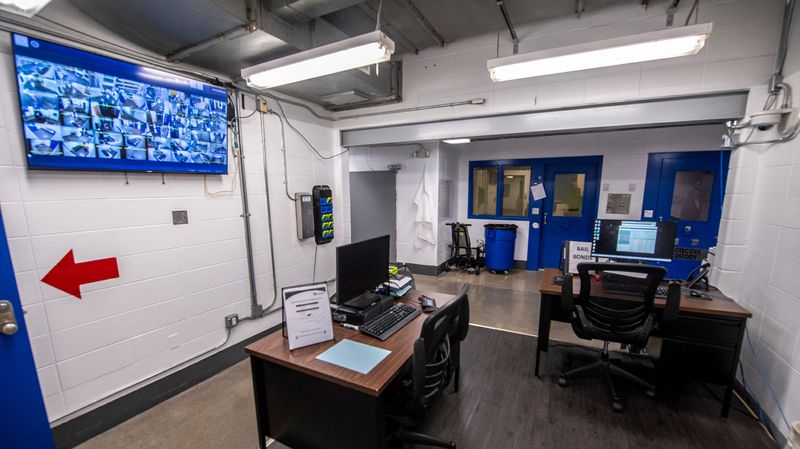
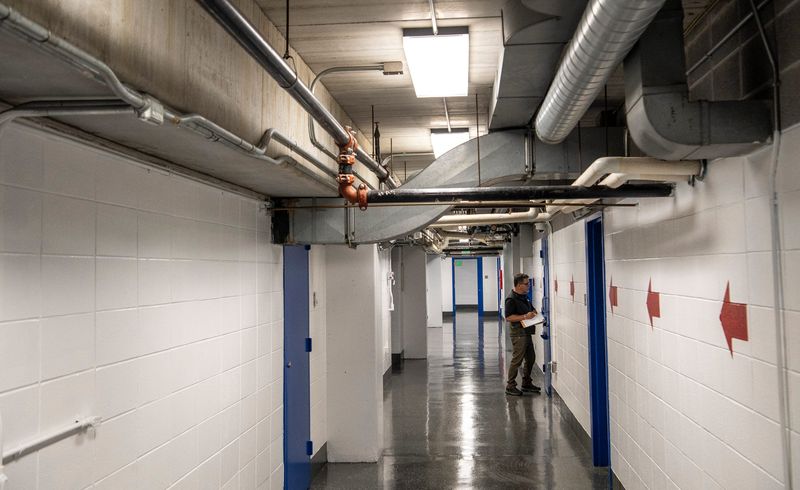
The three most recent Indiana Department of Correction jail inspection reports consistently reported that the Monroe County Jail, at 301 N. College Ave., had 294 operational beds, that there was a bed for every incarcerated inmate, and that no inmates were being housed out of county at the time of the inspections. Inspectors recorded inmate populations of 208 on the inspection day in 2024, 210 in 2025 and 222 in 2026, with average daily populations of 210, 227 and 220.
However, Chief Deputy Phil Parker told commissioners this month that the math isn’t that easy.
He said by the sheriff’s office calculation, the jail’s functional capacity is only 186. He said inmate counts this year have averaged 244 and had peaks above 270, meaning the jail exceeded its functional capacity by more than 80.
Parker said the calculation excludes beds in segregation and holding cells as well as the J Block, which is reserved for inmates with significant mental-health needs. That leaves 233 beds.
To be able to separate different classifications of inmates — gender, age, criminal sophistication, severity of offense, etc. — the sheriff uses 80% of 233 to arrive at 186 as the jail’s functional capacity.
The sheriff’s department did not respond to an emailed inquiry seeking average inmate counts for the same periods of 2025 and 2024. County officials also have not explained whether the jail’s functional capacity also was 186 in prior years and, if so, why they did not declare an emergency earlier.
The Federal Bureau of Prisons did not responded to requests for information about any formal 80% functional capacity standard, and county officials have not pointed to any independent analysis supporting the sheriff’s conclusion that the jail’s functional capacity is 186 inmates.
A spokeswoman for the Indiana Department of Correction said via email that the department does not have any written policy, administrative rule, inspection standard, guidance document, training material or other official publication stating that a county jail should be considered functionally full or overcrowded at 80% of capacity.
However, Noelle Russell, the department’s chief communications officer, said the IDOC “recognizes the National Institute of Corrections (NIC) standard that when a facility is at 80% of total bed capacity, the jail is considered full.”
She said the state’s 80% calculation includes permanent living areas only and excludes temporary housing areas such as a medical unit.
The Herald-Times made repeated requests to interview Marté about the emergency declaration and jail capacity calculations but did not receive a response.
None of the last three jail reports from the state identified overcrowding, assigned a lower functional capacity figure, or applied the sheriff’s calculation that the jail should be considered operationally full at 80% of available housing capacity.
Indiana’s county jail standards define both operational capacity and rated bed capacity but do not define “functional capacity,” the measurement at the center of Marté’s emergency declaration. County officials have not identified a state rule, regulation or policy establishing the sheriff’s calculation that the jail’s functional capacity is 186 inmates.
The sheriff’s calculation also excludes beds reserved for inmates with mental-health needs, while separately reducing capacity to account for inmate-classification requirements. Because mental illness is itself a classification category, the sheriff’s report does not explain how those two adjustments interact.
Although commissioners ratified the jail-emergency declaration, they removed a specific functional capacity benchmark from an initial draft resolution and instead acknowledged the sheriff’s office’s determination that the jail population exceeds its functional capacity.
Commissioner Julie Thomas said the change was intentional because commissioners are not experts in jail operations or inmate capacity calculations.
Commissioners did not respond to repeated emailed inquiries.
The emergency declaration comes amid a broader debate over the future of the county jail. Marté and commissioners have long argued that the existing facility is obsolete and should be replaced, though the county council has twice rejected the commissioner’s plan to build a justice complex on property between Bloomington and Ellettsville. A recent community advisory group — in which both the sheriff and commissioners declined to participate — recommended renovating the existing jail and expanding it on adjacent property.
During discussion of the emergency declaration this month, Marté said proposals to renovate the existing facility underestimate its limitations.
“When people say, ‘Well, just remodel the jail and you can make it work,’ I don’t think they fully understand the scope of this,” he said.
Boris Ladwig can be reached at bladwig@heraldt.com.
This article originally appeared on The Herald-Times: Monroe County jail emergency could cost millions. How full is it?
Reporting by Boris Ladwig, The Herald-Times / The Herald-Times
USA TODAY Network via Reuters Connect

By Boris Ladwig, The Herald-Times | USA TODAY Network