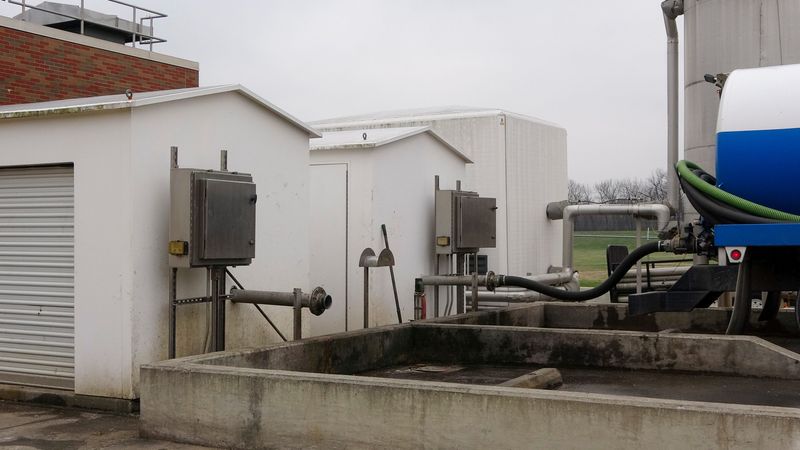
EVANSVILLE — An ordinance making it easier to establish privately owned septage receiving pumping stations in the county passed 2-1 before the Vanderburgh County Commission.
Mike Goebel, D-District 1, was the one no vote, voicing his support of tabling the issue to a future meeting. There were also concerns from the public, many who are worried about potential proximity to homes and other businesses under expanded zoning.

The ordinance, which the Area Plan Commission voted 6-2 in favor of earlier this month, updates the “Land Use and Zoning” section of Vanderburgh County Code to allow the creation and use of privately owned septic receiving stations in M-1, M-2 and M-3 zoning districts.
The ordinance was proposed to address the planned closure of the septic receiving station at the Evansville Water and Sewer Utility.
County commission president Justin Elpers, R-District 3, said when the closure was first announced he knew it would be a big issue that could impact a lot of county residents. After a meeting Elpers had with Mayor Stephanie Terry and EWSU Executive Director Vic Kelson, the closure date was pushed from Jan.1 to July 1.
That date is now coming fast.
Elpers said the priority is to find a solution. With private septage receiving stations only allowed in areas zoned M-3, opportunities were limited in where a new station could be built.
Under the new zoning, haulers wanting to build a private station could look for land in M-1 and M-2 areas, as well. Elpers said this will offer more flexibility. And without it, local residents with septic could see their bills look a lot different when the waste is being hauled out of town, he said.
As defined by code, M-1 is light industrial, M-2 is general industrial and M-3 is heavy industrial. Each zoning district has specific uses allowed and requirements and restrictions that go with those. Now those uses will include locations where private companies can dispose of septic.
M-1 includes businesses like professional offices, art galleries, retail stores, manufacturers of cosmetics, signs and metal awnings, along with recreational uses like tennis courts and an archery range. The list of uses is long and can be found on the APC’s website.
M-2 takes out the possibility of office space or a childcare center but adds uses like freight handling and petroleum bulk storage. M-3 allows for heavy duty uses like manufacturing of fertilizer and tar, as well as the storage of explosives.
Residential uses are not permitted in these three zoning districts, but it doesn’t eliminate the possibility of homes or other types of businesses being nearby. The APC zoning map shows multiple examples of zoning districts abutting against each other.
Ashlee Bowlds, a county resident, said her concerns started when a property near her home on Allen’s Lane was brought forth for a rezoning with the end goal being a private septic receiving station. That rezoning was ultimately withdrawn, but Bowlds had over 160 neighbors sign a petition in opposition to the plan.
Now, she has over a 100 signatures opposing the updates allowing the stations to be placed in M-1, M-2 and M-3 zones. The overall ask of the petition is for private septic station to remain only in M-3.
Reasons for that include potential odors, heavy truck traffic and impact to local homeowners.
Bowlds said there is concern around the transparency and communication that comes with the updates. Businesses wanting to locate a septic station in M-1, M-2 and M-3 won’t need to file for a rezoning. This means neighbors could be less likely to know when a facility is moving in.
“When people are informed, they show up and they speak out,” Bowlds said.
This article originally appeared on Evansville Courier & Press: It’s now easier to build a septic dump station in Vanderburgh County
Reporting by Sarah Loesch, Evansville Courier & Press / Evansville Courier & Press
USA TODAY Network via Reuters Connect