Update: The Ethics Committee on May 27 voted to recommend approval of the plan to remove councilors’ home addresses from ethics forms. The full council will vote on the proposal June 1.
Indianapolis City-County Council leaders are trying to remove councilors’ addresses from an online form after one councilor’s home was targeted in a shooting following a controversial data center vote.

A new proposal to be heard May 27 would remove the requirement for councilors to report their home address on ethics forms posted to the city’s website. Top councilors from both parties say it will enhance privacy in a heated political climate where public officials face frequent threats and rising violence.
But at least one councilor and an open government expert told IndyStar they oppose the idea because they said it reduces transparency without really improving safety. Even councilors who back the proposal concede it won’t do much to prevent people from finding out where they live.
What Indy councilors disclose in ethics forms
Councilors must file annual ethics forms that disclose where they live and where they work, as well as any payments over $5,000 that the city made to their employer. Councilors must also report information about their immediate family members’ employers and gifts they received from people and firms who do, or seek to do, business with the city, among other things.
Councilors updated the law in 2024 to require the forms to be posted online each year by March 1 and to include more information about contracts between their employers and the city.
But now council leaders want to remove home addresses from the forms with a resolution that the Ethics Committee will discuss May 27. Sponsored by Democratic Councilor Jessica McCormick, the proposal follows an instance of violence and threats against multiple councilors.
In early April, Democratic Councilor Ron Gibson’s home was shot overnight after he vocally supported a planned data center in the Martindale-Brightwood neighborhood. Democratic Councilor Nick Roberts said he had threats directed at his home last fall after he condemned similar threats to Republican state senators for their lack of support for mid-cycle redistricting. No one was injured in either case.
Gibson told IndyStar that before the shooting, which remains unsolved, he probably would have opposed the idea of removing his address from the ethics form. But after seemingly political violence hit close to home, he said he supports the proposal.
“I think it’s important to be transparent to voters,” Gibson said. “But in this changing time, when the rhetoric and even political violence is so real, I almost feel like anyone serving in a public capacity probably should not have their address out in the public.”
Top councilors back the idea, one councilor opposes it
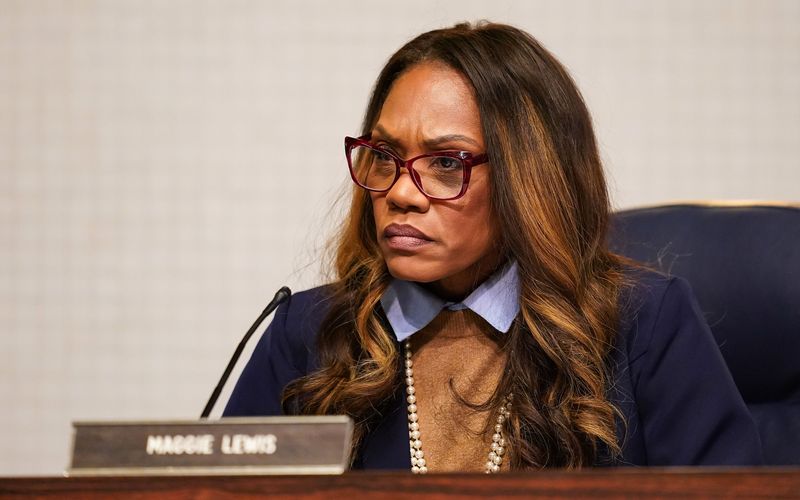
Council President Maggie Lewis, a Democrat, told IndyStar that removing addresses from ethics forms is an important first step in protecting the safety of councilors and their families.
“When elected officials and public servants are being targeted, I think it’s important that we do what we can to address the concerns about their personal safety, their family’s safety,” Lewis told IndyStar. “I do believe that this is the start of an ongoing conversation. I can see us adding in a conversation about all our public safety officers, our city-county employees.”
Brian Mowery, the top Republican on the Democrat-led council, said he also supports the idea and wants to see similar protections established for city-county employees in general.
“It’s one thing for someone to come after me at a council meeting or out in public,” Mowery said. “It’s another thing to know where my family lives, and where my family would be at any given time, even when I’m not there.”
While council leaders support the idea as a step in the right direction, Councilor Jesse Brown and an open government advocate said they oppose it. They fear it would complicate residents’ search for information without meaningfully shielding councilors from harm.
Brown, a Democratic socialist who often disagrees with Democratic leadership, said the council should be strengthening its ethics disclosures to include more information about stock ownership and travel or entertainment perks — not weakening the laws.
“It reads really, really poorly to the average person, and I don’t think it actually helps solve any real problem,” Brown said of the proposed change. “But I do think it makes it harder for the public to access information about the public officials who get paid with their tax dollars.”
Brown also said the council failed to adhere to the ethics ordinance this year by posting the forms in late April, over a month and a half after the March 1 deadline.
Council spokesperson Sara Hindi confirmed the forms were posted after the March 1 deadline, but did not answer IndyStar’s questions about why they were posted late and what date they went online.
As of May 22 a form was still unavailable for Councilor Dan Boots, who told IndyStar that he’s waiting on financial information from his employer, the law firm Dentons.
Open government advocate says address change is ‘the wrong solution’
While the proposal would remove addresses from one public-facing form, councilors who back the idea acknowledge that people still have ample ways to find out where they live.
Councilors must report their home addresses to election officials to prove they live in the district they represent, which means people can obtain that information through a public records request. Other avenues for learning where councilors live include campaign finance forms, voter registration records and property tax documents.
“If you do a Google search, it’s so easy to find our information,” Lewis told IndyStar. “So we are being transparent. The information is available on other documents.”
Despite the real danger to public officials, the public still has a right to know where councilors live and how that might be influencing their decision-making, said Zachary Baiel, president of the Indiana Coalition for Open Government, an advocacy group.
That need was made clear in recent reporting that showed several councilors allocated road funding to pave streets in or near their neighborhood. Each councilor said their decisions weren’t based on the benefit to themselves, but some acknowledged that leaders in their neighborhood knew how to get their attention.
Baiel said this new ethics proposal is the “wrong solution to a very serious problem” of political violence. In his view, councilors can turn down the temperature by ensuring their constituents have a say in the political process — not by trying to hide their addresses or phone numbers.
“Violence is never the solution when it comes to these types of disagreements,” Baiel told IndyStar. “But on the flip side, what are they doing to make sure that they’re actually engaging the constituents and being the public servants that they’re elected to be?”
Email Indianapolis City Hall Reporter Jordan Smith at JTSmith@indystar.com. Follow him on X @jordantsmith09 and Bluesky @jordanaccidentally.bsky.social.
This article originally appeared on Indianapolis Star: Indy council tries to nix addresses from public form after councilor’s home was shot
Reporting by Jordan Smith, Indianapolis Star / Indianapolis Star
USA TODAY Network via Reuters Connect