Whatever the ideal amount of fried chicken to consume in a year is, I’m pretty sure I blew past it sometime in late March.
Such is the risk of managing IndyStar’s Fried Chicken Challenge, which reached its conclusion April 13. My efforts to verify the tournament’s results took me to beloved neighborhood spots, historic establishments and even a grocery store deli. But lest it get lost in the shuffle, I wanted to dedicate some words to:

The next dish you should try in Indy
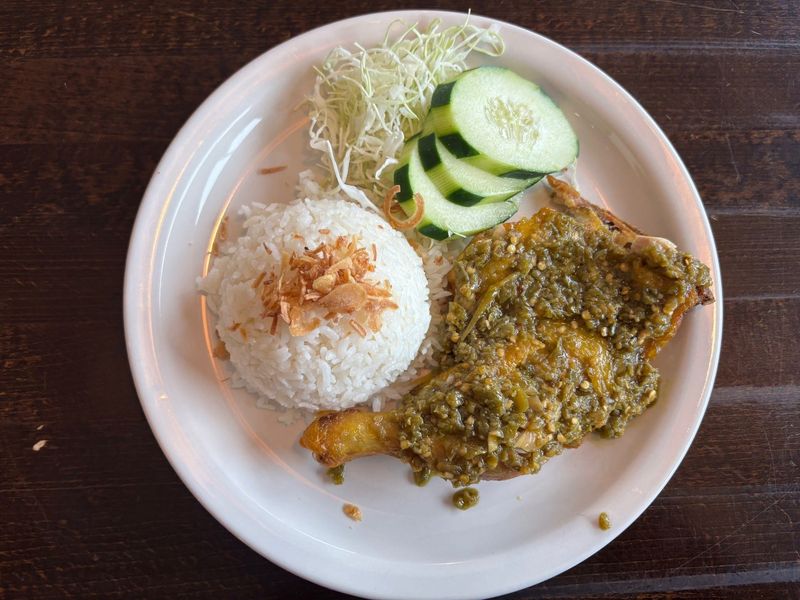
Though it didn’t exactly pull off a Cinderella run, the Indonesian fried chicken from Wisanggeni Pawon at Keystone Avenue and 71st Street was among the most distinctive competitors in our tournament. So for this edition of INdulge, I swung back by the north-side eatery for a plate of ayam penyet ($17).
Roughly translated as crushed, smashed or pulverized chicken in Javanese, ayam penyet features chicken (ayam) that is partially braised, then fried and finally smushed (penyet) with a pestle before it is served with searing-hot sambal, or spice paste. The result is a tremendously tender bird with glass-like skin, all extremely desirable qualities in the field of fried poultry.
Historical records of ayam penyet are sparse, though the dish appears to have originated within the last five decades or so on Indonesia’s main island, Java, as a twist on classic ayam goreng (fried chicken). Most versions of ayam goreng are distinguished by the inclusion of bumbu kuning, a blend of several ingredients including garlic, shallots, ginger-like galangal and enough earthy turmeric to give the “yellow spice” its name. Many Indonesian fried chicken recipes begin with marinating and subsequently par-cooking meat in bumbu kuning, softening the meat and imbuing it with flavor.
Exactly how much flavor is a matter of some debate. Anyone who has waded into home cookery has likely encountered a head-spinning maelstrom of meat-related maxims, ranging all the way from “you must marinate your meat” to “marinades do literally nothing.”
As with most contested culinary wisdom, the truth lies somewhere in the middle. It’s true that soaking your bird probably won’t do as much as you’d hope, as most herbs and spices are far too large to pass through animal muscle. It doesn’t matter how meticulously concocted your marinade or brine is; even the best-resourced food scientists have yet to crack how to blast chicken breast with the full might of Lawry’s Honey Teriyaki.
The good news is that this doesn’t especially matter. Chicken isn’t very large, and even a quick hot bath in bumbu kuning is enough to impart some lovely semi-floral flavor and plenty of tenderness. And if the yellow spice paste isn’t strong enough for you, that’s where the sambal comes in.
Sambal is a cornerstone of multiple Southeast Asian cuisines, arguably most importantly Indonesian. By combining the chili peppers brought by Portuguese and Spanish traders in the 16th century with lime juice and pungent native herbs, Indonesians over time created a brilliant and widely varied array of bristling condiments.
Certainly, I do not believe pain and satisfaction are mutually exclusive when it comes to food; after all, one of the most iconic dishes in our city is cocktail sauce that hurts your skull. That said, I suspect ayam penyet crosses into a stratosphere of spice that many have no desire to enter. The green sambal that coated the smashed-in nooks and crannies of my penyet drumstick and thigh was as punishingly hot as anything I’ve eaten in Indy.
Not that sambal is devoid of flavor. Much of the charm of Indonesian food is, to me, how it balances face-exploding spice with bright botanical notes and subtle vegetal flavors. Now, I imagine I’d have an easier time picking out those flavors had my ancestors spent less time eating boiled fish and dry bread, but sometimes you just have to roll with the punches.
Indeed, the punches came swiftly, and I left the restaurant looking as though I had literally gotten the snot kicked out of me. Feel free to opt for Wisanggeni’s milder but similarly delicious fried chicken madura, but I greatly enjoyed my bout with the merciless smashed chicken. If nothing else, I thoroughly appreciated a certain poetic irony in my meal. I’d like to think that I am no chicken, but on that day, I was unquestionably penyet.
What: Ayam penyet, $17
Where: Wisanggeni Pawon, 2450 E. 71st St., (317) 756-9477, wpawon.com
In case that’s not your thing: Wisanggeni Pawon offers a deeply flavorful (as in, not always spicy) variety of meats, noodles, rice and tempeh. The bakmi jawa (Javanese stir-fried noodles, $15) are classic sticky-sweet takeout comfort, while the bebek madura (fried duck, $25) coated in toasty black sauce skews more luxurious. You’ll also find a handful of comforting soups ($8 to $15) and classic satay ($12 for chicken, $23 for lamb) alongside assorted Indonesian coffees and lattes. And if for some reason you want slightly different but equally spicy chicken, check out ayam penyet’s heavily breaded American cousin, ayam geprek ($17).
Know of a dish or drink worth trying around Indy? Let dining reporter Bradley Hohulin know at bhohulin@indystar.com. You can follow him on Instagram @BradleyHohulin and stay up to date with Indy dining news by signing up for the Indylicious newsletter.
This article originally appeared on Indianapolis Star: INdulge: Spicy, smashed fried chicken is next dish to try in Indy
Reporting by Bradley Hohulin, Indianapolis Star / Indianapolis Star
USA TODAY Network via Reuters Connect