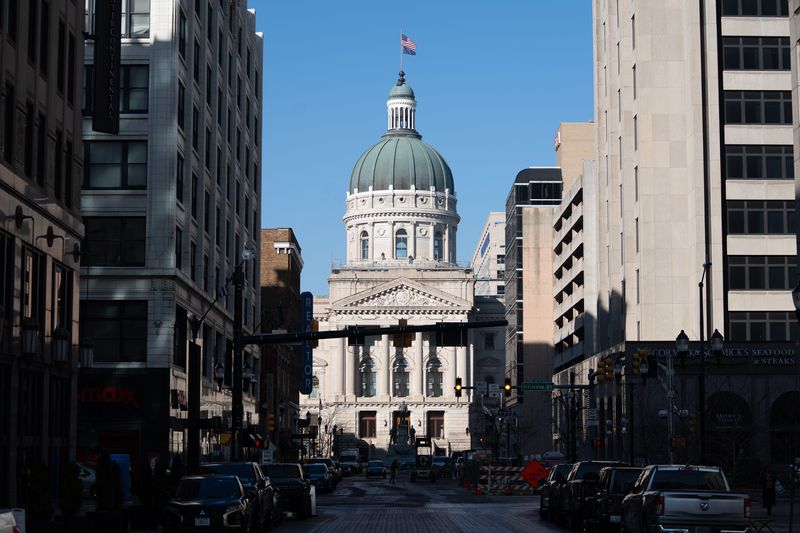
In the past year, 29-year-old Caleb Guerrero has found himself coming to the Statehouse more often than ever before.
On a Tuesday in February, the occasion was a bill granting hundreds of Indiana National Guard members power to make arrests and conduct searches and seizures across the state. The east-side Indianapolis resident took off work, made a sign in protest and stood calmly outside the room where a committee was hearing the bill.

He was also watching a bill that would force local institutions, including schools and businesses, to fully comply with the mass deportation efforts sweeping American cities. And another that would make it illegal to sleep on public property because you don’t have a home.
It seemed to him like the Statehouse was becoming an extension of the White House — taking a harsh law-and-order approach to his city that doesn’t match his lived reality.
“Hearing the same rhetoric from the White House trickle down to bad-faith [arguments] from our own representatives in office tells me that it’s a case of being immensely out of touch with voters on the ground,” Guerrero told IndyStar.
The perennial power struggle between the conservative Indiana General Assembly and the state’s more progressive cities is a tale as old as the Republican supermajority. Yet it felt especially fraught this year to Guerrero and many others, as President Donald Trump repeatedly picks fights with Democrat-led cities across the nation, particularly over issues affecting public safety.
Critics say many policies that encroach on local law enforcement seem out of touch with reality and more closely aligned with the president’s view that major cities are “hellholes” where Republicans must impose their will to maintain order.
After federal agents killed two American citizens who protested the Trump administration in Minneapolis this January, many progressives are on high alert about how state or federal law enforcement could crack down on similar backlash in Indianapolis.
Republicans who legislate with cities like Indy in mind say that years of policy failures on urban issues like public safety and homelessness show what happens when Democrats are left to their own devices: Violent crime rises to unprecedented levels. Neighbors are forced to live next to sprawling homeless camps. Businesses get windows broken during anti-police protests.
Although many Statehouse Republicans acknowledge the complexity of these issues, they advocate for stricter responses than Democrats and community organizers tend to support.
During this year’s legislative session, Republicans stripped power from civilian-led police oversight boards, focused on one in Indianapolis. They banned homeless camps on public property, with the belief that some people won’t seek help until they’re forced to do so. They empowered part of the Indiana National Guard to act as full-service police officers whenever they’re deployed by the governor.
They also targeted Marion County Prosecutor Ryan Mears and county judges for what they perceive to be weak charging and sentencing practices. One new law will strip power to select judges from four Indianapolis-based organizations and instead grant more influence to Indiana Gov. Mike Braun and the Indiana Supreme Court.
Republicans who control state government have a vested interest in ensuring that their capital city, the “economic engine of the state,” is running smoothly, argues Indianapolis Sen. Aaron Freeman. Indy is the front door to Indiana for visitors who come here for conventions and sporting events. Accordingly, the state has also chipped in for major projects, like backing the bonds to build Lucas Oil Stadium downtown.
“There’s a tug and a pull there. There’s always going to be,” Freeman said. “Remove Indianapolis from Indiana and that’s not a good situation. … They need us — you can’t do Lucas Oil without us — and we need them.”
But to progressive politicians and observers, state policies that lean harder on law enforcement will undercut more holistic solutions implemented after the police killing of George Floyd. Rolling back reforms like the civilian oversight board while granting more power to National Guard members erodes the community’s trust, they argue.
Some fear that current trends harken back to the tough-on-crime era of the late 20th century, whose policies showed progressives that communities cannot police their way out of complex issues like substance abuse, poverty and homelessness.
“If all we see is a nail, and the only way to fix that is a hammer, that’s what we’re going to use,” Rabbi Aaron Spiegel, president of the Greater Indianapolis Multifaith Alliance, said of the slate of Republican policies. “I think they see immigration and lawlessness writ large as the nail, and the only way to solve that is law enforcement.”
Perception vs. reality on Indianapolis crime
Republicans’ concerns about public safety in Indianapolis aren’t purely based on vibes. But critics say their policies oversimplify issues to score political points with their base — often voters who live on Indianapolis’ outskirts or in surrounding counties — while threatening local progress.
Violent crime did rise during Indianapolis Mayor Joe Hogsett’s first two terms, according to police data, with murders eventually peaking at nearly 250 in 2021 — about 70% higher than the deadliest year under his Republican predecessor, Mayor Greg Ballard. After protests in 2020 had devolved into late-night rioting, the former police chief himself said, “Downtown is not safe at this time.” That same night, two people were killed.
That increase in murders was erased by the end of 2025, however, after the city spent years investing in violence-prevention programs that aim to address root causes. Violent crime has fallen nationwide.
Yet a high-profile mass shooting downtown last July prompted some Republicans, as well as the police union, to call for the state to intervene in local law enforcement.
“The intent is to suggest that cities, particularly run by Black mayors but just big cities in general, are places that are unsafe,” said Marshawn Wolley, president of the African American Coalition of Indianapolis.
That statistics have improved lately is not lost on state Rep. Andrew Ireland, a Republican from the south side of Indianapolis — not far from where a Beech Grove officer was killed on Feb. 16. But the numbers aren’t as low as they used to be in an average year under Ballard. And per capita, Indianapolis’ homicide rate is still higher than Chicago’s.
“For all of the kind of strategic advantages I would think we would have on that issue, we still struggle,” Ireland said. “So there’s been a lot of talk recently about, ‘Oh, the perception really isn’t reality,’ but I disagree with that.”
To those working on the ground, a fixation on statistics overlooks the community-based work that’s chipping away at the root causes of violent crime.
At the Statehouse, interest groups — sometimes from outside Indiana — tend to dominate the discussion and have the wherewithal to lobby lawmakers. Meanwhile, community groups that come together in the wake of events like the series of youth shootings in July are too busy trying to connect with young people, Wolley said.
“When the state steps in, we have legislators who are not from the community, or maybe not connected to the community organizations that are trying to develop positive solutions,” he said, “coming up with solutions in a vacuum.”
How echoes of the pandemic, George Floyd protests linger
The gulf between the two parties and the ubiquity of national politics was on full display during debates over House Bill 1343, which could create an Indiana National Guard “military police force” to enforce local laws during state emergencies.
What Republicans spoke of as a benign bill to offer police training to ad-hoc troops who normally patrol federal property, Democrats rebuked as a loophole for the governor to send a cadre of guardsmen to city streets to intimidate residents.
Citing Trump’s aggressive use of federal forces in liberal cities nationwide, critics said the bill would open the door to Braun deploying guardsmen to curry political favor with the White House. Indiana law already gives the governor sweeping authority to activate guardsmen for reasons including public disasters, breach of the peace and “any other time the governor considers necessary.”
Rev. David Greene, an Indianapolis faith leader who’s also running for Indiana Senate District 29, told IndyStar it’s not far-fetched to imagine the governor wielding this new authority in problematic ways.
“If [Immigrations and Customs Enforcement] is coming, it’d be nice to have the National Guard be able to make arrests. And wouldn’t that discourage people from protesting?” Greene told IndyStar. “One supports the other.”
Community organizers are already mentally preparing for such scenarios, with an eye toward the polls during the 2026 midterm elections.
Josh Riddick, an Indianapolis-based organizer with Live Free USA, said there’s plenty cause for concern: Attorney General Pam Bondi asked Minnesota Gov. Tim Walz for his state’s voter rolls. Department of Homeland Security Secretary Kristi Noem has pushed for federal legislation to tighten voting laws. And a leaked October memo from the Pentagon ordered all 50 states’ National Guard units to form “quick reaction forces.”
“If you want to sink voter engagement in the midterms, you militarize a force who can show up in and around election time to overpolice communities,” Riddick said. “And you use crime as a justification to do it.”
Governors have already used guardsmen in seemingly political ways. Last year Trump convinced Tennessee’s Republican governor to deploy troops to Memphis on the pretense that crime had reached emergency levels. A judge later sided with state and local officials who sued to block the deployment, finding that the city’s crime rates were not in fact a “grave emergency.”
Indiana National Guard officials denied that the new law had any association with Trump’s deployment of guardsmen nationwide. Rather, they said it was partly inspired by the protests and riots that overwhelmed downtown Indianapolis in 2020 after Floyd’s death.
The scars from the George Floyd-era protests were top of mind for Republican legislators who supported not only the National Guard bill but other attempts to intervene in Indianapolis law enforcement.
“I can remember vividly when folks were trying to, I don’t know, burn down the Statehouse during a riot,” Freeman said during debate on the bill. “Thank God there were people that responded, and thank God that the National Guard could have been called in because Indianapolis was clearly incapable of defending anything.”
Ireland said he thinks both sides of the aisle are overstating the impacts of the National Guard bill. He sees this becoming handy if, say, the state hosts another Super Bowl and needs specialized law enforcement.
But Democrats can’t get past the timing and the political context.
“Indiana’s been in existence since 1816, and all of a sudden somebody said, ‘Oh my God, why haven’t we done this before?’” Indianapolis Rep. Mitch Gore said. “Our governor does have a track record so far of kind of parroting Trump’s rhetoric and policies.”
Making homelessness a law enforcement issue
Now homelessness in Indiana is part of the policing discussion, and the justification for that partly comes from what lawmakers from far-flung parts of the state see when they come to the state capital for session.
Rep. Wendy McNamara, a Republican who represents a small southern Indiana county, said during a debate over the street camping ban that she’s been forced to “step over feces, step over urine, step over homeless people” near the apartment she rents during session. She said she no longer wants to see them lying outside downtown businesses, warding off customers.
Indy’s homeless population ballooned to more than 1,800 people last year, the third-highest total since 2010. In those numbers Republicans see the failure of the “Housing First” approach, whose proponents argue the best way to end homelessness is to house people and then offer social services.
So conditions are ripe to grab onto a different policy solution, one pushed nationally by the conservative Cicero Institute to ban public camping and allow police officers to fine or arrest people who don’t move along within 48 hours of a warning.
“State legislators come here for three to four months once a year and in their minds, nothing has changed. And you know what? They’re right. Nothing has happened,” Spiegel said. “All the promises the city has made around homelessness have not come to fruition.”
Homeless advocates say the numbers remain high because the Housing First strategy has never been adequately funded, and more people slipped into homelessness as evictions rose and housing costs skyrocketed from 2020 onward. Only in the past year has Indianapolis committed money to a public-private partnership, Streets to Home Indy, to move more than 300 people sleeping outdoors into housing by this summer.
Indianapolis resident Chris Wakefield gives a spiel about potential encounters with people experiencing homelessness to anyone who joins one of his walking history tours downtown.
He tells them that some people might approach and ask for money. Some may just want to talk. He informs the interrupter politely but firmly that this is a private tour. Usually, he said, “it’s a quick two-minute thing and we’re on about our day.”
Wakefield, who lives near downtown, knows that the city has a problem with finding enough services for unhoused people who need help. From his vantage point, however, punitive solutions like the street camping ban seem more performative than helpful.
“It’s like this kind of dance that we do,” Wakefield said, “that we know it’s not really going to fix anything, but you can take that back home to your constituents and say, ‘Look at how I’m making this big, scary city safer for you,’ instead of the structural change that we need.”
Housing advocates, as well as many Indiana sheriffs, would rather see the resources spent enforcing the street camping ban and holding people in jail go toward solutions like permanent supportive housing and mental health services.
And that’s what bothers everyday citizens like Guerrero most of all about a politics ruled by “culture war rhetoric.”
Practical issues that most people care about like paving roads, addressing food deserts and making health care affordable can get overlooked because hot-button debates distort reality.
“We’re not at war,” Guerrero said at the Statehouse. “The screaming in our screens doesn’t reflect our everyday life. … I just want us to be serious.”
Email Indianapolis City Hall Reporter Jordan Smith at JTSmith@usatodayco.com. Follow him on X @jordantsmith09 and Bluesky @jordanaccidentally.bsky.social.
This article originally appeared on Indianapolis Star: Indiana’s barrage of law-and-order policies stokes fear of crackdown in Indy
Reporting by Jordan Smith and Kayla Dwyer, Indianapolis Star / Indianapolis Star
USA TODAY Network via Reuters Connect