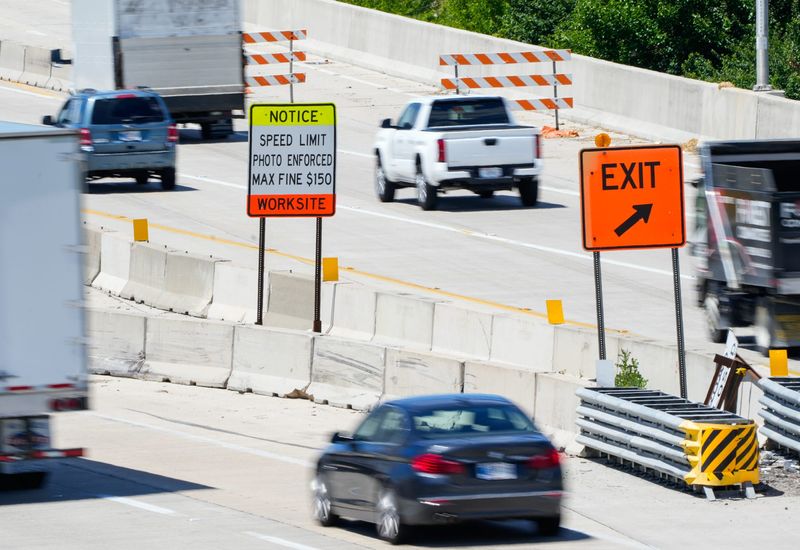
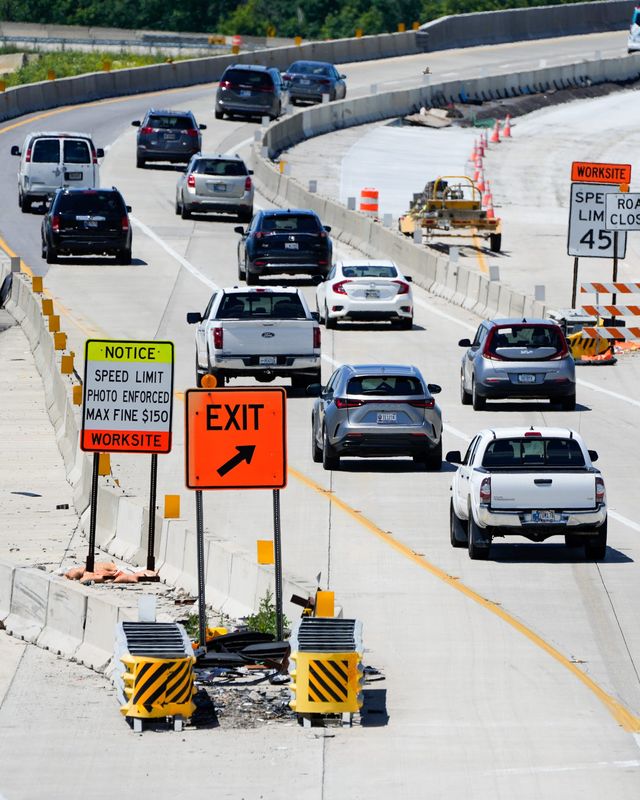
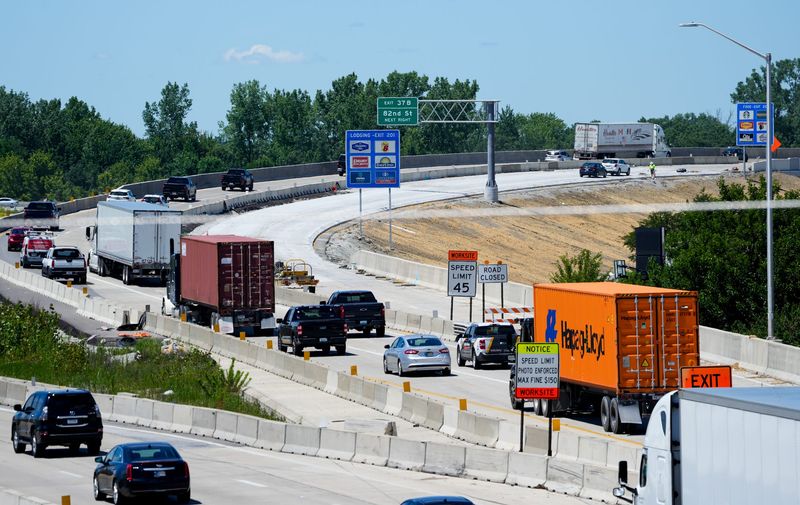
The bright yellow and orange signs catch drivers’ attention as they drive through the busy I-465/I-69 construction zone:
“ACTIVE: SPEED LIMIT PHOTO ENFORCED.”

Despite the warning sign since the camera was installed more than a year ago, thousands of drivers received violations from a camera for driving over the speed limit in the area. Most of the people ticketed were driving 60 miles per hour or lower in the 45-mile-per-hour construction zone.
Others were more egregious: One driver was captured speeding past the camera at 102 miles per hour – more than double the construction zone speed limit.
In the pilot year of Indiana’s first “Safe Zone,” the Indiana Department of Transportation doled out nearly 278,000 speeding tickets in the Clear Path I-69/I-465 construction zone on the northeast side of Indianapolis. The construction zone has slowed traffic for the past five years as INDOT undergoes a complex reworking of the interstate interchange.
Not only has it slowed traffic; it’s also good money for the state.
The tickets have earned more than $3.2 million for state coffers, according to INDOT revenue records obtained by IndyStar. That money goes straight to the Indiana General Fund, which state lawmakers use to allocate money to services like Medicaid, prison facilities and pension payments.
An average of 1,300 violations were delivered each day the camera operated, with the most occurring on Friday, June 27, 2025, when the camera captured 4,566 speeding violations. Most days, the camera ran between the hours of 9 a.m. and 3 p.m., according to an IndyStar analysis of the data.
In one instance, the camera caught 22 people speeding in less than a minute.
Records show the camera starts giving out violations at 56 miles per hour. INDOT says the measure is meant to slow drivers down, reduce crashes and save the lives of both motorists and construction workers. The program went live last spring after state lawmakers passed a 2023 bill approving the zones.
Though the speed camera technology catches more speeders than any one police officer could, the new technology still has its limits. The camera, mounted on a pickup truck, must be set up and manned, meaning it only operates during active construction hours. Data shows the camera rotates between four spots on I-69 and I-465.
The camera bases its citations on license plates, so violations are issued to a physical vehicle, not a specific driver, and are not shown on a driver’s record. Plus, the state can legally operate only four safe zones at one time.
The camera never operated on the weekends and ran on about 80% of weekdays. At times, INDOT went several days without turning on the camera, going as long as 10 days without ticketing any drivers during the holiday season.
In an email, an INDOT spokesperson said the days and times of speed enforcement were generally determined by weather, traffic speeds and contractor requests.
The northeast side of Indianapolis speeding initiative launched in May 2025 was the first in Indiana to use technology rather than law enforcement to slow down traffic in potentially dangerous areas for construction workers. In 2024, 30 people were killed in work zone vehicle crashes, while more than 1,500 were injured in similar crashes, according to INDOT.
Since then, the state has expanded to include three more zones, one on I-65 in Jasper County, one on I-70 in Hancock County and one on I-74 in Decatur and Shelby Counties.
Drivers fined for 2nd and further violations
Not all violations result in an immediate fine. First-time violators get a warning notice in the mail. Second-time offenders receive a $75 ticket. Three times or more and drivers cough up $150 a ticket. Data shared with IndyStar did not specify how many violations were repeat offenses.
An INDOT spokesperson said just 13% of violations have fines attached, indicating that “the majority of drivers are slowing down after receiving a first warning.”
“Overall, the program has been successful,” the spokesperson wrote.
For drivers going through the construction zone on a daily basis, navigating the speed zone is a balance. Paul Radaker, a videographer from Noblesville who commutes south from I-69 to I-465 every day, thinks INDOT is trying to do the right thing to protect construction workers from hazards.
On the other hand, the cameras often cause cars to screech to a halt, which leads to backups on the interstate. Those driving slowly can get run off the road by drivers ignoring posted speed limits.
“If I am going 45 miles per hour and everyone else is going 70-plus miles per hour, that’s an accident waiting to happen,” Radaker said.
Radaker said he hasn’t received a violation, yet, but questions the constitutionality of a measure that is based on a vehicle, not the individual driver.
Cheryl Dudley has received two violations in the mail, the second costing her $75, and worries a third may be on its way.
Dudley said she set her cruise control to 55 miles per hour, within the range INDOT said would spare drivers a fine. Still, a warning came in the mail. Months later, a second violation with a fine arrived. She decided not to contest it.
“I was just like ‘Is this worth my time?’ Absolutely not,” said Dudley, who commutes downtown three days a week from Fishers.
Going forward, she is changing her tune. If a third violation comes, she says she will contest it.
Alysa Guffey writes business and development stories for IndyStar. Contact her at alysa.guffey@indystar.com.
This article originally appeared on Indianapolis Star: In one year, INDOT raked in $3.2 million in I-465/I-69 speed zone
Reporting by Alysa Guffey, Indianapolis Star / Indianapolis Star
USA TODAY Network via Reuters Connect
By Alysa Guffey, Indianapolis Star | USA TODAY Network