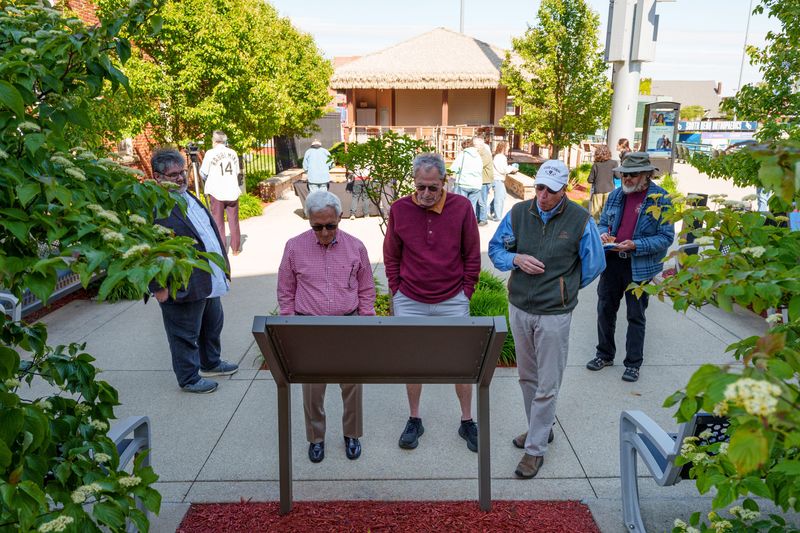
SOUTH BEND — Community members and Cubs fans alike gathered Friday, May 15 at South Bend’s Four Winds Field, as The Indiana Jewish Historical Society hosted a historical marker dedication ceremony honoring Albert Von Tilzer’s contributions to baseball as the composer of “Take Me Out to the Ball Game.”
Von Tilzer (born Elias Gumbinsky) grew up in a Lithuanian Jewish immigrant family in the 1870s on the southside of Indianapolis.

“His family was very musically inclined. He was kind of like the first Indiana King of Pop,” said Michael Brown, the executive director of The Indiana Jewish Historical Society. “You can almost compare [the Von Tilzers] to The Jackson Five, because all [five of] the brothers were all very musically talented, and many of them became great music writers and artists in their own right.”
For Albert, his landmark contributions to the music industry came at the turn of the 20th century when he moved to New York and played a key role in the establishment of Manhattan’s Tin Pan Alley, which “represented a creative and commercial energy that was to have a hand in American music today,” according to Sound American Organization.
Tin Pan Alley was the environment from which Albert composed “Take Me Out to the Ball Game” while among equally musically gifted individuals, like Jack Norworth, a colleague who first came to Albert with the idea for the tune, Brown said.
“The funny thing is that neither Albert nor Norway had ever been to a ball game,” Brown said.
Rather, the song is written from the perspective of Norway’s then-girlfriend, who was trying to talk him into going to a baseball game.
“I think it’s really fascinating, because you don’t think of women in the 1910s as being big sports fans,” Brown said. “So, she’s sort of an outsider — an outsider looking in. [Albert]’s sort of an outsider too, because his parents are immigrants, and he’s watched people play baseball, [but] he’s never been to a game, himself, his entire life. He grew up so poor that his parents probably couldn’t afford to take him to a baseball game,” Brown added.
The song was composed in 1908, but its lyrical debut on the baseball field came nearly three decades later. “At first, [the song] wasn’t actually played at ballparks,” Brown said. “Originally, it was actually played before silent movies.
“It’s just wild how this song has been so endearing. It’s one of the most famous songs ever written in American history.”
Yet, Brown said that despite the song’s nationwide exposure through the decades, it is “surprising” how few people know of the Jewish history that surrounds baseball. “I think the lesson in the song is really about outsiders wanting to fit in, and baseball [is] this rite of passage to becoming a ‘real American.’’’
The meaning of the song is what Brown said reinforces the intentionality and relevance of the historical marker, even today, nearly a century after the song’s first ballpark performance.
“It recognizes not only a song, but also the broader story of those of those whose contributions were often overlooked,” he said. “… We wanted to create this [historical marker] to basically talk about the idea of inclusivity and acceptance — and ballparks kept turning this [idea] down, left, right and center.”
After the historical marker was rejected by Indianapolis — Albert’s hometown — Brown pitched the idea to The South Bend Cubs. “I knew they already had a synagogue there as their gift shop. If they were afraid of some type of branding, I think they’ve already crossed that bridge,” Brown said with a laugh.
The unveiling of the historical marker featured keynote speaker Rabbi Michael Friedland of Sinai Synagogue in South Bend. Though Friedland was at a Cubs affiliate stadium dressed in a White Sox jersey, his excitement for the occasion was palpable.
“Baseball and American Judaism are very much connected. It is a sport that American Jews have always loved, and American Judaism and baseball go together like…a hot dog and mustard — not ketchup,” Friedland joked, drawing from his background as a Chicago native.
What binds the two together, he said, is one common objective: to come home.
“For thousands of years, the object [of Judaism] was to return home to the land of Israel. Judaism, like baseball, is a balance between an individual’s performance and the team’s results. All of Israel is responsible for each other; our successes and failures impact each other,” Friedland said. “In baseball, failure is ever-present. The greatest hitters in the game fail 70% of the time, but there’s always another at bat as many as four times a game — so there’s always a chance of redemption.”
The underlying message of community engagement and interconnectedness was felt by the dozens of attendees in the crowd, including locals Hannah Kurtz and Stacy Handchu.
“I think there’s something to knowing history,” Handchu said. It “can, in many ways, enlighten the connections that unify us, [while] also helping [us] understand where people have come from and the decisions they make today. The more that we know about our past, sometimes that helps us to know our present better.”
Kurtz said she regularly buys Hollow Bread from a nearby bakery and enjoys both history and the happenings of the South Bend area. After hearing about this event on social media, a meld of those two interests, it felt like the ideal way to spend her evening.
“I grew up in this area, but I had no idea about the early Jewish presence and the Jewish community,” she said. “So, I think it’s so good to have gatherings like this for us to learn more about our past.”
In totality, the historical marker ceremony, as Brown pointed out, showcased the subtextual meaning that extended beyond the one verse of words commonly echoed throughout the nation in the middle of each baseball game.
“Every May is Jewish American Heritage Month, and for over a century, this song was echoed through ballparks nationwide,” Brown said. “It’s familiar; it’s joyful; it’s unifying. Today, we recognize it as more than baseball’s anthem. It tells the story of inclusion, aspiration and cultural influence.”
This article originally appeared on South Bend Tribune: Iconic baseball song given marker at South Bend Cubs’ Four Winds Field
Reporting by Katherine Hill, South Bend Tribune / South Bend Tribune
USA TODAY Network via Reuters Connect