This article is part of a series addressing key issues that will be top of mind during this year’s elections.

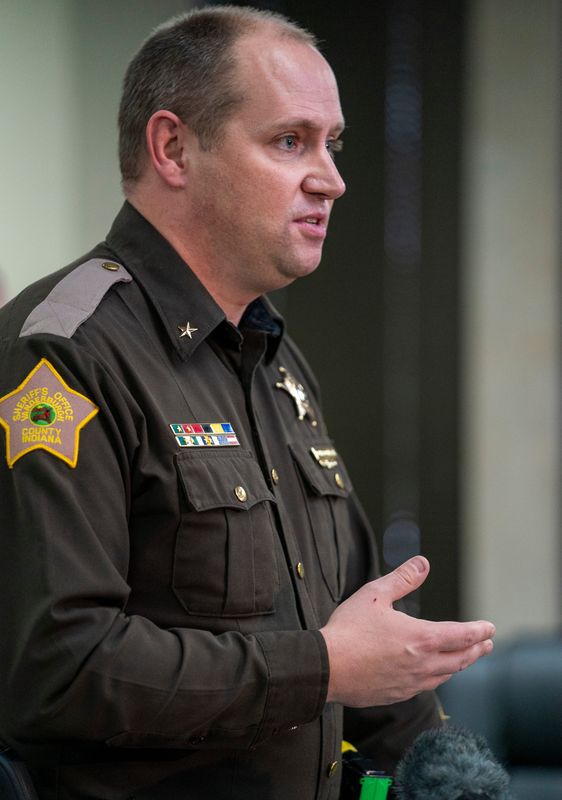
EVANSVILLE — Vanderburgh County Sheriff Noah Robinson describes his approach to leading one of the state’s largest local law enforcement agencies as middle of the road.
In a recent interview with the Courier & Press, Robinson said that after several years in office, he is doing his best to keep deputies out of the political front lines and squarely focused on their core mission of public safety.
That’s arguably becoming an increasingly difficult task as the federal government seeks to enlist local law enforcement in its mass deportation campaign — a sprawling effort to accelerate arrests and deportations in furtherance of President Donald Trump’s pledge to deport millions of undocumented immigrants.
As part of that effort, White House border czar Tom Homan has pushed for sheriff’s offices to serve as “force multipliers” for U.S. Immigration and Customs Enforcement and has singled out migrants detained in local jails and lockups as key targets for arrests. Under Homan’s direction, ICE has dramatically expanded partnerships with local agencies that allow deputies and officers to perform certain functions of federal immigration agents.
Robinson, an elected Democrat in a county that voted overwhelmingly for Trump in the past two presidential elections, is running for re-election unopposed. No Democrat has challenged him for the party’s nomination, and Vanderburgh County Republicans have not fielded a candidate for sheriff.
The Courier & Press is sitting down with candidates and officeholders ahead of this year’s elections to ask about the issues voters care most about. Robinson spoke recently about his approach to immigration enforcement, how his office has cooperated with the federal government and what recent changes to state law mean for deputies and the community.
‘Follow the law’ — Robinson on how the sheriff’s office approaches immigration enforcement
Asked to give his view on the sheriff’s role in immigration enforcement, Robinson cited a principle he would return to again and again: a sheriff’s job gets easier when politics stays out of it.
“Life is so much simpler for a sheriff when the sheriff just follows the law instead of trying to make a political point,” Robinson said.
That philosophy, he said, is tested by immigration enforcement more than almost any other issue he faces, in large part because it cuts across contentious questions of federal authority, state law and local responsibility all at once.
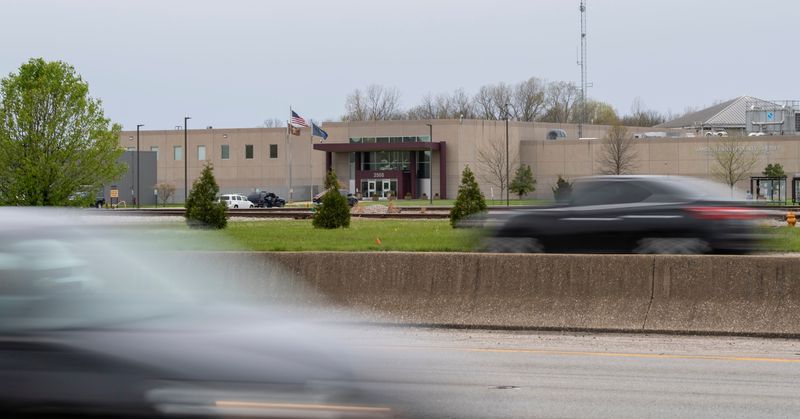
The Vanderburgh County Sheriff’s Office cooperates with ICE primarily through its operation of the county jail by notifying federal immigration authorities when a suspected undocumented immigrant is scheduled for release and honoring immigration detainers that allow the agency to hold a person for an additional 48 hours so ICE can take them into custody.
It’s the kind of cooperation some Democratic officials in progressive-leaning cities have pushed back against, arguing detainers expose local agencies to legal liabilities and are a strain on resources, among other issues. But Robinson said his office’s policy of cooperation has been consistent throughout his time as sheriff.
“Anytime someone is brought in that we suspect is undocumented, we notify ICE,” Robinson said. “And ICE tells us whether they want to detain that person or not. If ICE does not respond within 48 hours and that person posts bond or is released by the court, we don’t detain them and we release them the same as we would for anybody else. But if ICE wants them, we will hold them for 48 hours and wait for ICE to pick them up.”
That cooperation has become more frequent as the Trump administration has moved aggressively to ramp up deportations. According to data reviewed by the Courier & Press, the number of detainers lodged by ICE against people held at the Vanderburgh County jail rose dramatically as Trump’s policies took hold — increasing from just a handful in 2024 under former President Joe Biden’s administration to more than 80 in 2025.
Indiana’s legislature moved this session to codify close cooperation between local authorities and ICE into law. In March, Gov. Mike Braun signed Senate Bill 76 into law, which will require local law enforcement agencies to cooperate with federal immigration agents or else face investigations and fines of up to $10,000. The law goes into effect July 1.
Robinson said the new law doesn’t meaningfully change what his office already does.
“It requires us to notify a judge that ICE wants somebody in our custody,” Robinson said. “That’s a new requirement, not particularly burdensome — something that we can do fairly easily. In fact, we’ve already got a process for notifying the court now when someone is being detained by ICE.”
The law also prohibits local governments from enacting policies that restrict cooperation with ICE. Robinson said that, too, is a non-issue in Vanderburgh County.
“We don’t have any of those policies locally — not officially, and none unofficially, either,” he said. “Nothing’s changing in that regard.”
Why Robinson has not signed a formal ICE partnership
While Robinson has consistently cooperated with the Department of Homeland Security and ICE through the jail, he has declined to take the additional step of entering into a 287(g) agreement — the program through which the federal government trains and deputizes local law enforcement officers to perform certain federal immigration functions.
The Trump administration has expanded the use of 287(g) agreements and sought to curtail the amount of training local officers receive to speed up participation. Robinson said his decision not to seek such a partnership comes down to a belief that they don’t improve public safety.
“There’s no funding that comes with that,” Robinson said of 287(g) agreements. “And just as importantly — in fact, if not more importantly — I’m not looking to take on additional responsibilities that are the federal government’s. We have enough responsibilities already as local law enforcement, as a county sheriff’s office.”
Robinson drew a sharp distinction between his office’s existing cooperation with ICE and the deeper integration 287(g) would represent. Should deputies effectively become immigration agents, would immigrant families – regardless of their legal status – feel comfortable dialing 911 in an emergency?
“I’ve got kids here in this community that are citizens — maybe the mom is a citizen, maybe the dad is not, or vice versa,” Robinson said. “I do not want any household here in this county to hesitate to call 911 because they know that the sheriff’s office has made the deliberate decision to partner with ICE and is now vested with some authority of the federal government to do immigration enforcement.”
The costs of wading into politics
Robinson’s approach to immigration enforcement is also informed by what he described as law enforcement’s “recruitment problem.” He doesn’t see much upside in more closely linking the work local deputies do day in and day out to politically divisive immigration policies.
“Why would I want to have a sheriff’s office step into this other controversial area of immigration enforcement that A, demonstrably does not make our community more safe, and B, would further reduce the pool of willing candidates that might decide they want to be a sheriff’s deputy?” Robinson said.
Robinson tied recruitment woes to a broader erosion of the public’s trust in law enforcement over the past decade following high-profile cases of excessive force and other controversies: “That doesn’t necessarily apply to our sheriff’s office, but we get painted with a pretty broad brush.”
“It’s my job to make sure that our badge means something — that our badge stands for honor and integrity,” Robinson said. “I do not want to associate my deputies or my agency with any kind of tactics or any kind of law enforcement methodology that I think doesn’t meet the high standards that we set for ourselves here.”
As part of a push to reverse downward recruiting trends, Robinson said he is pushing for improved deputy pay in negotiations with the County Council.
What Robinson has to say about ‘migrant crime’ rhetoric
One of the Trump administration’s central arguments for aggressive immigration enforcement is a claim that undocumented immigrants have driven a surge in crime in communities across the country, including small and midsized cities like Evansville.
Asked to respond to the administration’s contention that “migrant crime” is a serious problem, Robinson replied that he takes people “one at a time, as they come to me.”
“Your immigration past doesn’t really affect my decision to lock you up or not,” Robinson said. “If you come in my community burglarizing a home, I’m going to put you in jail. I don’t care where you were born or what paper you have in your pocket.”
Sheriff’s office data reviewed by the Courier & Press shows that non-U.S. citizens who may have entered the country illegally accounted for a small fraction of local arrests in recent years. In 2024, of more than 9,300 people booked into the county jail, 75 were referred to ICE for potential immigration violations. In 2025, preliminary data indicates the number of referrals increased slightly, but overall still accounted for fewer than 1% of jail bookings.
Robinson said the debate over immigration enforcement at the local level, stripped of its political noise, really comes down to a simple question of what the job of a local sheriff is.
“We’re not out here to make a political statement one way or the other,” Robinson said. “We’re just trying to follow the law, keep the community safe and keep our reputation intact.”
He knows his approach may draw criticism from both sides of the political spectrum — from those who believe any cooperation with ICE is excessive and those who believe local law enforcement should do more.
“To me, the logical path and the correct path is a path that this office has always taken — which is in the middle,” Robinson said. “Not bowing to the pressures on either side. Just following the law.”
This article originally appeared on Evansville Courier & Press: How Vanderburgh County’s sheriff approaches immigration enforcement
Reporting by Houston Harwood, Evansville Courier & Press / Evansville Courier & Press
USA TODAY Network via Reuters Connect