INDIANAPOLIS — Andrej Stojakovic’s head dropped as his shoulders sank, his body unable to contain a night’s worth of frustration and disbelief.
The Illinois wing had tried to score on an offensive rebound – an essential piece of the team’s impressive season and rise to the Final Four. The ball sat on the back iron for one second, then another, then rolled off to close another empty possession.

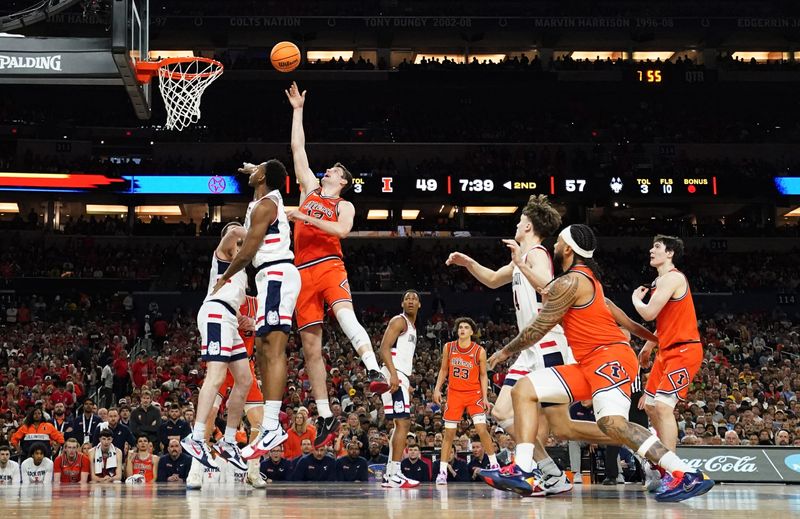
UConn’s 71-62 victory at Lucas Oil Stadium kept alive the program’s quest for a third national championship in four years. It got there by interrupting what came in as the nation’s most efficient offense – closing off each avenue Illinois previously took on its first Final Four run in 21 years.
The Huskies replicated much of their Nov. 28 victory over the Illini at Madison Square Garden. Illinois scored only 61 points that night. It held up all season as the worst offensive night for a certified scoring machine.
Over the next four-plus months, Illinois rose to No. 1 in adjusted offensive efficiency per Ken Pomeroy’s analytics site. The Illini had scoring guard with seemingly limitless range, shooters at all five positions and a team which crashed the offensive boards better than almost anyone.
UConn knew about that ranking – and accepted it as a challenge.
“We just had to pressure them and play as hard as possible,” UConn’s Malachi Smith said.
Having conquered one Big Ten beast, UConn now turns its attention to Michigan, which put up 91 points in Arizona in the other semifinal.
UConn made Illinois’ vaunted offense inefficient all night
Illinois’ efficiency thrived on playing turnover free, dominating the offensive boards and putting 3-point threats at all five positions. All five came up empty in that game at MSG, though – 6 of 29 as a team.
Keaton Wagler only took three shots that night. Illinois coach Brad Underwood said earlier this week the coaching staff left New York City determined to get the ball in their freshman’s hands more. So Purdue fans can blame UConn in part for that 46-point onslaught Wagler unleashed at Mackey Arena on Jan. 24.
“We definitely had to make adjustments to the All-America season he’s having,” UConn’s Alex Karaban said.
Wagler made a couple of deep 3s Saturday night, too. He had to. Much of the night, those were the Illini’s only chances for uncontested perimeter shots. The Huskies said they built off of the original defensive plan from the first meeting – pushing Illinois’ two-man actions farther out, limiting the best perimeter threats and potentially living with 3s from the second-tier shooters.
Illinois made 6 of 26 on Saturday – three makes in each half. Wagler made 2 of 10, though that included some desperation tries late.
If you reach back to the Eight Eight loss in 2024 as UConn thundered to a repeat national championship, the Illini’s three lowest scoring totals in the past three seasons came against the same team.
“Maybe it’s the uniforms,” Underwood said. “I don’t know. We make those shots against everybody else.”
Illinois showed its season-long form for about five minutes in the first half. Shots began falling. David Mirkovic started swatting UConn shots in the paint. A 13-3 run, capped by a Tomislav Ivisic 3, gave the Illini their first lead.
It also turned out to be their only lead. They didn’t score again for almost four minutes – UConn attacking in transition off turnovers and rebounds.
Another stat describes UConn’s ability to disrupt the Illini defense even better than those shooting numbers. Illinois did not record an assist until its ninth field goal, with 2:02 to play before halftime. That also reflected an inability to score around the rim.
“Basketball is very much a rhythm sport,” UConn’s Jayden Ross said. “Just pressuring their guys, their main ball handlers and scorers – just really making them uncomfortable. Trying to pick them up full-court and kind of chip away at them throughout the game, so by the end of the game, they wouldn’t have that energy to really push through.”
Illinois did not build that nation-leading efficiency number on shooting alone. In nine previous games shooting under 30% from 3, the Illini averaged 13.2 second-chance points per game. In its worst 3-point shooting performance of the season in the Elite Eight, it doubled Iowa up on second chance points in a 12-point win.
UConn’s Tarris Reed Jr. led the way in holding Illinois to a plus-two margin in offensive boards (12-10). The Illini’s six second-chance points marked only the fifth time this season they managed only single digits.
The final factor of refuge had been ball control. The Illini turn the ball over less than almost any team in the country. While the Illini committed only two turnovers in Saturday’s first half – only one of which was a live ball – they resulted in six points the other way.
UConn did not turn the ball over once in the first half. It led 37-29 at halftime by being better at everything which made Illinois a Final Four-worthy team in the first place.
UConn helps prove defense still wins championships
The Huskies did not merely end Illinois’ season. They took away that analytics title.
Purdue, which lost in the Elite Eight to Arizona on March 28, finished with a KenPom adjusted offensive efficiency of 131.5. Illinois came in 0.2 points better, but finished at an even 131.0.
Duke’s 130.1 last season had been the highest season-ending AOE score. The Boilermakers now own that distinction.
Illinois and Purdue spent all season on a quest to either improve greatly defensively or thwart a long-standing analytics trend.
Over the 30 seasons of KenPom data, only one national champion finished with an adjusted defensive efficiency score higher than 92.5. Villanova’s 2018 winner ended at 94.0 – still 11th best in the country.
Illinois endeavored to become an outlier to that rule. It made tangible defensive improvements recently to pull its scored below 98.0. It settled at 97.4 – still by far the highest among any of the Final Four teams.
UConn – at 93.1 entering its biggest defensive challenge of the season Monday night – came to Indianapolis with a season’s worth of defensive confidence.
“I think we’re just a bunch of dogs, man,” UConn’s Jaylin Stewart said. “We’re not the biggest. We’re not the strongest. But once you get out there with us, you feel our presence for sure.”
Nathan Baird is IndyStar’s Purdue insider. Sign up for IndyStar’s Boilermakers newsletter for the best Purdue coverage.
This article originally appeared on Indianapolis Star: How Illinois’ historically efficient offense was negated by UConn, denying all-Big Ten Final Four
Reporting by Nathan Baird, Indianapolis Star / Indianapolis Star
USA TODAY Network via Reuters Connect