After nearly two decades of warnings that the Monroe County Jail is unconstitutionally unsafe, ACLU attorney Ken Falk says time has run out — effectively ending the county’s ability to delay or reconsider where a new jail will be built.

After years without an approved site or construction timeline, county council members now have only weeks to decide whether to approve the purchase of the North Park property — previously rejected over concerns about scope, cost and distance from Bloomington’s downtown justice complex — or reject the deal and face renewed litigation from the American Civil Liberties Union.
If the council declines, Falk has said he will allow the settlement agreement to lapse and proceed with a lawsuit, placing the project under the authority of a court and reducing local control over the jail’s future.
Falk in an interview Thursday expressed frustration at the lack of progress.
“You know, give me a break,” he said. “I filed this case in 2008. … It’s 2026.”
A decade‑old settlement, nearing its end
The ACLU in that 2008 lawsuit alleged the jail’s overcrowding violated state and federal constitutions. The parties in 2009 reached a settlement that, among other things, limited the jail’s capacity and prompted county officials to pursue construction of a new jail. The lawsuit’s dismissal has been repeatedly postponed, mostly on an annual basis, with the understanding that the county makes progress toward eliminating the unconstitutional conditions at the jail.
However, despite repeated reminders of the jail’s deteriorating conditions, including from Monroe County Sheriff Ruben Marté, efforts have stagnated amid changing designs, funding questions and disagreement over whether to rehabilitate the existing facility or whether to build a new jail and, if so, where and how big.
North Park returns as deadline looms
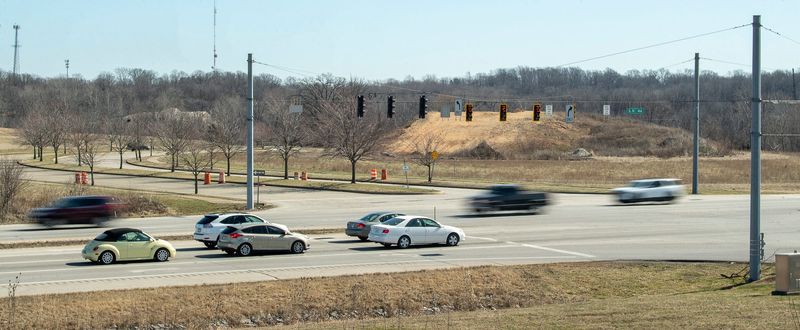
Officials for years had considered North Park, at the Ind. 46 junction with Hunter Valley Road, just west of Bloomington, as the location for a combined justice complex that would include courts and a jail. When the Monroe County Council rejected that project last fall, citing concerns about the proposed $225 million cost, the 404-bed scale and its distance from courts, the city and social services, it frayed relations with the commissioners, with their assistant describing the vote as a “blow to the gut.”
Council members more recently have returned their sights onto the former RCA/Thomson property on South Rogers Street. While the site is in the city, the county has owned the 80-acre property for more than two decades. The county had previously eliminated the site because of its proximity to a large power generating station and residential neighborhoods.
More recently, commissioners have said they understood the council’s rejection of the North Park site to reflect an antipathy toward the $225 million project — but not toward the site itself.
Commissioners and Falk on April 13 filed in U.S. District Court an agreement that lays out that unless the council approves the purchase of the North Park property, the settlement from 2009 would end, and the ACLU would move forward with a new lawsuit.
Blindsided or briefed? Officials disagree
County Commissioner Jody Madeira, a lawyer, said the county would lose that lawsuit and, with it, whatever remaining influence it has over the jail’s location.
However, some council members say the agreement has the effect — intentional or not — of narrowing their options to a site they don’t support, while benefiting commissioners, two of whom — Julie Thomas and Lee Jones — have long favored North Park.
Council member David Henry said council members felt “blindsided” by the commissioners’ agreement with Falk.
“I feel the agreement binds the hands of council — as the public’s fiscal voice — into a single choice, and may impede our statutory right to make fiscal decisions that aren’t predetermined for us,” Henry said via text message.
However, Madeira said none of the council members should have been surprised by the agreement, because closed-door sessions among county officials and meetings with Falk made clear that only the North Park property remains as a viable site to avoid litigation.
Local officials who participated in the meetings said some council members, commissioners and county attorneys met behind closed doors April 7 and spoke again April 8, after which county attorneys were directed to contact the North Park property owner to see if he would be willing to sell the property with the understanding that only a jail building — not an entire justice complex — would be built there.
Council President Jennifer Crossley and Madeira agreed that information — whether North Park was still available — was to give county officials options, but was not to be interpreted to lock the council into a purchase.
When the owner on Friday indicated his willingness to sell the property, county officials again met with Falk that day to relay the information. Falk then presented county commissioners with the agreement that required the council to approve the purchase agreement or face the ACLU in court.
Some county officials dispute some of the sequence of events and the conclusiveness of the outcomes, though some framed that confusion more starkly than others.
Crossley rejected the notion that the disagreement stems from misunderstanding.
“I don’t think there’s confusion. I think there’s lies,” she said.
In addition, she asked, “How can Commissioner Madeira talk about something in a room in which she was not a part of?”
Madeira counters that while she did not attend the meetings, all commissioners and council members received via email the same legal briefing that laid out what happened during the conversations and the terms Falk proposed.
A narrowing choice
She said that memo conveyed that Falk believes the Thomson site that the council may have been considering would take too long for two reasons: For one it would require relocation of utility poles, possibly before construction could even begin.
Secondly, Madeira said, “the thing that Falk is very leery of is the involvement of another governmental body, and that’s the city.”
The Thomson site would require county officials to go through city planning and the city council, Madeira said, and that adds delays and uncertainty that Falk is no longer willing to accept.
Falk said he doesn’t care where the jail gets built, but he said time is running out.
“We don’t care about anything except remedying constitutional problems,” he said. “(But) I’m not willing, at this point, given everything that’s happened, to wait for more contingencies to be met.”
Falk said he is not willing to wait another five months or so on city planning “when, my understanding is, the county site is ready to go.”
He said that as a condition of extending the deadline to May 29, he insisted on “having something definite.”
“And being told that, you know, there are other bodies that have to approve things, that we don’t know when that’s going to happen. And it may not happen. That is not acceptable to me as a lawyer for a group of people whose constitutional rights are being compromised,” Falk said.
However, Crossley said, “At no point in any conversation that we had last Wednesday did Ken Falk say, ‘If you all don’t do this, then I’m going to be releasing that.’ … He just said, ‘I’m not happy with how this goes, and it concerns me.’”
Crossley said she believes the Thomson site is still viable.
“I don’t think that we’ve done our due diligence,” she said.
Falk, however, said that after years of delays, the window for further exploration has closed.
“If you’re going to have a jail, which is a decision by the community, it has to be constitutional,” he said.
Boris Ladwig can be reached at bladwig@heraldt.com.
This article originally appeared on The Herald-Times: After years of delay, ACLU pushes Monroe County toward jail vote
Reporting by Boris Ladwig, The Herald-Times / The Herald-Times
USA TODAY Network via Reuters Connect