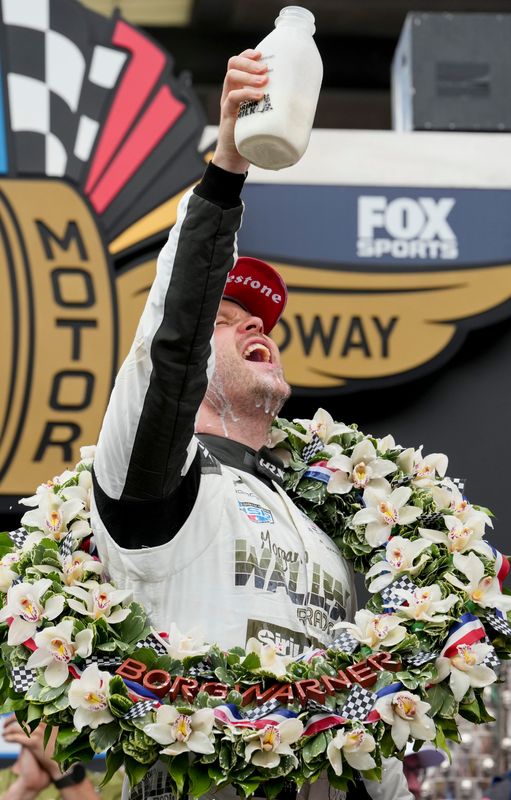
INDIANAPOLIS – Felix Rosenqvist said the last 41.7080 seconds of the Indianapolis 500 were “kind of a blur.”
Going into a last-lap restart, Rosenqvist trailed his Meyer Shank Racing teammate Marcus Armstrong and Team Penske’s David Malukas. As Malukas took the lead to start Lap 200 with the green and white flags waving simultaneously, it looked like he was on his way to glory.

But Rosenqvist made the boldest move in all of racing — going full throttle for an entire lap on the high line of Indianapolis Motor Speedway.
“I think that’s what it takes here to win it,” Rosenqvist said. “You need to be ready to risk it all on the last lap. If it ended in the fence, I think I would have been proud for my run.
“That’s the way you have to approach it.”
Malukas exited Turn 4 still holding the lead, but as Rosenqvist and Armstrong went side by side, Rosenqvist didn’t lift from the cockpit of his No. 60 Honda. He passed Armstrong out of the turn and stayed on Malukas’ outside down the front straightaway instead of going low to attempt an overtake.
The result: Rosenqvist beat Malukas, his former MSR teammate, to the bricks by 0.0233 seconds — the closest margin in the 110 iterations of this race.
“I had that momentum going, and I was kind of like, ‘I’m going to go on the high line, and I’m not going to ruin this momentum,’” Rosenqvist said. “If someone comes in the way, that’s it. But no one did, and I was able to stay on the high lane through the whole thing.”
Rosenqvist reverses fortune
Rosenqvist is in his eighth year in IndyCar, and much of his career has been made up of moments like Sunday that don’t go his way.
Starting his career in 2019 with Chip Ganassi Racing, the team that has won 12 of the 18 IndyCar championships since the 2008 merger, the Swedish driver left the team after two seasons and just one win. The next six years of his career — three with Arrow McLaren from 2021 to 2023 and his tenure with MSR from 2024 to now — have seen Rosenqvist fail to return to victory lane, which he did at Road America in 2020.
Just over a month ago at the Grand Prix of Long Beach, Rosenqvist had the pace to get his second career IndyCar win until a caution occurred that led to Rosenqvist losing a potential win to CGR’s Alex Palou, who has won four of the last five IndyCar championships and last year’s Indy 500. Rosenqvist called the unfortunate turn of events “heartbreaking.”
The penultimate caution at the Indy 500 gave Rosenqvist déjà vu. With eight laps to go in the race, Rosenqvist and the crew on the No. 60 crew had perfected an alternate strategy for what seemed like a comfortable lead over Arrow McLaren’s Pato O’Ward, who was the best man in Rosenqvist’s 2024 wedding. Then, AJ Foyt Racing’s Caio Collet crashed into the outside wall in Turn 2, leading to his car catching fire and a red flag being deployed.
Armstrong and Malukas passed Rosenqvist on the Lap 196 restart, which stayed green for only one lap as Mick Schumacher brushed the wall in Turn 1, leading to one last yellow flag and a Lap 200 shootout to decide everything.
“I just tried to stay positive because I think that’s been something in the past, I’d let it get to my head,” Rosenqvist said. “And it’s like, you start thinking in your head that, oh, this is bull—- or this is bad luck or whatever. And at that point, you just have to be strong and look forward, which is a tough thing to do because you’ve lost the biggest thing you can lose, really, in the race car.”
“I didn’t know what was going to happen,” MSR owner Mike Shank said. “And when you’re leading this thing, obviously, you get overwhelmed in Turn 1 and Turn 2. But, man, he just kept kicking, just never stopped. I can’t wait to watch it back tonight. He just didn’t stop, and I think it says a lot about him.”
Rosenqvist claimed he had the “hunger to do it,” which made the difference. Before Sunday, Rosenqvist had never even been on the podium on an oval course. He’s now won on the oval that matters most, and it took a level of confidence he had not shown in his first seven Indy 500 starts.
“I’ve never been flat around the high line for more than one corner,” Rosenqvist said. “To do a whole lap on the outside, that was pretty cool. It’s kind of unheard of at Indy. Yeah, that’s just how much you want it. It’s hard to explain that feeling, that you want it so much and you have so much adrenaline that you literally don’t care if you’re going to crash. You’re just going all in. It was cool that that’s what it took to win it.”
Why Rosenqvist and MSR needed each other
It was not just Rosenqvist’s second career win, but it was the second in the history of Meyer Shank Racing. Before Sunday, MSR hadn’t won since Helio Castroneves captured his fourth Indy 500 win with the team in 2021. Now, this team has won on the biggest stage in racing twice.
MSR has undergone steady growth from its IndyCar debut in 2017, an Indy 500-only (driven by Jack Harvey) when Shank was the lone owner of the team, then-named Michael Shank Racing. Former Sirius XM CEO Jim Meyer became a co-owner a year later, and by 2020, the year Liberty Media — which owns Formula 1 — bought a minority stake in the team, MSR had one full-time entry in IndyCar.
The team added a second full-time entry in 2022, and a year later, Castroneves — the pilot of one of those entries at the time — purchased a minority stake in the team as well.
“We, as a team, are so much better than we’ve ever been,” Shank told IndyStar on Sunday morning. “We are literally pushing the door open right now. We are leaning on the door. We just need it to break open with a really, really positive result. Not that we haven’t had good results, but I just feel like we’re standing on the edge of really, really great things and we just need one spark.”
And that positive result came, with Rosenqvist winning the Indy 500 and Armstrong finishing fifth. (Castroneves finished 25th, exiting the race late with a mechanical issue.) From the battle with Palou in Long Beach to Row 2 qualifying efforts for the Sonsio Grand Prix and Indy 500 at IMS, Rosenqvist and that No. 60 car have become a force in the thick of the IndyCar season.
“If you look back on the last month, he’s been one of the guys that are harassing Alex (Palou) a lot,” Shank said. “And we’re always trying to figure out how are we going to beat Alex because he’s simply the best right now. … This will change his life and our life, so we’re grateful.”
“I think after Long Beach, something kind of changed,” Rosenqvist said. “We felt like we were actually able to be a threat even to Alex and the big dogs at the front, and just riding a good wave right now. So well timed, to be honest, to get it here.”
Meyer said that Rosenqvist was who the team wanted at the end of 2023, even after his underwhelming tenure at Arrow McLaren. He had made just two podiums with MSR before Long Beach, but on Sunday, Rosenqvist delivered the best performance — and best lap — of his career.
MSR still falls a tier below IndyCar’s most elite, and its ownership knows that. But the team continues to build and has as many Indy 500 wins in the 2020s as Chip Ganassi Racing and Team Penske, the two premier teams of the series.
“We’re kind of an upper-mid-pack team, is how I look at it now,” Shank said. “But we’re right there at the top, and this proves that we can do it when it’s all set up correctly. It’s just constant improving, constant improving. We want to get to the next level.”
For at least a day, Rosenqvist took the team to the next level, outdueling a Team Penske car for the win.
MSR’s last-lap divide
Rosenqvist’s dangerous move on the high line came with the risk of crashing with either Malukas or Armstrong, but all three cars managed to avoid each other during the intense lap. While Rosenqvist got a milk bath, Armstrong felt he surrendered a chance of winning at his teammate’s liberty.
“I’m so disappointed,” Armstrong told Fox. “I felt like the last corner, I was given two options. The first one was to either crash with my teammate or I have to lift. And I chose to lift a bit, and that was the situation. We were in position to win it, that could’ve been us that towed past Malukas. I can’t believe it, honestly. Just so close, and I feel like I just made the wrong call at the most pivotal moment.”
This was Rosenqvist’s moment, and he went full throttle regardless of who was racing beside him on the last lap. Armstrong, who has never won an IndyCar race, stayed conservative by lifting while Rosenqvist went all out.
“You try, obviously, not to take a teammate out, and you try to be fair because it would be stupid not to,” Rosenqvist said. “But when you’re in that position, you don’t care who it is.”
Shank said Armstrong was “torn up” about the finish, as he got passed by two other drivers, Scott McLaughlin and O’Ward, after lifting. Still, the team’s boss feels Rosenqvist did the right thing in pursuit of the win.
“But now you’re last lap, Indy 500,” Shank said. “There’s no argument, you’re going to do whatever you have to do to whoever it is to win the race. They’ve raced really well together for almost two years now. … Now, Marcus is going to be pissed off for a while, but if you go back and watch it, I thought for sure we were causing ourselves more damage than good during that lap with slowing them down, but it turned out it didn’t, and we’re super happy.”
Leading going into a restart was often a compromised position in Sunday’s race. The race had seven cautions and restarts, and on six of them, the leader was passed within two laps of the restart.
“It’s always nice to be the one hunting, as well,” Rosenqvist said. “I would hate to be in the lead for that last restart. Yeah, it’s not a good place to be, unfortunately. … That sucks for him.”
In less than 10 minutes, Armstrong went from hunting Rosenqvist to being hunted by him with the race on the line.
Rosenqvist’s new outlook
This month has changed Rosenqvist’s life forever, but not only for what he did in the Indy 500. On May 4, just 20 days before what became the biggest race of Rosenqvist’s career, Rosenqvist’s wife — Emille — gave birth to their first child, Stella.
Emille and Stella weren’t at the race, as they stayed at the Rosenqvists’ Indianapolis home. Although Rosenqvist entered Sunday a little sleep-deprived, the 34-year-old feels that becoming a dad delivered a new perspective for his racing career.
“We all put so much pressure on ourselves, and we also get added pressure from our teams, or media, whatever it is,” Rosenqvist said. “You always have way more pressure than you need, really, and you’ve been learning to cope with it all your life. I think somehow this was the first time I felt less pressure because I already had so much.
“I come home at night, and I’m the happiest man. When I crashed with Pato at the GP when I started third and he was second, day over. But it was like, I didn’t really care. I think that’s actually a strength, because if you bring the bad results with you home, there’s going to be someone else that is as good and he enjoys his life instead of being angry. Yeah, it was definitely a turning point for me.”
Rosenqvist feels like becoming a dad unlocked something in his personality and took the weight of racing off his shoulders. Those same shoulders sported the Borg-Warner wreath Sunday evening as Rosenqvist was the victor of one of the best Indy 500s ever.
Zion Brown is IndyStar’s motorsports reporter. Follow him at @z10nbr0wn. Get IndyStar’s motor sports coverage sent directly to your inbox with our Motor Sports newsletter. Subscribe to the YouTube channel IndyStar TV: IndyCar for a behind-the-scenes look at IndyCar and expert analysis.
This article originally appeared on Indianapolis Star: How Felix Rosenqvist won the closest Indy 500 in history: ‘Unheard of at Indy’
Reporting by Zion Brown, Indianapolis Star / Indianapolis Star
USA TODAY Network via Reuters Connect