Two groups of Detroit students are about to have the chance of a lifetime: to share their big ideas for problems facing today’s youth with a room of people who could make them happen.
Students from the Detroit International Academy for Young Women and Henry Ford High School are scheduled to travel next month to Colorado to present at the Aspen Ideas Festival. In the audience will be billionaires, CEOs, philanthropists and the media, all in search of solutions to seemingly intractable problems.

The two student groups were the winners of the first Detroit Public Schools Community District Aspen Challenge, a partnership between the district and the Aspen Institute. The institute, based in Washington, D.C., and Aspen, is a nonpartisan nonprofit that seeks to bring great minds and activists together to solve challenges.
Students at every Detroit district high school formed teams to compete in the challenge, each having the chance to tackle one of five issues that they felt most affected their community. The students had to create a way to address the issue, then put that plan into action before making a presentation in front of all of the other teams and a panel of judges.
“We believe that giving our kids this kind of experience unleashes something in them,” said Kaya Henderson, executive director of the Aspen Institute’s Center for Rising Generations.
What is unleashed, she said, is a sense of confidence and possibility. Students also have to do extensive research on their topic, work as a team to develop a plan, acquire the resources to execute the plan and see it through to completion — then tell an auditorium full of their peers all about it.
Sometimes, Henderson said, districts that partner with Aspen will implement the ideas students come up with across their schools.
“When these young people see that their policy recommendations and ideas are actually implementable — how is that team going to feel when they see every school across the district doing the thing they come up with?” she said. “You can’t buy that.”
DIA students tackle food insecurity
The students at the Detroit International Academy for Young Women, the only all-girls public school in Michigan, opted to tackle the problem of food insecurity.
Freshman MacKenzie Ball-Howell said it’s a problem she sees in her neighborhood every day.
“I feel like there’s a lot of food deserts. … It’s mostly like, junk food or really Dollar Tree or Dollar General,” she said.
The group decided to tackle this problem on two fronts: They designed an app to help neighbors in the Hamtramck area find fresh produce and planted their own vegetable garden in the school’s backyard.
“We have our idea of passing out free food, free produce, but with the touch of tech,” senior Aysha Uddin said.
Many of them had never planted anything before, although both Aysha and MacKenzie said their families grew vegetables. They advised the group that it would be a challenge. Gardening is “tedious,” Aysha said. Someone would have to come on the weekends to water their plants.
They forged ahead and planted vegetables like kale, tomatoes and bok choy in wooden beds behind the school.
For their presentation, a six-minute chance to tell the crowd how it went, each girl took a turn speaking. Some, Aysha and MacKenzie said, were quite nervous. Some expressed worry about their stomachs when they stood in the spotlight.
“And then when we were on stage, they, they did it,” Aysha said. “Nothing happened. They did so well.”
“The judges loved it,” MacKenzie said.
The winners were announced the next day on a live announcement viewed online from each school.
“There’s no word to explain how happy we were and like how unbelievable it was in the moment,” MacKenzie said.
As a senior on the team, Aysha said she was proud of her group.
“I’ve watched them go through their ups and downs,” she said. “They’ve doubted themselves, but they’ve pushed through. And I think that they’re capable of experiencing the ups and downs of agriculture and a community project. And I think with a little support, they can continue.”
That support came largely from their coach, RoseJean Easthouse, the school’s parent outreach coordinator.
“I was a very hands-off coach,” Easthouse said. “They didn’t need a lot of direction. They’re all very strong-willed. But it’s good. It’s in a good way.”
Easthouse said she selected students for the team who she knew had leadership qualities, but might not always get a chance to show them.
“They are capable of so much more than what a lot of adults realize children can do,” she said. “And they are their best advocates.”
Henry Ford students pitch a tent to curb cellphone use
Henry Ford seniors Kierra Byrd and Adriel Moravec would prefer not to admit exactly how much time they spend on their phones every day.
So when the Aspen challenge offered screen time and teens as a problem to tackle, they thought it would be a good fit.
“I feel like this would be probably the best for our group because a lot of us do use our phones a lot, and it would be beneficial for us, not only us, but for our community and our school,” Kierra said.
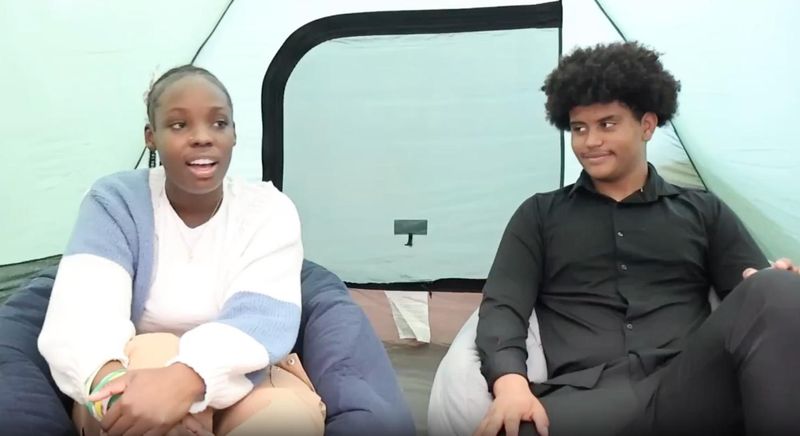
They came up with the idea of locking as many students as possible inside their school overnight ― without their phones.
Adriel had the idea to turn it into a camping trip.
“I’ve been camping growing up, and it was really fun,” he said. “I really enjoyed it, and I thought adding a little twist to the already interesting experience would be really fun.”
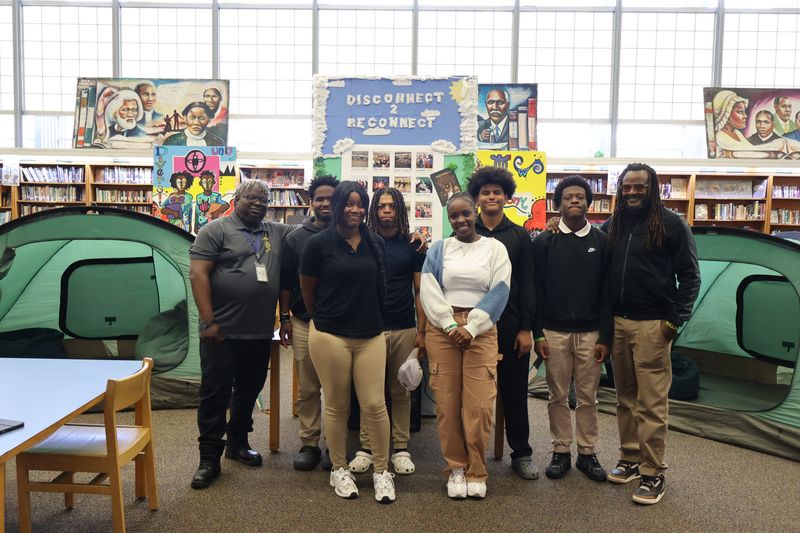
They turned two rooms in the school into campsites, complete with pitched tents, sleeping bags and board games. They went outside for a campfire and s’mores, despite some rain. For one full night, about 50 students ― separated by gender and supervised by adults — slept at the school and went without their phones.
Kierra and Adriel were surprised at how well students adapted. They talked to each other. They played games. They laughed.
“The girls, we were just playing a bunch of board games,” Kierra said. “We were talking about things that happened around school. It was just bonding. I feel like it was a lot of people I never knew before that I know now.”
The boys, Adriel said, played sports in the gym for a while before just hanging out and spending time together.
“I got to reconnect with one of my friends I haven’t talked to in a while, and we … just got closer,” he said.
Their presentation to the judges, they said, didn’t go quite as planned. Six minutes go fast. After showing a three-minute video about their phone-free lock-in, only two team members ended up getting to speak. They plan to revamp the speech before they get to Aspen.
Still, they impressed the judges.
“It was so hard,” Kierra said. “I’m so proud we got it done.”
Their coaches, James Ngari, the school’s attendant agent, and Martino Milton, the building’s substitute teacher, said it’s hard to keep students off their phones all day.
“Once they disconnect, they don’t know what else to do,” Ngari said.
The Aspen Institute provides $500 in funding for students to execute their challenge, but Milton acquired the camping gear through an outdoor program he completed.
Ngari said he shed a few “excitement tears” when the announcement came through that Henry Ford had won.
“I’m so proud that this school is getting some recognition,” he said. “And we’re a neighborhood school. We’re not schools that you apply for. … But we have so many bright kids here that are talented and that inspire me.”
Partnership fits with district’s goal of elevating student voices
Detroit schools Assistant Superintendent of Family and Community Engagement Sharlonda Buckman said the partnership with Aspen lasts two years, but the challenges and presentations are designed to continue after the partnership ends.
Buckman said the challenge aligned with Superintendent Nikolai Vitti’s goal of providing students with more opportunities for leadership experience.
“I remember telling Dr. Vitti that education is not just what happens in the classroom, but how do we provide our students with extended experiences that help refine them as young adults?” Buckman said. “Especially at the high school level when they’re preparing to go off to college.”
It was an opportunity, she said, for students to use their voice and in ways that can impact their community.
“It aligned with what we believe about how you value young people, being able to identify and articulate what the issues are within their community, work together to develop a plan, and really problem solve those things,” Buckman said.
It was also an opportunity, she said, to pay students for their time. The district could reward students for their work with the money from the Aspen allocation, she said, noting that students had to take time away from their responsibilities at home or work to participate in the eight-week challenge.
“They are the experts. They deserve to be paid for their expertise,” Buckman said.
Buckman said she plans to mine the students’ challenge proposals for ideas the district could implement.
“One of the groups came up with, they wanted they created a hotline for vaping,” she said. “I want to look a little closer at that. It might be something that we can connect to. We already have a homework help hotline. We’ve had a mental health hotline. So who knows where that can go, but they came up with some great ideas.”
There’s no telling who at the Aspen Ideas Festival, which starts June 25, may be just as inspired to elevate their ideas.
“Who knows what could come of this?” Buckman said.
jpignolet@detroitnews.com
This article originally appeared on The Detroit News: Detroit students set to pitch big ideas to bigwigs at Aspen festival
Reporting by Jennifer Pignolet, The Detroit News / The Detroit News
USA TODAY Network via Reuters Connect