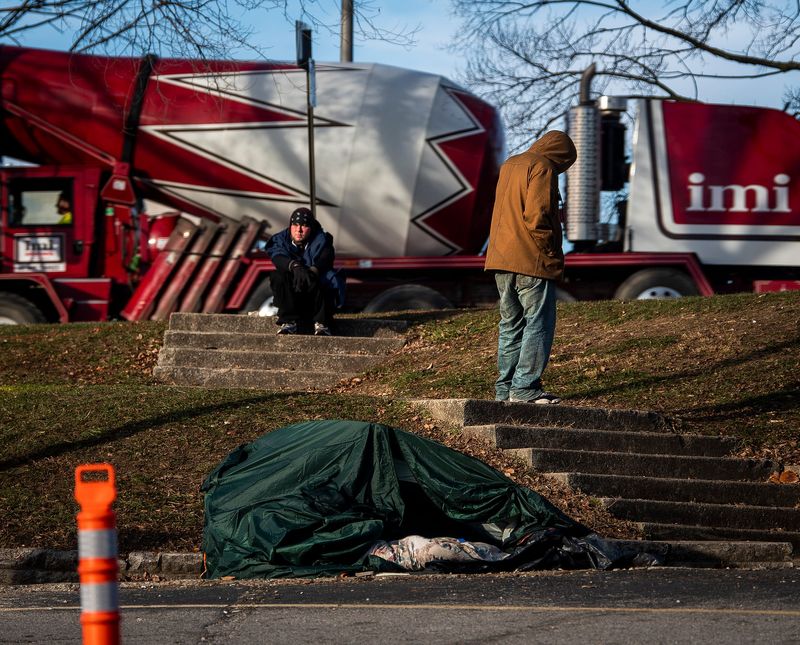
Street homelessness in Bloomington is far reaching and out of control, a situation mayor Kerry Thomson intends to rein in.
During a July 29 press conference focused on the city’s housing and homelessness response, Thomson said her administration will take substantive steps to end homelessness.

She made clear that the city’s efforts to provide mental health and substance use disorder treatment, life skills and housing will be provided to people from within the 6-county federal region that includes Bloomington.
Bloomington-based non-profit Heading Home is tasked with helping decrease homelessness in the six counties but has extended its scope to assist anyone without a place to live who comes to Bloomington.
Thomson, who serves on Heading Home’s board of directors, disagrees with the agency’s policy to offer local services to anyone experiencing homelessness no matter where they are from.
By removing residency requirements, Heading Home’s housing plan hinders the city’s ability to provide comprehensive help to homeless people from Monroe and the other five other counties federal funds provide are designate for, Thomson said.
Since there aren’t enough resources to help everyone when they are spread too thin, Thomson said, the ability to fully help people fades.
She said the homeless situation in Bloomington exemplifies “what happens when we do not draw boundaries around who we can and cannot serve.”
‘Cease sending people to Bloomington’
She suggested other communities step up and help their own instead of driving them to a distant place away from the familiarity of home and a support network of family and friends.
The mayor said Bloomington’s social service network has been overwhelmed by the challenges — from crime to health issues — of having so many unhoused people living on the streets and in wooded encampments.
No longer, the mayor said, will the city provide services to just anyone who lands homeless in Bloomington — they must have ties to Monroe, Morgan, Owen, Greene, Lawrence or Martin counties.
Thomson asked other cities “to cease sending people to Bloomington if they are not from here.” The recently hired homeless services coordinator has been calling municipalities to spread the message.
Thomson said police and agencies that assist unhoused people bring them to Bloomington and drop them off so they can access the city’s services.
“We continue to meet people on the streets who are not from our region,” Thomson said, reiterating that the city cannot provide care and housing for everyone who shows up.
“Dropping them off here, they end up in encampments and they lose any ties at all they have to family and friends who may be able to help them,” she said. Long-term homelessness often results.
“Our community’s mission is to get our heads above water, to truly end the cycle of homelessness for the people in our HUD district.”
She said outsiders sometimes end up in Bloomington for addiction treatment or get admitted to IU Health-Bloomington Hospital with medical problems, then are released with no resources and nowhere to go.
Others, many just out of state prisons, find temporary shelter at Wheeler Mission and then stay in Bloomington, often living on the streets.
Bloomington, Thomson said, cannot manage the influx. The city and other agencies have what are called “reunification funds” earmarked for transporting transient people back to their home counties to live.
So with a renewed focus using Lilly grant funds for intervention workers and case managers to re-direct the lives of local homeless people, the city moves forward.
Spokeswoman Desiree DeMolina summed up the city’s stance.
“Our community cannot serve as the destination for every person in crisis across the state,” she said in an email response to questions. “When resources are stretched too thin, no one gets the support they need. Caring means knowing the limit.”
Police crack down on homeless drug dealing
Part of the initiative involves police intervention to stem drug selling that’s rampant in the homeless community.
Dealing-related arrests at Seminary Park on July 25 and more at Crawford Apartments the day of the mayor’s press conference reflect the ongoing effort to address the out-of-hand situation.
“We can’t arrest our way out of the homeless problem,” Thomson said, adding that law enforcement is necessary.
“We are taking a stand against the dealers in our community who are taking advantage of people with substance use disorder and causing extreme challenges and more difficult lives for those who are the most vulnerable.”
She challenged the notion that homelessness is an intractable problem here to stay.
“If there’s any community in Indiana that can end homelessness,” Thomson said, “it’s Bloomington, Indiana.”
Contact H-T reporter Laura Lane at llane@heraldt.com or 812-318-5967.
This article originally appeared on The Herald-Times: How does Mayor Kerry Thomson plan to end homelessness in Bloomington? By keeping it local.
Reporting by Laura Lane, The Herald-Times / The Herald-Times
USA TODAY Network via Reuters Connect