Construction is underway to build Lebanon’s up and coming tech park, known as the LEAP district despite opposition from thousands of Indianapolis residents over the way the state plans to supply water to the project.
At the heart of the controversy sits Eagle Creek Reservoir, from which water will be pulled for the district and eventually returned. Residents and environmental activists have expressed concern about potential contaminants entering the water in Lebanon and then being discharged with it into the reservoir.

Citizens Energy Group, the public utility that supplies water to Central Indiana, is in charge of treating the water and shipping it northwest to Lebanon. Utility officials say they’re aware of concerns about ecosystem health and water level impacts, but they’re convinced the process will not endanger the reservoir.
Here’s how they plan to do it:
Water in
To ship up to 25 million gallons of water to Lebanon every day, Citizens will increase the amount of water it regularly pulls from Eagle Creek Reservoir by about 2-3 million gallons. The rest of the water will come from the Citizens water system, which includes groundwater sources, Fall Creek, the White River and three other reservoirs.
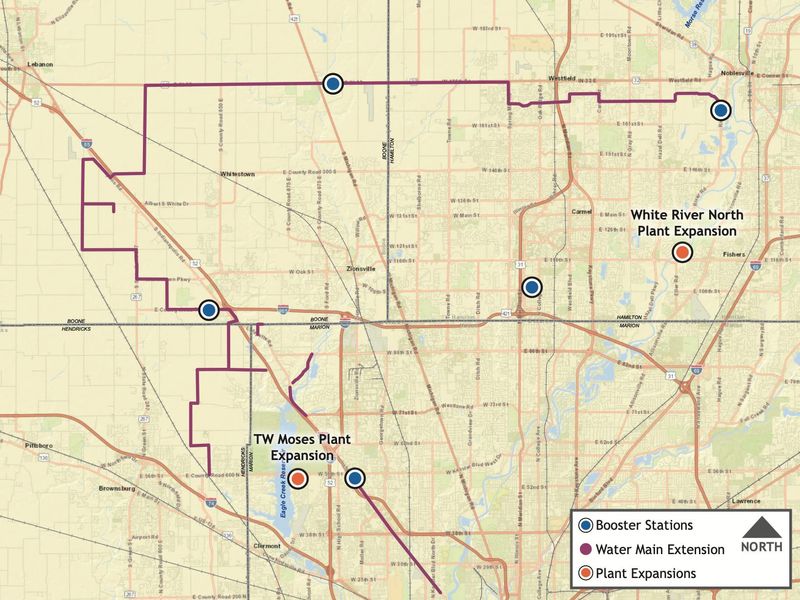
The utility treats water from Eagle Creek at the adjacent T.W. Moses Water Treatment Plant, where an expansion project to meet the rising demand is in the works. Construction is slated to begin by the end of 2027. The White River North Treatment plant, which is currently under construction, will also help support the water supply project.
Citizens officials said the T.W. Moses plant design isn’t finalized but they envision the expansion will involve bigger uptake pumps to bring more water into the plant from the reservoir.
Once the water is inside the plant, treatment takes several hours.
As the water flows through a cement maze, chemicals called coagulants are added to help get rid of preexisting “gunk,” like suspended particles or the occasional leaf. The water is slowly mixed in a large basin as heavier and heavier particles drop to the bottom.
Water is then filtered through physical barriers like sand, grit and anthracite, which separate microscopic particles from the water. Chlorine is added to disinfect and UV radiation helps kill off additional microorganisms. Ultimately, the water lands in underground reservoirs, where it sits, waiting to respond to customer demand.
Water out
The Citizens-Lebanon water supply program does not include plans for a direct pipe from Eagle Creek to Lebanon or the LEAP district. Instead, water from various sources in the Central Indiana watershed will accumulate as it travels through a series of pipes.
To facilitate the transport, Citizens is building four new booster stations, which keep the water moving, and about 52 miles of transmission mains. The utility is also finalizing property easements, almost 500 total for the program, along the pipeline’s path. Once the water reaches Lebanon, the local utility will provide it to the city and the LEAP district.
Plans exist for a pipe from Lebanon back to Eagle Creek, where Lebanon Utilities intends to discharge the treated wastewater, estimated to be more than 100 million gallons each week.
Wastewater can contain nutrients like phosphorus and nitrogen, which can contribute to the growth of toxic blue-green algae.
Martin Risch, a retired hydrologist who used to work for the Indiana Department of Environmental Management and the United States Geological Survey, said that he’s concerned the effect this discharge could have on the reservoir.
Citizens officials said they will watch for blue-green algae, as well.
“Everything upstream comes downstream,” Doug Payton, an operations manager at Citizens, said. “It will be more water and more challenges, but it’s going to be something that we’ll monitor like what we currently do.”
IndyStar’s environmental reporting is made possible through the generous support of the nonprofit Nina Mason Pulliam Charitable Trust.
Sophie Hartley is an IndyStar environment reporter. You can reach her at sophie.hartley@indystar.com or on X at @sophienhartley.
This article originally appeared on Indianapolis Star: Here’s how Citizens will treat and ship water to the LEAP district
Reporting by Sophie Hartley, Indianapolis Star / Indianapolis Star
USA TODAY Network via Reuters Connect