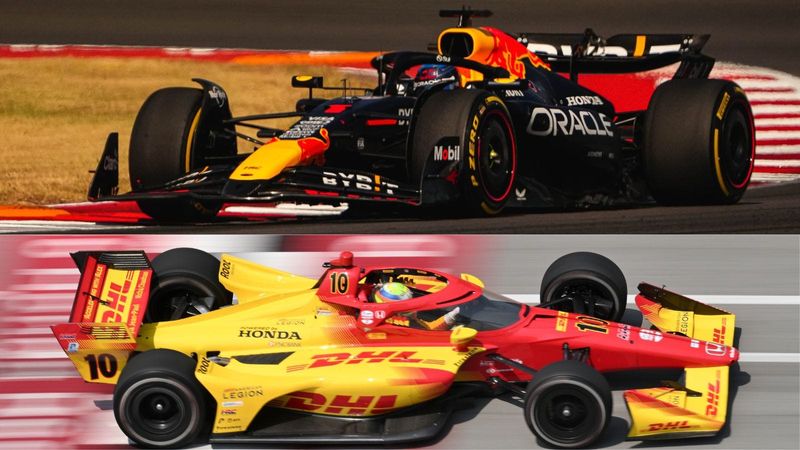
Formula One and IndyCar are the highest levels of open-wheel racing in the world. F1 competes worldwide, and IndyCar competes in North America.
The 2025 IndyCar schedule includes 17 races, starting on the streets of St. Petersburg, Fla., in March, and finishing at Nashville Superspeedway on Aug. 31. Races are run on downtown streets, road courses and oval speedways.

The 2025 F1 schedule includes 24 races in 21 nations/principalities, starting with the Australian Grand Prix in March and finishing with the Abu Dahbi GP on Dec. 7. Most races are on road courses, though some are on downtown streets (Monaco, Las Vegas). F1’s increased popularity in the United States is evidenced by three races in 2025: Miami, Austin, Texas, and Las Vegas.
When is the Indy 500?
The 200-lap race on the 2.5-mile Indianapolis Motor Speedway oval is scheduled for May 25, 2025, the same day of F1’s premier race of the season, on the streets of Monaco. Alex Palou won the Indy 500, and Lando Norris won in Monaco.
Can IndyCar drivers go to F1?
Several current IndyCar drivers previously raced in F1, including Indy 500 champions Alexander Rossi and Marcus Ericsson. It hasn’t worked the other way around recently, though Alex Palou, Colton Herta and Pato O’Ward are eager to try. O’Ward tested with the McLaren F1 team in 2024. F1’s Fernando Alonso has competed in two Indy 500s.
IndyCar drivers Marcus Armstrong and Christian Lundgaard have raced in F2, one level down from F1.
How much do IndyCar drivers make?
Driver salaries are mostly confidential, but reporting from various sources indicates these IndyCar drivers are paid the most in 2025:
A more common pay structure among the series’ drivers is that they must bring millions of dollars of sponsorship to their team, and they get a cut of it, as well as performance bonuses.
How much do Formula 1 drivers make?
Formula 1 driver salaries are mostly confidential, but reporting from various sources indicates these drivers are paid the most in 2025:
The lower-paid drivers make in the $2 million range.
Is IndyCar as good as F1? Series popularity
IndyCar races averaged about 1.7 million viewers on NBC in 2024, but lower on other platforms, such as Peacock, CNBC and USA Network. Overall viewership dropped slightly from 2023. The Indianapolis 500 averaged more than 5 million viewers. All series races in 2025 will air on Fox.
ESPN reported that F1 averaged 1.11 million viewers per race in the United States in 2024, essentially matching ’23 and down about 10% from ’22.
IndyCar vs. F1 car size
IndyCar dimensions: 1,635-1,785 pounds, depending on track (lightest on speedways); about 40 inches tall; about 77 inches wide; about 202 inches long; front tires are 25-26 inches in diameter, rear tires 26.5-27.5 inches. IndyCar machines use 100% renewable race fuel and a tank holds 18.5 gallons.
IndyCar chassis are made by Dallara, engines by Honda and Chevrolet, and tires by Firestone.
F1 car dimensions: Minimum weight 1,755 pounds; about 37 inches tall; about 78 inches wide; tires are 18 inches in diameter. F1 cars use fuel with 10% ethanol and a tank holds 28.6 gallons.
Each F1 team builds its chassis and several companies produce engines (Ferrari, Mercedes, Honda, Renault), and Pirelli makes the tires.
IndyCar uses hybrid engine
IndyCar debuted a 2.2-liter, twin-turbocharged V-6 hybrid engine in 2024. It uses an energy recovery system that builds an energy bank from drivers braking, and generates 650-700 horsepower.
Are Indy cars faster than F1?
An IndyCar machine produces 550-750 horsepower, with a top speed over 240 mph on the straightaways at Indianapolis Motor Speedway. Scott McLaughlin’s pole qualifying speed for the 2024 Indy 500 was 234.220 mph over 4 laps on the 2.5-mile oval. Cars go from 0-200 mph in about 8 seconds.
F1 cars can produce 1,000 horsepower. Franco Colapinto had a lap of 221.4 mph during qualifying in Las Vegas. F1 cars rarely hit that speed in races because they are on road or downtown street courses that rarely have long straightaways. Cars go from 0-200 mph in about 4.5 seconds.
McLaren drivers Lando Norris (F1) and Pato O’Ward (IndyCar) outline some differences in the series’ steering wheels.
IndyCar vs. F1 costs
IndyCar programs can run in the range of $7 million-$14 million per car. The series has two engine manufacturers (Honda and Chevrolet) and one chassis maker (Dallara). F1 has a cost ceiling of $135 million per two-car team per year, but those teams make, develop and test their machines.
What channel are IndyCar Series races on?
All 2025 races will be shown on Fox. Will Buxton is the play-by-play voice, with analysts James Hinchcliffe and Townsend Bell.
How can I listen to, stream IndyCar races in 2025?
IndyCar Nation is on SiriusXM Channel 218, IndyCar Live and the IndyCar Radio Network (check affiliates for each race)
What channel are Formula 1 races on in 2025?
ESPN networks.
How can I listen to, stream F1 races in 2025?
SiriusXM.
IndyCar drivers for 2025
(Team and drivers; *-Indianapolis 500 only)
Formula 1 drivers for 2025
(Team and drivers)
IndyCar Series 2025 schedule
The 2025 IndyCar Series schedule includes 17 races, all televised on Fox. (Times are ET; %-downtown street course, &-road course, *-oval)
March 2, St. Petersburg, Florida % (Winner: Alex Palou)
March 23, Thermal, California & (Winner: Alex Palou)
April 13, Long Beach, California % (Winner: Kyle Kirkwood)
May 4, Birmingham, Alabama & (Winner: Alex Palou)
May 10, Indianapolis & (Winner: Alex Palou)
May 25, Indianapolis 500 * (Winner: Alex Palou)
June 1, Detroit % (Winner: Kyle Kirkwood)
June 15, St. Louis * (Winner: Kyle Kirkwood)
June 22, Elkhart Lake, Wisconsin & (Winner: Alex Palou)
July 6, Lexington, Ohio & (Winner: Scott Dixon)
July 12, Newton, Iowa * (Winner: Pato O’Ward)
July 13, Newton, Iowa * (Winner: Alex Palou)
July 20, Toronto % (Winner: Pato O’Ward)
July 27, Monterey, California & (Winner: Alex Palou)
Aug. 10, Portland & (Winner: Will Power)
Aug. 24, Milwaukee * (Winner: Christian Rasmussen)
Aug. 31, Nashville *, 2:30 p.m.
Formula 1 2025 schedule
The 2025 Formula 1 schedule includes 24 races, including three in the United States (Miami, Austin, Texas, and Las Vegas; races are on ESPN, ESPN2 or ABC).
March 16, Australia (Winner: Lando Norris)
March 23, China (Winner: Oscar Piastri)
April 6, Japan (Winner: Max Verstappen)
April 13, Bahrain (Winner: Oscar Piastri)
April 20, Saudi Arabia (Winner: Oscar Piastri)
May 4, Miami (Winner: Oscar Piastri)
May 18, Emilia-Romagna, Italy (Winner: Max Verstappen)
May 25, Monaco (Winner: Lando Norris)
June 1, Spain (Winner: Oscar Piastri)
June 15, Canada (Winner: Geroge Russell)
June 29, Austria (Winner: Lando Norris)
July 6, England (Winner: Lando Norris)
July 27, Belgium (Winner: Oscar Piastri)
Aug. 3, Hungary (Winner: Lando Norris)
Aug. 31, Netherlands
Sept. 7, Italy
Sept. 21, Azerbaijan
Oct. 5, Singapore
Oct. 19, Austin, Texas
Oct. 26, Mexico
Nov. 9, Brazil
Nov. 22, Las Vegas
Nov. 30, Qatar
Dec. 7, Abu Dhabi
This article originally appeared on Indianapolis Star: Here are the key differences between F1 and IndyCar in 2025
Reporting by Scott Horner, Indianapolis Star / Indianapolis Star
USA TODAY Network via Reuters Connect