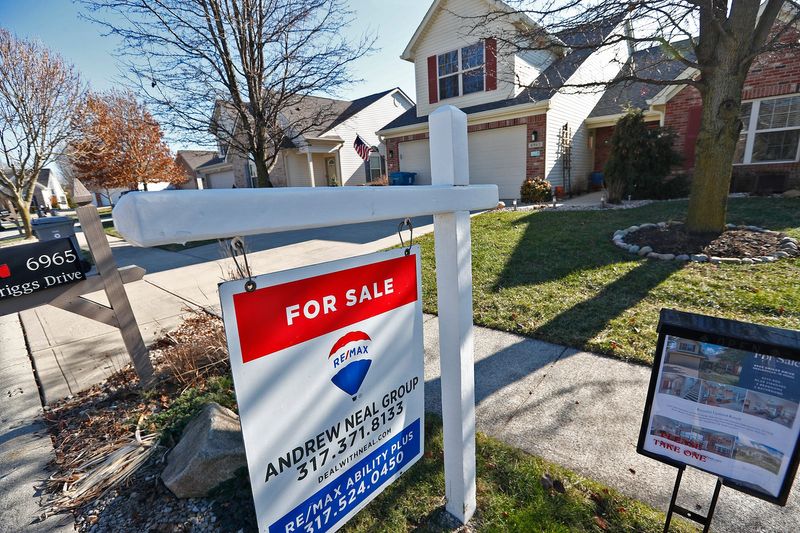
City leaders in Carmel and Fishers say they are losing a valuable tool meant to safeguard ownership of single-family homes in their communities — and the cause is a new law that appears to put Indiana Republicans at odds with a priority of President Donald Trump.
Starting Jan. 1, 2028, the Hamilton County cities will no longer be able to enforce their ordinances that cap the number of rental homes at 10% per subdivision. The ordinances took effect in both cities earlier this year and are believed to be the first of their kind across the country.

Fishers Mayor Scott Fadness and other elected officials from Fishers and Carmel have said the caps are about protecting against institutional investors, like large, out-of-state companies, that buy single-family homes in affordable neighborhoods and turn them into expensive rental properties.
The idea is gaining traction in the federal government too. The U.S. Senate overwhelmingly passed a bipartisan bill that would ban large institutional investors from competing with traditional buyers for existing single-family homes on March 12.
And Trump asked Congress to pass this type of legislation during his State of the Union address last month.
But Hoosier legislators, almost unanimously, passed legislation that will put a stop to the Carmel and Fishers ordinances that local leaders have said are meant to protect home ownership. Republican Gov. Mike Braun signed House Enrolled Act 1210 into law on March 12.
The language preempting the Hamilton County cities’ rental cap ordinances was added to the legislation as part of an under-the-radar, 140-page amendment during a January committee hearing, and the new law, filled with different amendments and provisions, ended up at more than 400 pages long.
Since before the Hamilton County cities’ ordinances were even passed, groups like the Indiana Association of Realtors, Indiana Apartment Association and Indiana Builders Association pushed state lawmakers to nullify them.
“It’s extremely frustrating because we spent two years working on this ordinance, we had bipartisan support and a unanimous vote at city council,” Fishers Mayor Scott Fadness told IndyStar in a February interview. “To have special interests go down to the Statehouse, and the way this amendment came about, is really disappointing and frustrating.”
Carmel City Councilor Rich Taylor agreed with Fadness’ frustrations and said Carmel is already limited when it comes to finding affordable housing opportunities.
“There’s not any developable sites remaining in Carmel to build any neighborhood with more affordable housing products, so we were hoping these caps would protect existing affordable housing product,” Taylor told IndyStar. “We’ll have to come up with a new strategy to protect our established neighborhoods, that were always intended to be owner-occupied neighborhoods, but our tools are limited.”
Data collected as part of Fishers’ rental registry, which was created as part of the rental cap ordinance, reinforced why officials moved forward with the rental cap, Fadness said.
Statistics, provided to IndyStar last month, showed 33% of rentals in Fishers have owners from out-of-state, and roughly 19% of rentals are owned by institutional investors. As of February, the city had 68 subdivisions made up of more than 10% rental homes, 20 subdivisions between 20% and 29% rentals and 16 subdivisions with over 30% of homes being used as rentals.
Amy Nelson, executive director of the nonprofit Fair Housing Center of Central Indiana, said her organization has identified institutional investors as bad actors in the housing industry.
“We started working on this in 2021 when I was hearing from real estate agents that their clients were putting in all kinds of offers and getting beat out by cash offers from investors,” Nelson told IndyStar. “We were also hearing directly from the public too, people who wanted to be homebuyers also experiencing those problems.”
A 2025 report from the Fair Housing Center of Central Indiana found investors owned 4% of all single-family homes in Hamilton County. Although that may seem like a small number of homes, the investors are targeting affordable neighborhoods and buying up as many homes as they can in those areas, where first-time buyers or people with low to moderate incomes may look to buy, Nelson said.
In Carmel, for example, the city’s rental map shows subdivisions at or above 10% rentals clustered in and around Home Place, which is regarded as one of the more affordable areas of the city.
Nelson added that investors often buy homes with cash, an advantage over many traditional home buyers, and living in a home owned by investors is often a bad deal for renters.
“From a renter perspective, the companies we have identified as being active here in Central Indiana, very few of them are actually based here in Central Indiana,” Nelson said. “The complaints we hear are these companies are hard to reach for maintenance needs. These companies tend to put policies in place that can really impact somebody’s ability to enjoy their rental housing.”
On the other hand, not everyone has been supportive of the rental cap ordinances in Hamilton County. Former Fishers city councilor and the county’s former Democratic party leader Jocelyn Vare said she was pleased the rental cap ordinances have been preempted by the state.
“I’m a big believer in home rule, however, in this particular case I felt strongly the City of Fishers did not have full community support for this really dramatic, sweeping housing policy, nor did I feel the City of Fishers adequately or accurately communicated it to the public,” Vare told IndyStar.
Vare, as well as some homeowners and renters in Fishers, joined real estate interest groups, like MIBOR Realtor Association, to push back against the rental cap ordinance before Fishers City Council passed it unanimously last year.
Those opposed to the ordinance in Fishers contended it would unduly reduce the number of rentals, restrict property owners’ rights and possibly depress property values. Vare pointed out that the surge of institutional investors buying homes in the city had subsided by the time Fishers passed its ordinance. She has also said that some of the data the city used to support its ordinance was misleading and included condo or townhome communities, where renters would be expected.
Vare also told IndyStar she’s frustrated the city hasn’t adopted recommendations from a 2022 report that was created by a city Housing Task Force that she believes would better address housing affordability than the rental cap ordinance.
“From my perspective, I have not seen the City of Fishers really prioritize affordable housing,” Vare said. “This is a big need in our community and across the country. I don’t see the city taking it seriously.”
How are Carmel and Fishers adjusting to the new law?
Fishers is going to continue with its rental cap ordinance for as long as legally possible, Fadness said. The mayor hopes that between now and the start of 2028, Fishers can demonstrate the effectiveness of its ordinance to state lawmakers and potentially get the law changed so its rental cap ordinance can continue.
“It would be great if we could demonstrate that, and, honestly, it’s just what we think is in the best interest of our community,” Fadness said. “If they take that authority away (in 2028) at least we got two years of what I think is good public policy in our community.”
Fadness added that the city would most likely continue maintaining the rental registry, which has contact information for landlords, regardless of if state lawmakers change their minds on the rental caps ban.
In both Carmel and Fishers, rental properties that existed before 2026 were grandfathered in and not considered out of compliance of the ordinances, even if the neighborhood they were in was above the 10% rental cap. When those properties change hands though, the cities will no longer allow them to be used as rentals if their neighborhoods are still above the 10% mark.
If the rental cap ordinance is effective, neighborhoods in the city with a high percentage of rentals will see that percentage decrease as ownership changes before 2028, Fadness said.
“Ideally, you’d start to see more home ownership in these neighborhood inundated with rentals,” the mayor said. “I don’t know if in two years you would see huge swings from 40% to 20% for some neighborhoods, but it will be interesting to see if we head in the right direction.”
Taylor, of the Carmel City Council, said the plan in his city will be similar to Fishers’ plan. Carmel will most likely leave the rental cap ordinance in place as long as possible to show its effectiveness, he said.
How are homeowners’ associations involved?
Homeowners’ associations are still allowed to implement caps on the number of rentals in their neighborhoods. And, only members of homeowners’ associations who use their property as a homestead, or primary residence, are eligible to cast a vote on restrictions on rental properties in their neighborhood now because of the new law.
“We think there’s an opportunity in some of these neighborhoods to organize them and get them to change their bylaws that would further restrict (rentals),” Fadness said. “We’re going to do some groundwork on that as well.”
Fadness argues that the efforts the city is putting into protecting single-family home ownership is what’s needed in addressing affordability problems.
“What we’re trying to do is create housing that’s attainable for purchase, which has been slowly squeezed out,” the mayor said. “The starter home, if you will, is becoming less available in Fishers. The dual-income family that wants to live in Fishers and own a home, a lot of those houses have been taken out of the inventory and used for rental properties.”
What options do local governments still have?
The Fair Housing Center of Central Indiana did not suggest caps on the number of rentals in a community as a solution in its 2025 report on investors in the housing industry. But Nelson, executive director of the nonprofit, said preemption of local governments’ authorities on these issues is never the right answer.
When asked what tools local governments have left to push back against institutional investors buying single-family homes in their communities, Nelson didn’t have a clear answer.
“I don’t know how to answer that when everything these local units seem to try to do gets preempted by the state, at least as it relates to housing,” she told IndyStar.
One idea Nelson does have in mind would most likely take some work from state lawmakers.
“Taxing these institutional investors at higher rates (than traditional homeowners) makes sense,” she said, “because the investors aren’t going to invest in our neighborhood, they aren’t going to buy supplies at our local hardware stores and they aren’t going to hire local employees to manage the properties.”
Contact Jake Allen at jake.allen@indystar.com. Follow him on X, formerly Twitter, @Jake_Allen19.
This article originally appeared on Indianapolis Star: Hamilton County’s efforts to take on investor home buyers banned by state. What now?
Reporting by Jake Allen, Indianapolis Star / Indianapolis Star
USA TODAY Network via Reuters Connect