WEST LAFAYETTE, IN — He survived deployment, a devastating diagnosis and suicidal ideation.
His annual gaming fundraiser is making sure other veterans do, too.

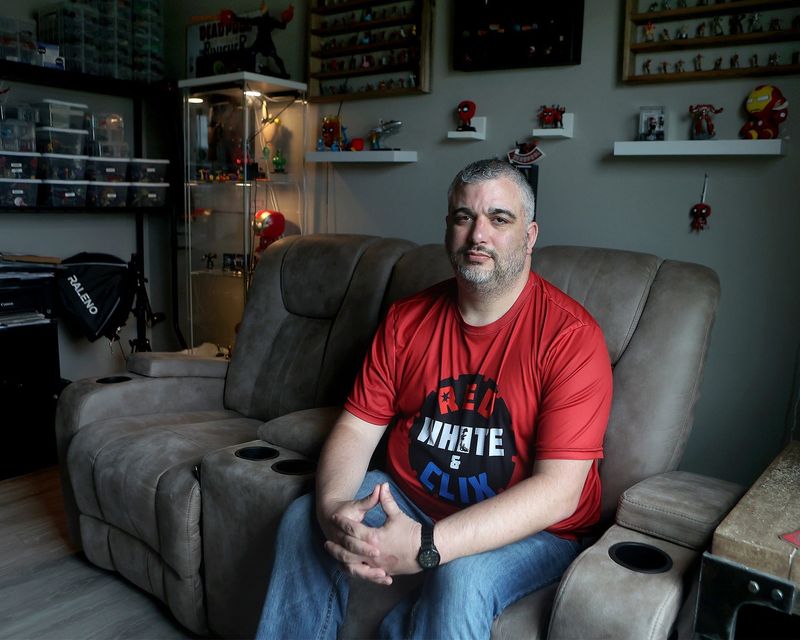
Wes Robertson keeps one hand on his cane as he gestures at the thousands of figurines lining his home office: Marvel and DC characters in lighted display cases, and shelves of Iron Man, Spiderman and Deadpool collectibles. His wife, April, thinks the game they belong to is the dumbest thing ever. “But after the first weekend,” Robertson says, grinning, “she said, ‘Man, I love these people.'”
The game is HeroClix, a team-building tabletop game in which players pit squads of heroes and villains against one another. The people April Robertson came to love are the ones who show up to her husband’s annual tournament, Red White and Clix: competitive players, brand-new players, veterans and civilians, packed into the Lafayette National Guard Armory for a full weekend every November. The proceeds go to organizations that have, in Robertson’s telling, saved lives.
The 45-year-old is measured but open, with dark eyes and silvering, close-cropped hair. When the subject turns to Iraq, he looks off to the side.
“People don’t understand what it’s like to see somebody dismembered in front of your face,” he says. “To see your friends killed. To experience the explosions and the fire. It’s just so intense.”
His late father was a major in the Indiana National Guard, he says. It was one reason he raised his hand to join in his senior year of high school.
He laughs: “I didn’t tell my mom about it.” He was attending school, working and commuting to Indianapolis twice a month for military band practice when he fell asleep and drove off the road, totaling his car.
“That’s when I was like, ‘OK, I need to find something closer.’” Closer was the 113th Engineer Battalion. Within two years, the Twin Towers fell. Within five, he was in Mosul.
He came home with what he calls “the packets”: dense, bureaucratic resource documents. “They said, ‘Here’s the stuff that’s out here. Go do your jobs,'” he says. “‘If you are suicidal, call this hotline.’ But anybody who is geared for combat and that kind of mindset, they’re not going to pick up a phone very easily.”
Within five months of his return, a battalion mate overdosed. In the years that followed, at least three more died of self-inflicted wounds.
‘They were there every step of the way’
Robertson built a career and started a family. He worked up to 70 hours a week. Then, a decade after his return, his body gave out. “I had constant migraines, just running into walls. I was stuttering and slurring.”
April dragged him to the VA in 2016, where doctors found his brain and spine peppered with lesions. A diagnosis of primary progressive multiple sclerosis and severe PTSD sent him home with a 100% disability rating.
He believes his illness may have come from an open burn pit, where the United States incinerated everything from chemical drums to human waste with JP8 jet fuel, or the depleted uranium located near his unit.
“I was suicidal,” he says of the situation. He reached out to a local organization: Mary T. Klinker Veterans Resource Center.
“They took me under their wing. They made sure I didn’t lose my house. They fast-tracked me through the VA process and Social Security,” he says. “They were there every step of the way — for my kids, my wife.” They helped fund Christmas presents that year.
Robertson wanted to give back. He became an event volunteer for Mary T. Klinker, then a keynote speaker and a board member.
But the donation of time didn’t satisfy him; he wanted to make a financial impact, and he had just seen an example: actor Scott Porter’s organization HeroClix for Huntington’s. Robertson had been playing the game for five years by that point, and he decided to follow a similar model.
‘Therapy can be anything’
For his first event, a weekend tournament in 2024, Robertson projected 20 attendees. More than 70 showed up — from Pennsylvania, California, and across the Midwest. He hadn’t realized how many HeroClix players are veterans, he says.
That first event raised $4,000, which Robertson donated in full to Mary T. Klinker. The organization credits his donation, part of a groundswell of community support, with contributing to 24 suicide interventions.
Robertson’s events are now a yearly weekend affair. Saturday’s one-on-one elimination tournament can run eight hours; Sunday’s three-on-three format runs similarly long. There are side events for casual and first-time players. Volunteer staff walk newcomers through buying a pack, opening it, and assembling a team. “Then battle it out,” Robertson says. “It’s very simple. You can pick it up in less than an hour.”
Tables draped in red, white and blue fill the floor of the armory. Food is on one side, raffle and auction items on the other, including event tickets, board games, gift cards, free car washes and local pottery, donated by more than 30 local businesses.
He projects 100 to 120 attendees in November this year. “But,” he says, laughing, “I was also projecting only 20 people on the first one.”
HeroClix’s appeal to veterans isn’t incidental. Robertson talks about the strategy and collectibility but emphasizes the HeroClix community, which spans from Texas to Australia, as unusually welcoming. He co-hosts a podcast, in which he interviews players from every level and corner of the world. “My tagline is, ‘We celebrate the heroes behind the heroes,'” Robertson says.
Christina Loveless, executive director of Mary T. Klinker Veterans Resource Center, had never heard of HeroClix before Robertson brought it to her. She doesn’t consider herself a gamer, but understands the draw.
“Veterans do tend to like gaming,” she says. “It makes them feel normal. If it brings that connection, if that’s what a veteran’s into — absolutely, therapy can be anything.”
Loveless runs the organization with an intensity that Robertson describes as around-the-clock. She talks about a crisis call she recently took at 2:46 in the morning.
“I’ve never met this veteran before,” she says. “We talked for a long time about being under-caffeinated.” She smiles ruefully. “Last year, we had 53 suicide interventions.”
Helping veterans return to home life
The organization tries to bridge the personal gap between the veterans and the packets Robertson received coming home. Loveless describes what she calls the robot switch: the psychological mode of combat, which doesn’t turn off when a soldier returns to a world of streetlights, grocery stores and suburbs.
“They come home, and they’re supposed to adjust to being in a town where, you know, light poles stand up,” she says. “And they feel isolated. They know that they’re being a jerk, and so they isolate more, withdrawing from families. I’ve seen many, many veterans leave stable homes to go live in the woods because they don’t know what nightmares are going to come at night, and how they’re going to react.”
Loveless says one of her Marine veterans described his discharge this way: “They said, ‘Don’t drink and drive. Don’t beat your wife.’ And that was it.”
Robertson has been personally frustrated by that system.
“I’m not calling a stranger on a hotline,” he says. “If I hit that point again, that’s just not something that’s going to happen. That’s why these programs exist. I can call Christina. I’ve got her direct number, and she’s there 24 hours a day.”
The PTSD is a drumbeat for Robertson. On July 4th, he drives out to a cornfield and watches fireworks from a distance with his family.
The fireworks take him back to Mosul, where constant explosions rattled the city. Back home, he’s leapt into civilian altercations, driven by adrenaline — he was once dragged 20 feet by a shoplifter whose car he hung onto, hampered by his multiple sclerosis.
April has developed her own reflexes, grabbing his arm whenever they hear raised voices to dissuade him from joining a fight. He’s haunted by the smell of cool summer air and the orange of the street lamps over an Iraqi bridge; now she rests her hand on his leg whenever they drive under sodium lights. “You’re here. You’re safe.”
“She just knows,” he says.
Trying to create a ‘one-stop shop’
Mary T. Klinker Veterans Resource Center recently pushed deeper into Robertson’s family history. In early 2025, the organization bought the Boswell National Guard Armory — a long brick building between the town and miles of farmland — with help from a groundswell of private donations, including Red White and Clix’s inaugural $4,000. Robertson’s late father had commanded the armory before his retirement.
Everyone is tightening their belts. The Indiana VA, which employs a high percentage of veterans, saw the departure of 6.9% of its clinical and administrative staff in 2025 alone, according to Office of Personnel Management data. The Department of Veterans Affairs has reinstated mandatory overtime to deal with a backlog of cases. About 1.2 million veterans live in households that receive SNAP food assistance, and hundreds of thousands depend on Medicaid, which have both faced significant cuts. Much of the burden falls downstream, onto people like Loveless, who says she works 80 to 100 hours a week.
She is not resigned. “I know that we can come together as a community of ordinary people and do something really extraordinary,” she says. For the armory’s restoration, she’s working toward a $250-per-donor campaign tied to America’s 250th anniversary. “If I get 250 people donating $250, that’s over $60,000. I’m halfway to putting those windows in.”
Robertson sees Red White and Clix as a connector. He displays resource flyers at every event — organizations covering mental health, housing, emergency assistance — and wants his website to share links for veterans navigating the system.
“The first thing I said when I discovered Mary T. Klinker was, ‘Is there a one-stop shop for all these organizations?'” he says. “Because every time I said, ‘I need this,’ Christina would say, ‘OK, call so-and-so, go to this website.’ And I’m like, how am I supposed to know all this is here?”
He’s expanding by baby steps. A Houston-based HeroClix player who cohosts his podcast may anchor a Texas event. Smaller, regional tournaments are in the works with other games. He’s taking it one step at a time.
“I’m a soldier,” he says. “I’ve never done anything like this before. I’m learning as I go.”
Loveless says she’s never had a veteran go on to start their own nonprofit. “I’m super proud of him,” she says. “I think this is a little bit of PTSD therapy for him, because PTSD therapy looks different for everyone.”
Robertson also donates proceeds from Red White and Clix to Magical Meadows in Warsaw, Indiana, an equestrian therapy program, where a man he served with in Iraq rides horses and goes camping for weeks at a time. “That’s the only way he can cope,” Robertson says. “He’s a huge supporter of mine. Emotionally.”
Robertson worries that therapy will soon be more necessary than ever. In December, President Trump signed the National Defense Authorization Act, which automatically enrolls the country’s young men into the Selective Service, making them eligible for a draft. Robertson says he has strong hopes that it isn’t in the cards.
“The idea is just shy of slavery. And the last thing I want when I’m in combat is somebody next to me who doesn’t want to be there. That is one of the most dangerous things there can be. I have strong hopes that that doesn’t happen.” But if it does, he says, the community is ready. “We are there to help them prepare to go if they need to, and when they come home, if you are drafted against your will.”
On Memorial Day, the country turns its attention to soldiers who died in uniform. Robertson’s Red White and Clix exists to support a different group: the ones who are still fighting at home.
“My brothers and sisters don’t know how to reach out, where to go, who to talk to, how to deal with it,” he says. “I’m trying to raise awareness to the community that, hey, these people are out here for you. All you have to do is call them.”
Red White and Clix’s next event is Nov. 14 and 15 at the Lafayette National Guard Armory in Lafayette, Indiana. More information is available at https://www.redwhiteandclix.org/.
For the Veterans Crisis Line, dial 988 then Press 1, or text 838255.
This article originally appeared on Lafayette Journal & Courier: Iraq veteran throws a lifeline to fellow soldiers, one match at a time
Reporting by Meagan Hipsky, Lafayette Journal & Courier / Lafayette Journal & Courier
USA TODAY Network via Reuters Connect