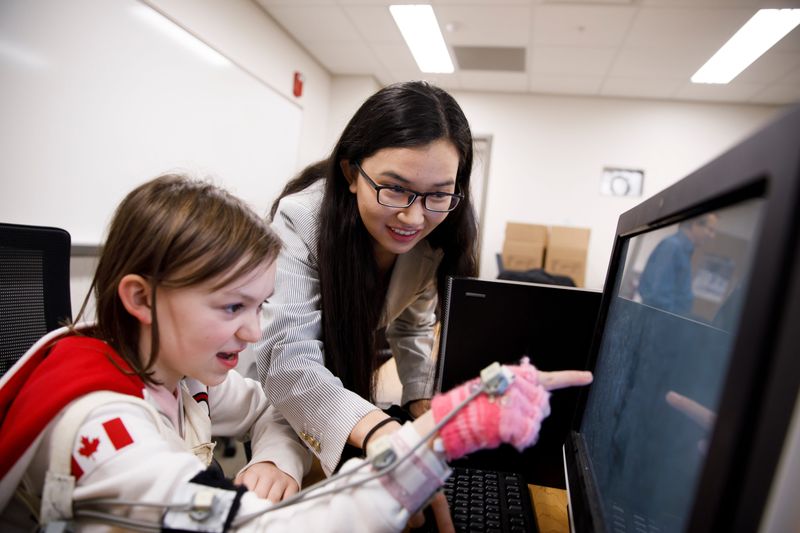
In the not-too-distant future, psychiatrists might be able to diagnose neurodivergent disorders like ADHD and autism in as little as 15 minutes.
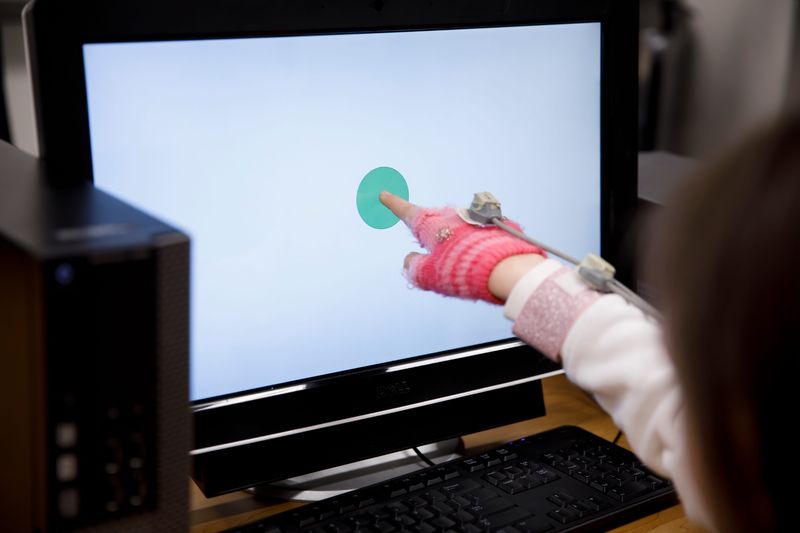
Using only a high-definition motion sensor and an approximately 10-minute test in which patients repeatedly tap a dot on a touch screen, an interdisciplinary team of researchers at Indiana University have developed a method that could assess attention deficit and autism spectrum disorders with close to 80% accuracy. If it’s further developed and accepted by the psychiatric community as a diagnostic tool, it could make testing for neurodivergent disorders as quick and painless as an eye exam.

“We can look at things that are beyond naked eye detection, which is not something that someone in the clinic could do,” said Jorge José, an interdisciplinary professor of physics at IU Bloomington and the lead researcher behind the movement-based test method.
Current ADHD and autism screenings use non-quantitative methods like interviews, questionnaires and behavioral observations to assess neurodivergent disorders. While effective, these tests can take days or even weeks to perform and often have monthslong wait times. And with the cost of testing typically between $500 to $2,000, it’s no surprise that ADHD and autism often go undiagnosed, particularly in women and girls.
José says the test method — which is grounded in physics but was developed with IU psychiatry professor Martin Plawecki and School of Medicine Professor Emeritus John I. Nurnberger — cannot and will not replace the need for a psychiatric diagnosis. But as a screening tool, it could not only reduce the time required to get an appointment and test but also lead to more widespread testing and treatment for neurodivergent disorders, especially in early childhood development.
“I think that’s really incredible,” José said.
Test uses simple arm movements to predict autism, ADHD with over 70% accuracy
For years, researchers have understood that there’s a link between a person’s motor movement and the presence of neurodivergent disorders. José says movement is like a fingerprint, unique to each person and rich with insight about a range of innate characteristics.
Within a person’s movement, there are subtle tells that can serve as predictors or “biomarkers” for neurodivergent disorders, particularly in children. Those biomarkers are invisible to the human eye — almost instantaneous differences in how a neurodivergent person handles complex movements and motor coordination. But when that movement is tracked by high-definition kinematic sensors that can measure movement down to the millisecond, the mere action of tapping a dot on a screen can provide a world of insights.
“Out of these little fluctuations that occur when you move your arms, we’re able to characterize the severity of the condition, and even tell you if you’re low-functioning, medium-functioning or high-functioning,” José said.
By comparing a patient’s movement data with those of participants with diagnosed ADHD and autism spectrum disorders, the test can not only predict neurodivergent disorders with over 70% accuracy, but precisely assess the disorder’s severity, informing treatment plans.
AI deep learning leads to rapid, 15-minute assessments
José first published a study about movement biomarkers in 2018. But the work has accelerated in recent years with the incorporation of AI deep learning – an innovation José credits to graduate student researcher Chaundy McKeever, who began working with José in 2021.By utilizing artificial “neural networks” to perform complex tasks like classification and regression, data analysis that used to take hours or days of manual observation can now be completed in real time. A new article outlining deep learning’s transformative impact on the method was published to Nature science journal in July.
“When we did the 2018 paper, we had to filter out the electronic noise in the sensors,” José said. “With deep learning artificial intelligence, we can do it as the raw data comes out, which is crucial.”
Method could provide fast, widespread testing for ADHD and autism in elementary schools
José and McKeever say the movement-based test still has a long path of development and refinement ahead. McKeever says they’re still assessing how medications like ADHD stimulants can affect results, and hope to soon substitute the kinematic sensors with electromagnetic ones that can provide insights about what muscles make a patient’s fluctuations happen. Still, the new article building upon the landmark 2018 study is sure to make waves in the medical and scientific communities.
While it won’t replace the need for a psychiatric diagnosis, McKeever envisions a world where the test could be used as a screening or referral tool in elementary schools. And because it’s about as simple as playing a game on an iPad, she says testing could start young.
“I like to think of it like the scoliosis test in elementary school where they trace your back,” McKeever said. “It’s like a referral method; if you test some sort of way with this, then maybe it’s a good idea to see a doctor.”
José says there’s still a lot of work to be done before the research could move toward implementation.
“Science is incremental,” he said. “We have so many questions that we would like to address.”
But as testing for ADHD and autism becomes more commonplace and diagnoses continue increasing, the prospect of a non-invasive, 15-minute screening test is sure to be welcomed with eager hands, whenever that day might come.
Reach Brian Rosenzweig at brian@heraldt.com. Follow him on X/Twitter at @brianwritesnews.
This article originally appeared on The Herald-Times: Could this AI-assisted screening test diagnose autism and ADHD?
Reporting by Brian Rosenzweig, The Herald-Times / The Herald-Times
USA TODAY Network via Reuters Connect