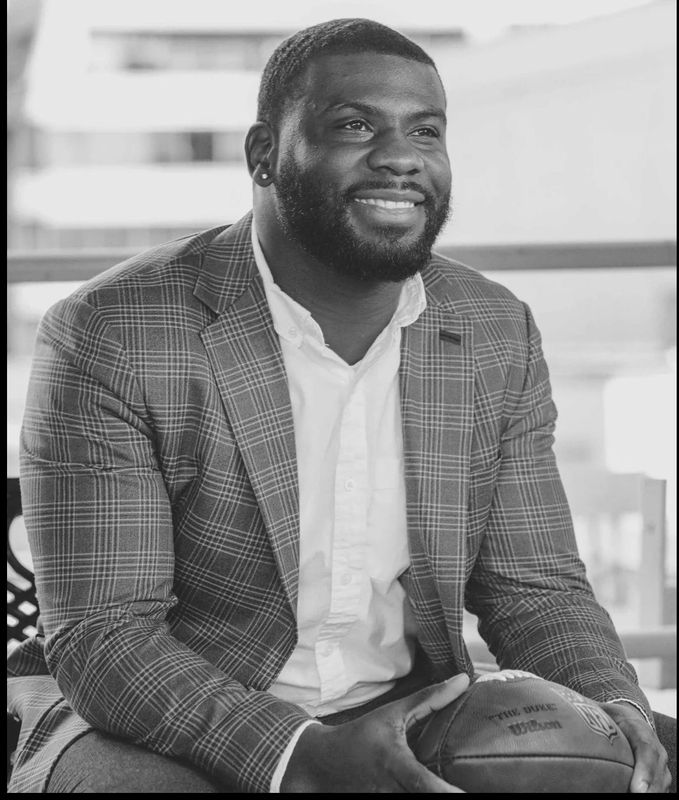
INDIANAPOLIS — It took Vick Ballard some time to grieve football. He still doesn’t really watch NFL games. It’s tough to witness your dream being played out on the field when, not so long ago, you were right there — right there at the cusp of greatness.
Then came the injuries, the devastating injuries, and all those visions of greatness vanished on that football field of dreams.

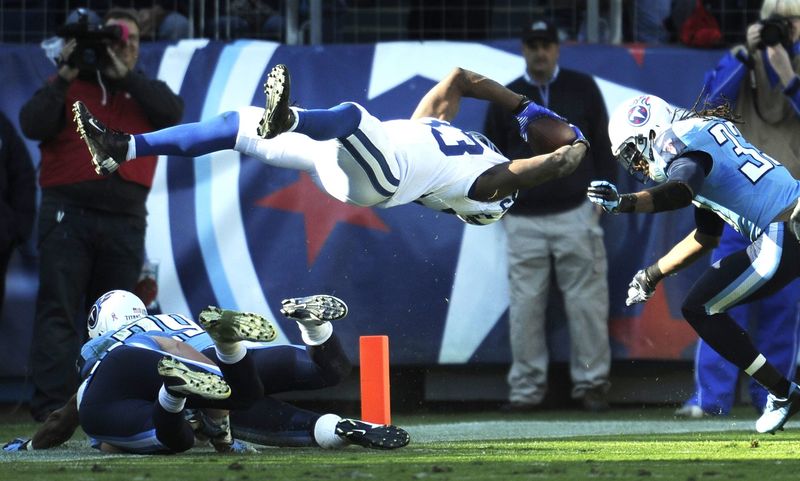
Ballard was a running back for the Indianapolis Colts drafted in 2012 and, early in his career, he showed moments of athletic brilliance. Like the play his rookie season when he left opposing fans in Nashville speechless with his iconic, flying, corkscrew dive, game-winning touchdown against AFC South rival Tennessee.
A newspaper article on his feat was published with a photo of Ballard soaring parallel to the field, clutching the football in the end zone. He has that newspaper article in a frame, a memory of a moment in time that captured all he had ever wanted to be.
For most of Ballard’s life, football was the only thing that mattered. So, being in the NFL was surreal, and it was magical.
“When I sit back and think, that was some of the best times of my life. I’m young, you know, 22, 23, 24 years old, around all of these other, essentially the stars,” Ballard, 35, told IndyStar this month. “My locker mates were Andrew Luck and Reggie Wayne. And at the time, those were two of the biggest names. It was an incredible opportunity.”
Colts RB Vick Ballard: ‘Sometimes, it feels like people just forgot about me’
In his rookie season, Ballard started 12 of the Colts’ 16 games, recording 814 yards and two touchdowns on the ground and 152 yards and one touchdown through the air.
But in his second season, in September 2013, Ballard tore the anterior cruciate ligament in his right knee and missed 17 games. He fought, and he battled, and he worked his way back.
Then on the second day of training camp in July 2014, Ballard shredded his left Achilles, a season-ending injury, which led to a Tuesday evening in September 2015.
That was the night the Colts waived Ballard. The team couldn’t take a chance on this injury-plagued running back who had just suffered a hamstring injury in the final preseason game.
“Whenever I got cut, I kind of felt like I was … I lost a family. It was a sad day for me,” said Ballard, who lives in Texas. “But I guess if I could go back, I wouldn’t change a thing. Everything I experienced, that helped me become the person I am today.”
Ballard went on to sign a reserve, future contract with the New Orleans Saints on February 3, 2016. But three months later, Ballard was released by the team.
Nearly a decade later, Ballard has nothing but positive feelings for the NFL and the game that gave him so much joy. He just isn’t always up for watching on game day.
“I always tell people, ‘I’m not really a football fan. I just, I used to love playing,'” Ballard said. “I can’t really sit down and watch a game. I mean, I can watch it, but I’d rather be the one out on the field making the plays and hitting people. But I guess at this point, that’s no longer an option for me.”
And with football no longer an option, and grieving the sport he had played since he was a young boy, Ballard decided not to wallow in the injury-ridden hand he was dealt.
Instead, he forged ahead in life, went back to school and is thriving in his new career, his brainy, scientific, mathematics, physics-induced career.
Ten years after being cut by the Colts, Ballard is an aeronautical engineer.
From Colts running back to Fighting Falcons
Ballard’s job description at Lockheed Martin — a global aerospace, defense and security company known for its advanced technology systems, primarily for the U.S. government and allies — tells the story of just how drastic his career change has been.
He went from running footballs to “performing stress analyses on F-16 aircraft structures and components,” said Mark Skya, aeronautical engineering associate manager at Lockheed Martin, Making sure they can withstand the rigors of flight and meet the highest standards of quality, safety and performance.
The F-16, officially named the Fighting Falcon and commonly called the “Viper,” is a compact, single-engine, multi-role fighter aircraft known for its high maneuverability in air-to-air combat and air-to-surface attacks.
“I am grateful Vick traded in his cleats for a calculator and joined (us),” Skya said. “Vick is thriving in a critical role, and his attention to detail, commitment to excellence and hard work are inspiring to us all.”
Ballard has heard that from other people in his life, and from people he doesn’t even know. They tell him he is an inspiration, a a former NFL player who didn’t give up, who took a tough situation and turned it into something big.
“I never went into it thinking, ‘Oh, I’m going to do this to become an inspiration. I literally did it because I felt like this was the most logical thing for me to do,” Ballard said. “It’s kind of what I always wanted, to be an engineer, and I always was curious.
“When you hear the job title ‘engineer,’ people automatically think, ‘Oh, this person must be brilliant.’ So I just wanted to see how I stacked up against people like that.”
To be honest, Ballard wasn’t sure how he would stack up. He says he “was a decent student” in high school and “decent” in college.
“But I really didn’t apply myself. In high school, I was more concerned with having fun and playing football,” he said. “Even in college, you know, athletics came first.”
But then as his career played out in the NFL, Ballard started realizing athletics probably weren’t going to be there for long.
“I didn’t want to be one of those guys who was constantly chasing something that wasn’t for me,” Ballard said. “Even when I was still with Indianapolis, I was kind of coming up with a game plan just in case things didn’t work out. And that game plan involved me potentially going back to school.”
Which is exactly what Ballard did. With the help of The Trust Scholarship, part of the NFL Players Association, which helps former players transition from the field to new careers, Ballard enrolled at the University of Central Florida.
“I wanted to go to an out-of-state school, because I kind of wanted to get away from people that had an idea of who I was. Not saying that I was a big-time person, but I was still kind of battling with the transition,” Ballard said. “I was trying to forge a new lane for myself, but still probably grieving my old life because I still wanted to play ball.”
Ballard turned his ambitions for football toward a degree in mechanical engineering. He went all in.
“I’m back to school to be an engineer. Now, school is my main thing. So, let me see if I find myself,” he said. “How well can I do?”
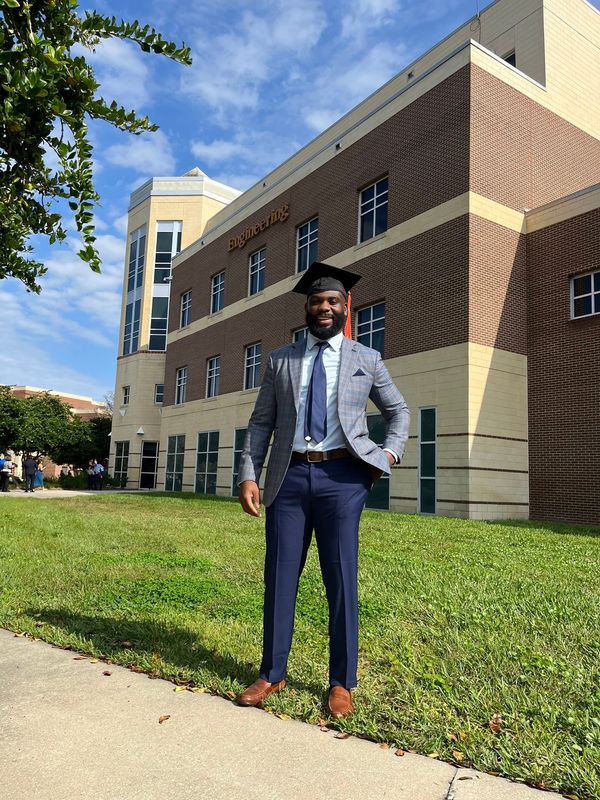
How well Ballard could do? He graduated in December 2022 from Central Florida with a 3.6 GPA.
A testament to life after the NFL
By the time Ballard graduated, he had a job offer from Lockheed Martin to start the next month in January 2023. More than two years later, he says he is loving his career.
It’s challenging, it’s rewarding, and it’s the next best thing to being a running back in the NFL.
Ballard’s days are filled with solving aeronautical puzzles. As a stress analyst, he is tasked with making sure his aircraft are ready to fly. Whenever a deviation is found, Ballard is sent a proposed repair to the plane.
“So, a part being located in the wrong place or a hole being drilled in the wrong place place or even like a scratch or gouge,” he said, “they send that proposed repair to us to analyze it, to make sure the aircraft is fit to fly and getting the proposed repair.”
Beyond his undergraduate engineering degree, Ballard has since earned a master of science in industrial and systems engineering from the University of Florida, and he is working toward an MBA.
Pat Angerer, Ballard’s former Colts teammate, said he has no doubt Ballard is killing it in his new career. Angerer saw on the field the seeds of what made Ballard destined for success.
“Vick came in and, right away, you could tell he was serious about being a good football player and doing things the right way. He was high character and led by example,” Angerer said. “For someone with the success he had in college, it was great to see a guy come in with no ego and the willingness to work. He’s what you wanted in a teammate.”
But beyond football, Angerer says simply, “Vick is a good man.”
Yet, football has been a key to Ballard’s success off the field, said Lockheed Martin’s Skya.
“His transition from the football field to engineering may seem like a dramatic career change,” Skya said. “But it’s a testament to his ability to apply the skills and discipline he developed as a professional athlete to a challenging and rewarding new field.”
A new field. A different field than the one Ballard dreamed of playing on.
“Now, I’m just a regular guy,” Ballard said, albeit an aeronautical engineer, “who’s trying to figure it out.”
Follow IndyStar sports reporter Dana Benbow on X: @DanaBenbow. Reach her via email: dbenbow@indystar.com.
This article originally appeared on Indianapolis Star: Colts’ Vick Ballard grieved loss of NFL dream. Then he became an aeronautical engineer
Reporting by Dana Hunsinger Benbow, Indianapolis Star / Indianapolis Star
USA TODAY Network via Reuters Connect