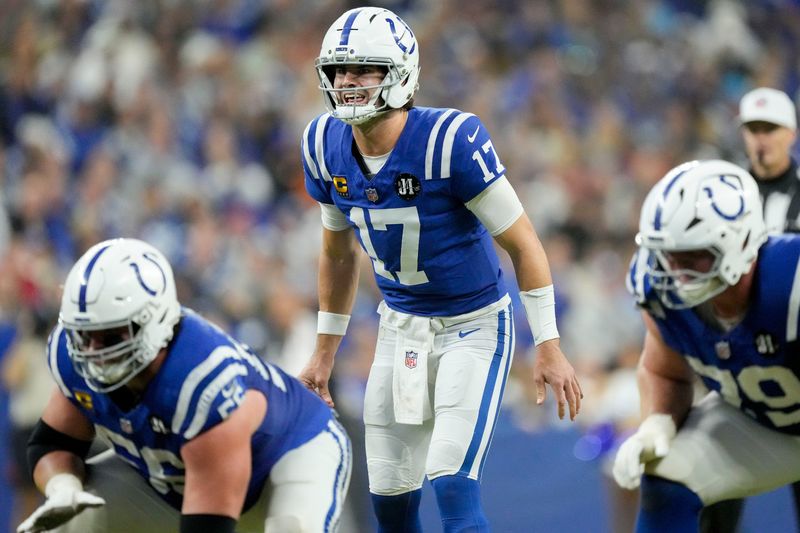
INDIANAPOLIS — The Colts wanted to make their news before the tag deadline.
Indianapolis general manager Chris Ballard wanted to sign starting quarterback Daniel Jones and wide receiver Alec Pierce to long-term extensions before he using a tag, an option he’s only used once before.

The Colts couldn’t accomplish Ballard’s goal.
Indianapolis is using the transition tag on Jones, multiple league sources told IndyStar Tuesday, the first time the franchise has used that tag since placing it on linebacker Tony Bennett in 1998 and the first time an NFL quarterback has received the transition tag since the Falcons used it on Jeff George in 1996.
Jones will receive a one-year tender worth $37.833 million, approximately $6 million less than the franchise tag, that allows the Colts to match any contract offered by another team if Jones were to reach free agency. If the Colts decide not to match, a team can sign Jones without sending Indianapolis the two first-round draft picks that would come if Indianapolis had placed the non-exclusive franchise tag on the quarterback.
The Colts have been working on a deal with Jones and his representation for more than two weeks, league sources told IndyStar, but . By placing the transition tag on Jones, the Colts allow Pierce to get one step closer to free agency, the team’s goal for the next week remains the same: Sign both Jones and Pierce to long-term extensions before the NFL’s legal tampering window opens March 9.
“Daniel and Alec are such big pieces,” Ballard said at the NFL scouting combine last week. “We move and fit from there.”
Bringing back Jones would go a long way toward finalizing a deal with Pierce.
From the start of the offseason, Pierce has made it clear that bringing back Jones would influence his approach to free agency. The two players forged a tight bond on the golf course last offseason, and then Pierce turned in the best season of his career with Jones at the helm, catching 47 passes for 1,003 yards and seven touchdowns to establish himself as arguably the NFL’s best deep threat.
The price of both players rose accordingly.
The $37.833 million that Jones can earn if he accepts the one-year transition tag likely sets a floor for the average annual value on a long-term deal for the quarterback, although the structure and guarantees will be important.
Indianapolis is expected to have a little more than $33 million in cap space when free agency opens next week; the Colts would use all of that space if they cannot reach a long-term deal with Jones. If Jones signs a long-term deal, Indianapolis can structure the deal to cost less against the cap in 2026, pushing the cap figures into future years.
The Colts have to find common ground with Jones on a long-term deal. Indianapolis has few other options available at the position this offseason, and Pierce has made it clear that he wants Jones is back in the fold before he commits to the Colts on a contract of his own, according to sources.
Indianapolis badly needs both players in 2026.
Under heavy pressure to win after five consecutive seasons without a playoff berth, Ballard and head coach Shane Steichen believe their best bet is to put the ball in Jones’ hands, though the quarterback will be roughly nine months removed from tearing an Achilles tendon.
The Colts have few options at the position outside of Jones. Miami’s Tua Tagovailoa, a wild card who also has significant injury concerns, is expected to be the best veteran option available. Few quarterbacks are highly regarded in the NFL draft aside from Indiana’s Fernando Mendoza, the presumptive No. 1 pick.
Jones has also earned the Colts’ trust, particularly Steichen’s.
Deployed mostly as a run-first, dink-and-dunk quarterback in New York, Jones reinvented himself in Indianapolis by partnering with Steichen, who recognized the quarterback’s ability to read defenses as Jones’ greatest strength.
“The way he works, the way he goes about his business, his preparation is phenomenal,” Steichen said. “What he was able to do before the injury was awesome for us. Obviously, a very talented player, sees the game well, can get us in and out of the right plays, which was huge.”
Jones has always been meticulous in his preparation, searching relentlessly during the week for cues to what the opposing defense is going to do.
Steichen is the same way, capable of giving his quarterback an answer for every coverage, as long as the quarterback’s able to make the right read as the seconds tick down on the play clock.
Because of that shared approach to the game, Jones blossomed in a new role as a pocket passer, completing 68% of his passes for 3,101 yards, 19 touchdowns and eight interceptions. The underlying numbers backed up the Jones renaissance: Jones averaged 8.1 yards per attempt, produced a career-best 100.2 quarterback rating and averaged 0.12 expected points added per dropback, tied for the seventh-best mark in the NFL.
By the time the season reached the trade deadline, the Colts were comfortable enough with Jones under center that the team traded its next two first-round picks, along with wide receiver Adonai Mitchell, to New York to get cornerback Sauce Gardner.
Then the Achilles tendon tore, throwing a wrench into Jones’ resurgence and tanking the Indianapolis season as a whole. Jones and the Colts believe the quarterback has a chance to be back by the start of the season.
“He’s on track,” Ballard said. “With the Achilles, it’s the three-month mark where you’re kind of past the danger zone. What is he at now? Seven weeks, eight weeks. … Y’all have been around Daniel enough to know, he’s pretty diligent in everything he does. You almost have to bring him back a little bit, but we feel good enough about where he’s at and where he’s going.”
Injuries are now the biggest question about Jones, and the team’s decision to sign him to an extension.
Jones has played a full season’s worth of games just once in his career, and he’s suffered two major injuries. Brought into Indianapolis to compete with Anthony Richardson in part because of Richardson’s own lengthy injury history and issues with availability, Jones still has to prove his own durability at the NFL level.
“It’s valid, and it’s fair,” Ballard said. “There’s been a history of guys that I’ve been with that have kind of had a similar career path, and then they don’t. He’s played 83 games in his career. … The two big ones have been the ACL and the Achilles. I just think the way he prepares, how he’s built, in the long run, he’s going to be perfectly fine.”
Indianapolis believes it has a short and long-term option at quarterback in Jones.
The tag gives the Colts the right to match any offer.
And whether or not another team makes an offer, it looks like Indianapolis will have to put its money where its mouth has been since the end of the regular season.
Joel A. Erickson and Nathan Brown cover the Colts all season. Get more coverage on IndyStarTV and with the Colts Insider newsletter.
This article originally appeared on Indianapolis Star: Colts use cheaper, riskier transition tag on Daniel Jones; what it means
Reporting by Joel A. Erickson, Indianapolis Star / Indianapolis Star
USA TODAY Network via Reuters Connect