Carmel Mayor Sue Finkam pushed back against some residents’ concerns about flooding in one of the city’s oldest neighborhoods, rejecting one city councilor’s proposal to raise the stormwater fee to pay for infrastructure improvements.
Instead, Finkam said many of the flooding problems in the Concord Village neighborhood just east of City Center were caused by fencing and landscape choices — which are fixable by the residents themselves. The pipes in the area, she said, are in excellent quality.

“There’s no stormwater system failure,” Finkam said. “There’s no emergency access or egress problems with the school and the library. There’s no broken promises on a road extension, and no verified pattern of unresolved resident concerns.”
Her comments came a week after Council President Matthew Snyder held a townhall listening to resident concerns and vowed to push for completely new infrastructure. Snyder is pushing an ordinance to increase the stormwater fee by $3.15 a month to help fund a $16 to 18 million infrastructure replacement.
Individual neighborhoods like Concord Village would likely benefit, but the Board of Public Works would ultimately decide where upgrades would be made throughout the city. Currently most of the $4 million in stormwater fee revenue goes to debt service for prior bonds.
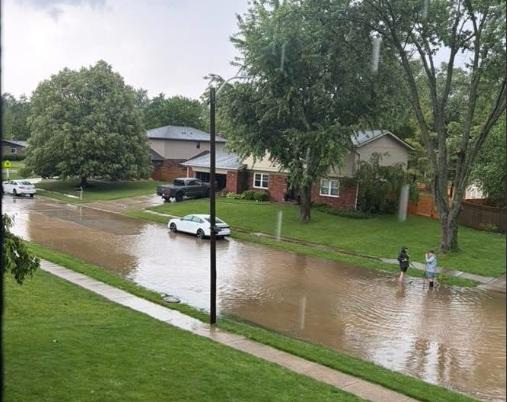
Concord Village residents have raised concerns about constant flooding, narrow sidewalks and fast traffic, and outdated roads for decades. They say they’ve been passed over for repairs in favor of newer, wealthier developments while they deal with feet of standing water. More than half of the homes in the area the neighborhood sits in were built prior to 1980, and the median income is two thirds of that of Carmel as a whole, according to census data.
However, rather than raise fees for construction, Finkam and city engineer Bradley Pease say the solution is up to residents. Mayor Finkam said she has no plans to request a fee increase.
Out of 13 requests for drainage repair from Concord Village in the past ten years, 12 were denied due to being private issues. Pease said the city does not guarantee no flooding but will replace pipes at the end of their life. He said that 97% of Concord Village pipes are in “excellent” condition.
Residents are also responsible for repairing sidewalks. They can apply for a 50% match grant from Carmel.
Councilor Jeff Worrell, who called for the presentation, said earlier this month that he was in favor of gathering more data before raising the fee, which he called a “drastic acceleration.” He said Pease was not allowed to fully detail the cost and condition of infrastructure at an earlier city council meeting.
“When we allow passion or assumptions to outpace the facts, we risk making policy that is reactive rather than effective,” Worrell said at the July 14 meeting.
Finkam also said that the city will not be extending Richland Avenue, a project mentioned in the July 7 townhall aimed at increasing traffic flow to an elementary school that would require two houses to be torn down. She said the city is not responsible for ensuring no traffic during emergencies, and that Deputy Fire Chief Lucas Ray did not see traffic as a problem or code violation.
The city will make some changes in the area, however.
The concrete road paving will be replaced with asphalt, despite the fact that Concord Village roads are in slightly better condition than Carmel’s average according to Carmel project manager Ryan Murt. Maintenance would cost more and hurt rideability, according to Pease.
Carmel will also install a raised crosswalk with flashing lights on Lexington Boulevard near school entrances, add bump outs to slow vehicle traffic and replace water mains during road repaving.
Finkam said Carmel is investing in infrastructure, but must weight costs and benefits, especially given a decline in property tax revenue due to a state law. She said increasing the stormwater fee would hurt nonprofits and schools.
In response, Snyder said statements from Carmel leadership “likely close the door on the greater conversation about long-term infrastructure funding.” He declined to say if he would withdraw his proposed ordinance about the increase.
“The administration and some councilors have made their positions clear on the standard of care for a specific neighborhood,” Snyder said. “Unfortunately, the stated goal of addressing citywide issues that had been presented has been completely lost.”
The best way to report drainage and infrastructure problems, Finkam said, is through the city’s 311 app. Finkam also said to direct recent “negativity” to her administration or elected officials, rather than city staff.
“Our city employees come to work every day to serve you at the highest level,” Finkam said. “They have the deep badge of honor to take care of this community, and they’re the reason we have the number one ranking for best place to live in the country.”
Download the free IndyStar app and turn on notifications to get breaking news and sports alerts.
Lucy Tobier is the politics reporting intern for the Indianapolis Star. She can be reached at lucy.tobier@indystar.com or on X at @TobierLucy
This article originally appeared on Indianapolis Star: Carmel Mayor Sue Finkam pushes back on flooding concerns, fee increase for residents
Reporting by Lucy Tobier, Indianapolis Star / Indianapolis Star
USA TODAY Network via Reuters Connect
By Lucy Tobier, Indianapolis Star | USA TODAY Network