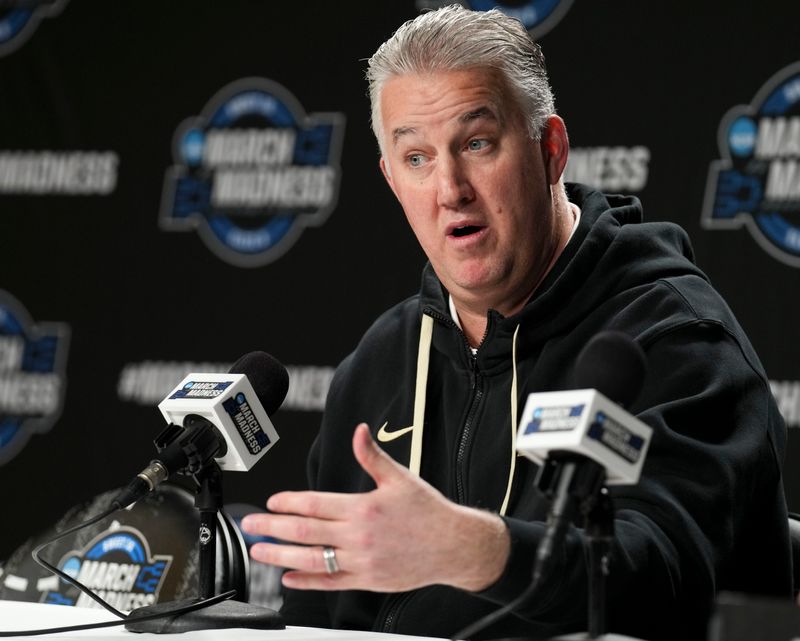
Purdue men’s basketball coach Matt Painter is on the record about his belief the rise of gambling on college sports has resulted in athletes receiving death threats and other harassment.
The NCAA on Thursday brought its national effort to reduce those instances of abuse to the Boilermakers’ home turf.

The NCAA presented a request to ban individual college player prop bets in the state at Thursday’s Indiana Gaming Commission meeting. Its goal is to reduce the abuse – both online and from the stands – directed at athletes face due to unsuccessful bets on their performance.
Members of the Sports Betting Alliance also spoke at the meeting to push back on the NCAA’s request to state regulators. They argued allowing such bets in a regulated market allows the industry to better identify bad actors and notify law enforcement of suspicious or illegal activity.
The gaming commission voted unanimously to table the motion until its Sept. 24 meeting.
Athletic directors at Butler, IU and Purdue all submitted letters supporting the NCAA’s request. Painter and football coach Barry Odom also signed Purdue’s letter, which asked the gaming commission to join governing bodies from Louisiana, Maryland, Ohio and Vermont, which have all removed individual college prop bets from their markets since 2024.
“We recognize that legal sports betting is now an established part of the sports landscape,” Purdue AD Mike Bobinski wrote. “However, individual proposition bets on college student-athletes create unique risks that are not present – or are significantly reduced – in traditional wagers based on team outcomes.
“These wagers place the focus of betting activity directly on individual young people and expose them to unnecessary pressures that can impact both student-athlete welfare and the integrity of collegiate competition.”
NCAA says prop bets put target on athletes’ backs
Prop bets refer to wagers on the performance of a single player, such as points scored in basketball or touchdown passes in football. A sports book might bet an over-under line on the number of assists Braden Smith will get against Michigan, or the total passing yards for Fernando Mendoza against Ohio State.
Such bets – generally only available on the most notable athletes from each team – may not materially affect whether a team wins or loses. In his letter of support for the NCAA proposal, Indiana AD Scott Dolson said the statistical minutiae involved can make manipulation difficult to detect because the final outcome still appears legitimate.
“Such bets can also prompt outsiders to seek nonpublic information about injuries or availability, and may tempt student-athletes to provide it, or to bet on their own performance, jeopardizing their eligibility,” Dolson wrote.
While sports gambling is legal in 38 states and Washington, D.C., 19 of those jurisdictions do not allow prop bets on individual college athletes. Indiana gaming law does not allow such wagers in-game. The NCAA wants the state to go one step further and not allow those bets before games, either.
Its argument addresses two concerns – abuse of athletes (and coaches and officials) when bets don’t come in, and potential threats to competitive integrity.
Tim Buckley, NCAA senior vice president of external affairs, told regulators the organization’s own surveys showed “almost half” of all men’s basketball players reported experiencing social media abuse.
“And we know, because we screen for this type of activity, that it’s related to betting,” Buckley said. “And we know that it’s quite often related to their prop bets.”
The Big Ten Student-Athlete Issues Commission sent a letter to NCAA President Charlie Baker in February urging the continued effort to restrict or eliminate player prop betting.
The NCAA included Painter’s comments from a 2024 press release regarding the prevalence of cyberbullying toward college athletes. He said increased online gambling exposure “exacerbates the online abuse, with many students receiving death threats via social media.”
However, the NCAA also argued some athletes’ use of the other end of the betting spectrum raises concerns. Mark Hicks, NCAA managing director for enforcement, cited cases outside Indiana in which athletes wagered on their own prop bets, either on their own or through proxies.
He also cited at least one instance of an athlete agreeing to underperform to manipulate the outcome of a prop bet. He said that case – out of the Eastern District of Pennsylvania – was detected by the NCAA member institution, not through the operator which took the bet. That case was passed onto authorities in that state.
The bulk of the NCAA argument, though, centered on the harassment athletes are subject to based on the outcome of their props. It argued the state should draw a distinction between college and professional athletes on that particular subject. Gaming law already restricts any wagering to Division I sports.
Buckley admitted the prohibition would not be a “silver bullet” to end harassment, but would help curtail the problem.
“We understand the importance of regulating (gambling) activity,” Buckley told regulators. “But we also understand the importance of drawing bright lines about what type of bets should be offered and what shouldn’t.”
Gambling industry says ending prop bets won’t end abuse
Representatives of the Sports Betting Alliance, some representing the most well-known gambling operators in the country, denounced the harassment athletes have reported.
However, they also contended their marketplace helps weed out – and even punish – those abusers. They also argued their oversight helps detect anomalies in the betting market which could indicate whether a performance is being manipulated.
Scott Ward, an attorney representing the SBA, said eliminating prop bets in the public, regulated market would direct gamblers to an unregulated “black market.” He provided the commission a list of 140 illegal online sports books and casinos which have received cease-and-desist letters from at least one state with regulated sports gambling. He said eliminating regulated prop bets would give those casinos “a monopoly” on such bets in Indiana.
“It does not eliminate harassment,” Ward told the gaming commission. “It just eliminates critical visibility and data used by this commission and the NCAA to identify integrity concerns.
“These prob bets will continue, just not under your watchful eye.”
Athletes can be targeted for social media abuse without regard to gambling. Sara Tait, head of legal for Fanatics Batting & Gaming who previously was executive director of the Indiana Gaming Commission, argued Indiana lawmakers should join those in Ohio, West Virginia and Wyoming who passed laws directly addressing the harassment of athletes.
She also said the NCAA’s own data suggests enforcement efforts work. The NCAA has used Signify Group to monitor online abuse and threats during championship events. Tait cited 2025 NCAA men’s basketball tournament data, when over 1 million posts were analyzed, 50,000 were flagged and 10 incidents were reported to law enforcement. Signify measured a 23% reduction in sports betting-related abuse.
The NCAA included that same fact in its news release about Thursday’s proposal.
Fanatics announced Thursday its own partnership with Signify and sports gambling consultant IC360 to implement the Bad Actor Program. The effort will use Signify’s Threat Matrix AI to monitor social media platforms and identify individuals harassing players, coaches and officials.
“There’s no place for this behavior on our platform,” Tait told regulators. “We’re the first sports book to be implementing this, but we are hoping that others follow our lead.”
Not every state gaming commission lobbied by the NCAA has moved to restrict prop bets. Sports gambling became legal in Missouri in December, and while prop bets on in-state college games are not allowed, prop bets on out-of-state games are.
The NCAA asked the Missouri Gaming Commission in January to prohibit all such bets. The commission voted 3-0 to reject the proposal. However, at least one commissioner said their vote was based on the desire to gather more information before making a decision.
IGC commissioners bought themselves that time Thursday by holding off on a vote until September. Painter could know before the next basketball season whether Boilermaker players will no longer show up on betting apps by the name on the backs of their jerseys.
“Student athletes are telling us they don’t want their every move to become a micro bet,” Buckley told the gaming commission. “States across the country are moving in this direction.”
This article originally appeared on Indianapolis Star: Bets on Boilers, Bulldogs, Hoosiers could end if Indiana adopts NCAA request
Reporting by Nathan Baird, Indianapolis Star / Indianapolis Star
USA TODAY Network via Reuters Connect
By Nathan Baird, Indianapolis Star | USA TODAY Network