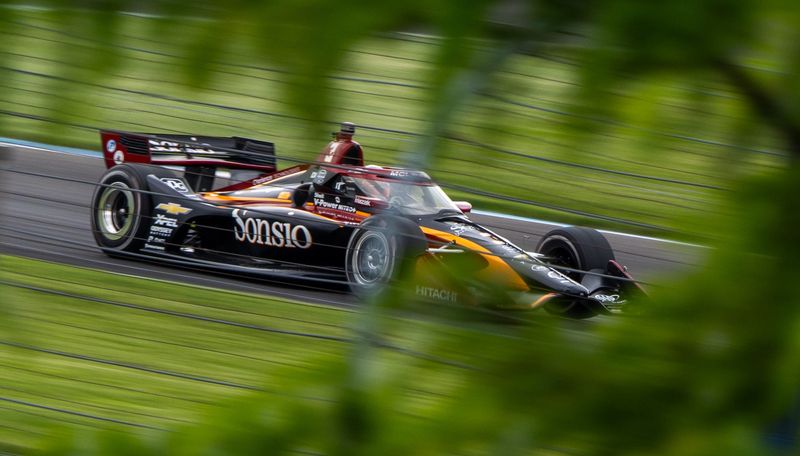
If the thought of eco-friendly motorsports might raise a few eyebrows, sports sustainability experts say that at the Indianapolis Motor Speedway, these programs aren’t just buzzwords. From biofuels to soybean tires, composting and carbon offsets, IndyCar is awash with sustainability initiatives.
“Everybody says, ‘How could motorsports be sustainable? All that gas, all that oil, all that noise, all that pollution?'” said Aileen McManamon, board chair of the Green Sports Alliance, a non-profit focused on sustainability in the sports industry.

But yet. Racing series across the globe are marketing their efforts to reduce the carbon emissions that seem they would inevitably go hand in hand with vehicle-centric sporting events. NASCAR facilities use renewable energy. Formula 1 cars have hybrid engines. And, according to the IndyCar website, the series is “on a journey to become the most sustainable motorsport in North America.”
The tangible climate impacts of these efforts remain difficult to quantify, but McManamon still thinks sports sustainability programming pays off if for no other reason than engaging the public with climate-friendly goals.
“In the grand scheme of things, the carbon footprint of sports is relatively tiny,” she said, comparing it to emissions from industry, transportation and electricity production. “However, people think it is huge because they see us. We’re very visible.”
And because of this visibility, when a venue goes green, fans tend to notice.
Sustainability at IndyCar comes in many forms
A decade ago, the Indianapolis Motor Speedway wasn’t marketing sustainability. In fact, the annual Idy 500 balloon release attracted the ire of environmental advocates.
After a years-long tussle over the release, the speedway put the practice to bed in 2022. This apparent pivot in their approach to environmental responsibility wasn’t an isolated event at IMS — the series as a whole was pursuing climate-friendly operations. The following year, IMS was deemed one of the most sustainable sports venues in the world.
“We’re a racetrack, the last thing you’d think of is sustainability,” Doug Boles, president of IndyCar and the Indianapolis Motor Speedway, said in a 2023 video tour of IMS sustainability operations.
The IndyCar series used a 100% renewable race fuel that year, too, a biofuel blend Shell made of sugarcane and animal waste. An eco-friendly option, the fuel is also prized for its speed. IndyCar tires are now engineered with recyclable materials and this year, soybean oil is the basis for some tire compounds once derived from fossil fuels.
For $5, IndyCar fans can purchase a carbon offset while grabbing race tickets for events at IMS. The add-ons don’t directly offset the carbon emissions generated by attending the events, according to IMS, but most of the money directly funds projects that reduce or remove carbon from the atmosphere.
IMS is stewarding the track’s natural space as well. Each year, fans walk onto a 1,000-acre venue that, despite hosting auto races, is also home to at least 196 species of plant life and 57 animal species — including a fox that raced across the track during the Indy500 Open Test on Apr. 29.
Climate impact is hard to pin down
However, it’s difficult to gauge the impact of IndyCar’s climate work. Unlike Formula 1, IndyCar doesn’t publish detailed emissions data.
Still, the sustainability programs baked into venue operations asks fans to engage. Last year, the speedway had recycling bins out on race days — a simple, but key component of the venue’s ability to interface with fans about sustainability.
“When I started in 2016, our waste diversion rate was 0%. We didn’t have any type of recycling, composting, food recovery initiative on our property,” Logan Waddle, the sustainability program lead at Penske Entertainment, said in a 2025 video about waste at IMS. “And I’m really proud of how much it’s grown.”
Last year, the venue recycled 381 tons of material and composted 28 tons of food and yard waste.
IMS officials say they’re proud of what they and their IndyCar colleagues have accomplished.
“Across INDYCAR, sustainability provides a showcase for the spirit of innovation and partnership that has fueled our sport over many decades,” Alex Damron, a spokesperson for IndyCar, wrote in an email. “At IMS, it also provides an opportunity to ensure we are being good stewards of an important community asset and positive neighbors encouraging best practices at our facility and beyond.”
McManamon also thinks that demonstrating that a venue like the speedway can recycle makes the practice seem easier for people to weave into their own lives.
“If we can do it there, then you’re demonstrating to the built environment around you — the companies, the schools, public buildings — you should be able to do it, too,” she said.
IndyStar’s environmental reporting is made possible through the generous support of the nonprofit Nina Mason Pulliam Charitable Trust.
Sophie Hartley is an IndyStar environment reporter. You can reach her at sophie.hartley@indystar.com or on X at @sophienhartley.
This article originally appeared on Indianapolis Star: Auto racing may not seem green, but IMS takes eco-friendly steps
Reporting by Sophie Hartley, Indianapolis Star / Indianapolis Star
USA TODAY Network via Reuters Connect